From syllabus to proof.
Your syllabus is a plan. Your attendance sheet is a number. Neither one tells you what a student has actually done on the mat. Here is how MatPilot closes the gap, one ticked box at a time.
A six minute read. Published August 2026.
Ask a professor what a blue belt should know and you will get a real answer, usually a long one. Ask them what this particular student has covered in the last six months and the answer changes shape. It becomes a feeling. A good one, often an accurate one, but a feeling.
That is not a failure of memory. It is that the two records a gym actually keeps do not touch each other. The syllabus lives in a document, a whiteboard, or a coach's head, and it describes an ideal student. The attendance sheet lives in the software and counts bodies in a room.
One says what should be taught. The other says who turned up. Nothing says what happened.
So when a grading comes round, the honest position is that you are grading on impression and mat time. Which works, because good coaches are good at it. It just does not scale, it cannot be handed to a second coach, and it gives a student nothing to look at.
One syllabus, written once.
It feeds the class, and the class feeds every student who was there.
-
01 · Syllabus
White belt
- Knee shield
- Hip escape
- Americana from mount
- and 77 more
-
02 · Tuesday, 19:00
The coach ticks
- Knee shield (taught)
- Hip escape (taught)
- Americana from mount
- and 77 more
-
03 · Everyone who attended
On every profile
- Ana Silva
- Knee shield · Hip escape
- Bruno Reis
- Knee shield · Hip escape
Two techniques each. Not eighty.
Six steps. One of them needs a coach.
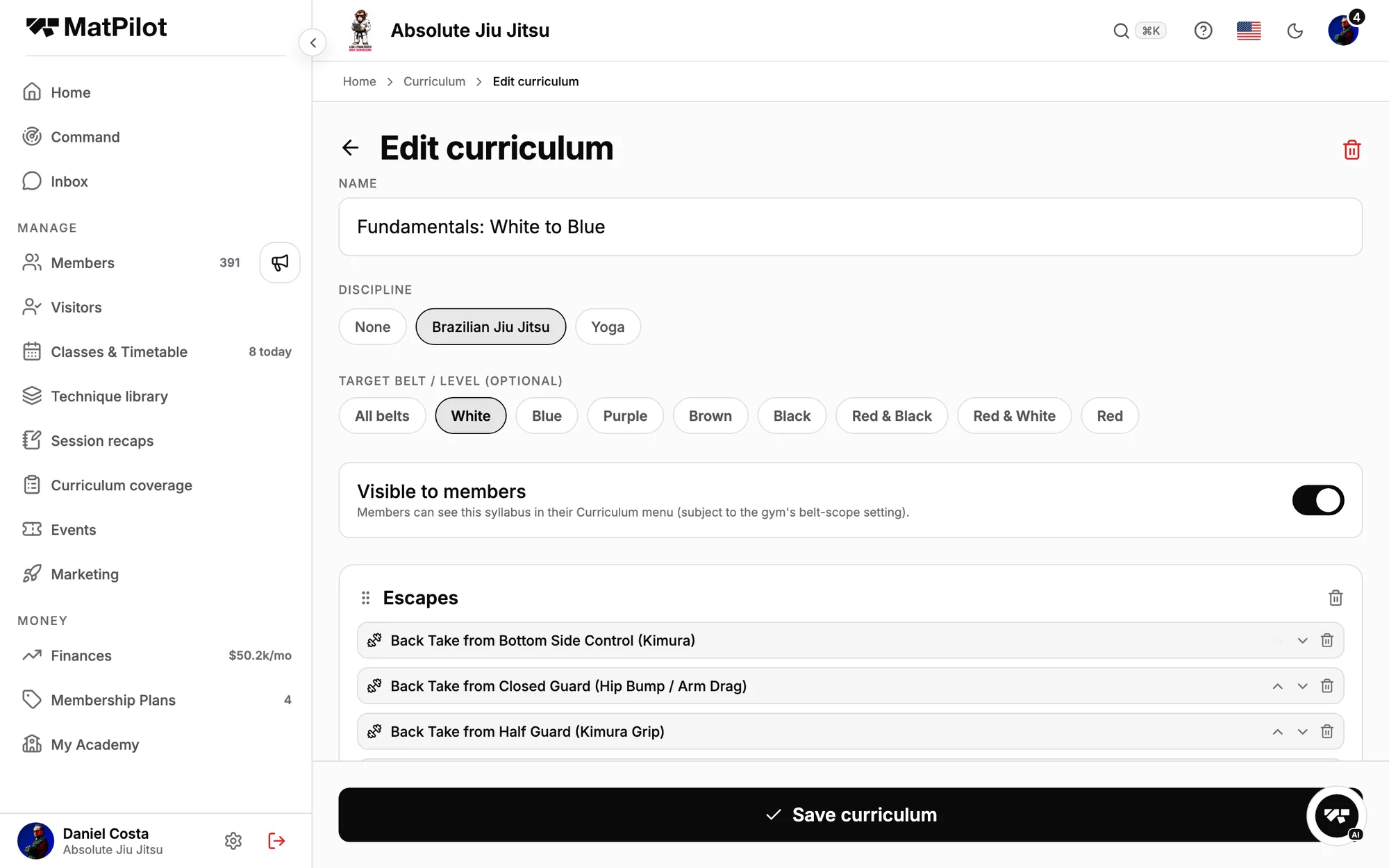
Write the syllabus once
Build it from a library of thousands of named techniques across nineteen martial arts, or type your own. Most academies do both, because every gym has a sweep the books do not have a name for.
A syllabus is made of modules, and a module holds whatever a round on the mat actually holds. Techniques, yes. But also the warm-up you always run, the drill sequence, the sparring format, the coaching points you want a new instructor to say out loud. If it belongs in the lesson, it belongs in the module. Drag it into the order you teach it in.
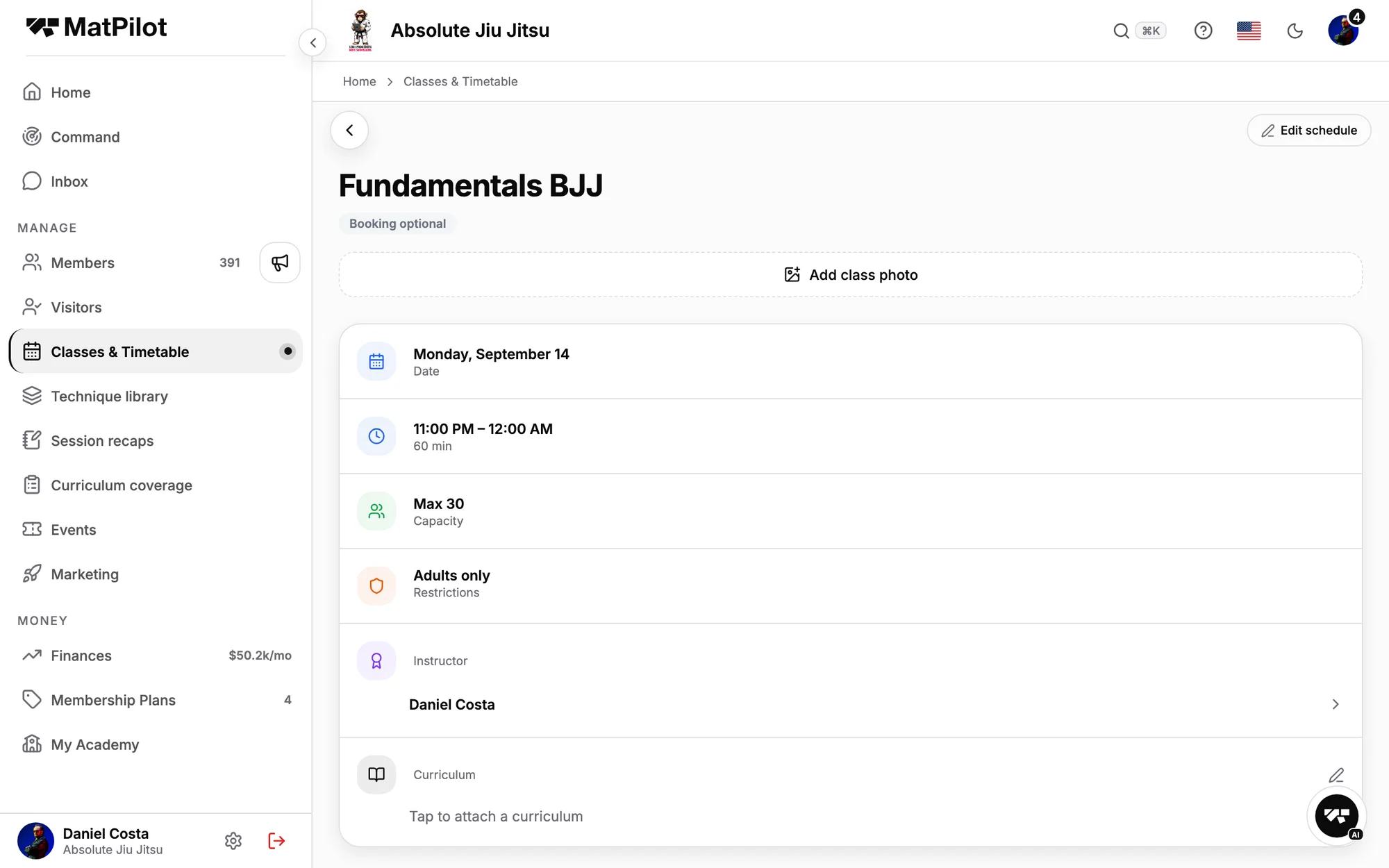
Attach it to a class
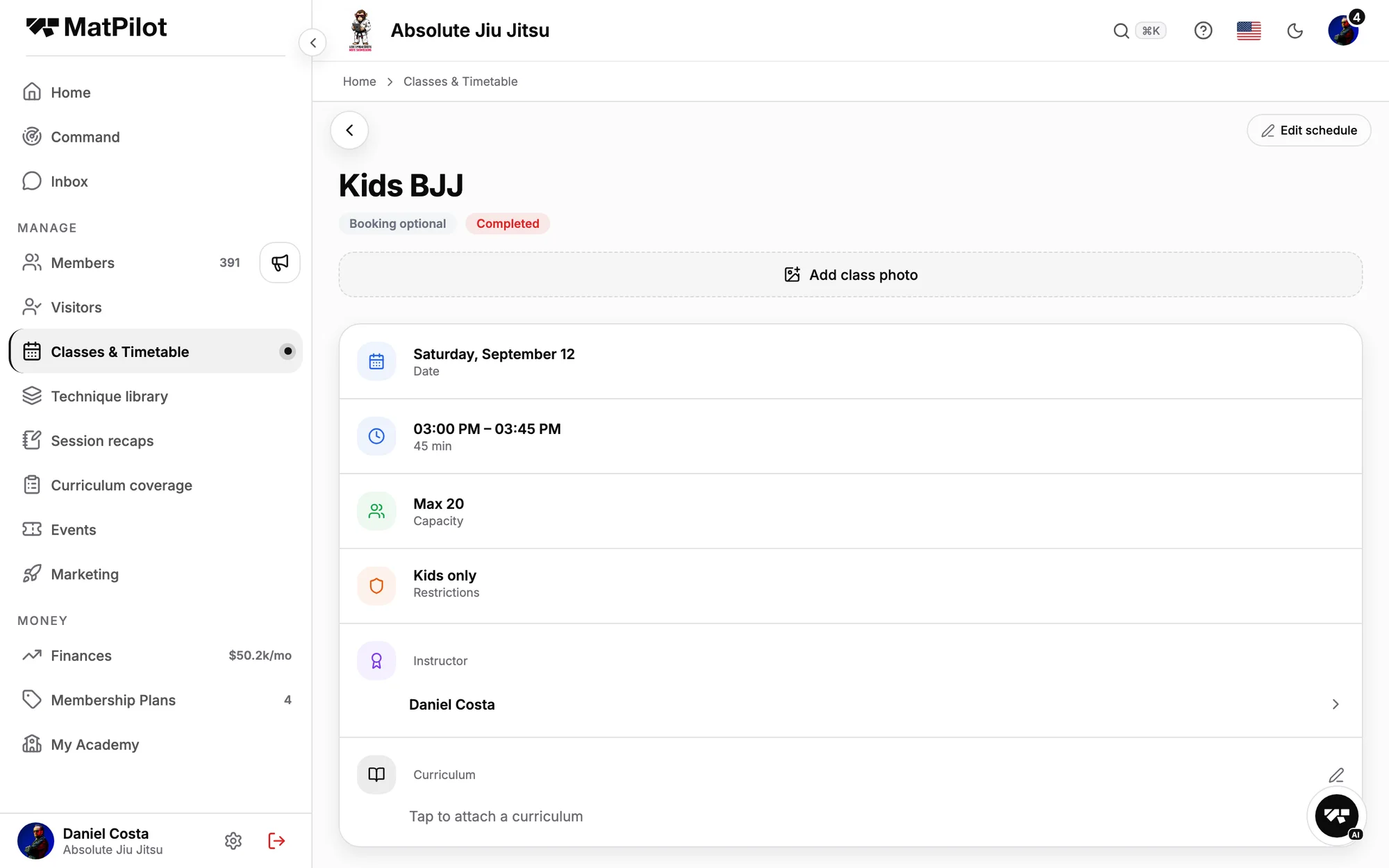
Pin a syllabus to a session or to a recurring slot, and it becomes the shortlist for that class. Tuesday fundamentals draws on white belt. The competition class draws on something harder. A coach covering a class they do not normally teach opens it and finds the plan already there.
Tick what you actually taught
This is the whole idea, and it is worth being precise about why.
A white belt syllabus holds around eighty techniques. A class covers two or three. Software that treats "this class had a syllabus" as "everyone learned the syllabus" will tell you a student practiced eighty techniques on a Tuesday evening, which is not true and, worse, is not useful. The number looks impressive and means nothing.
So the syllabus is the list you choose from, never the answer. After class, open the session and tick the two or three you covered. It takes about as long as writing them on a whiteboard, and it is the only moment in the whole loop that needs a human, because only the person who ran the class knows what happened in it.
Anything you taught that is not in the syllabus goes in the same place, picked from the library or typed straight in. The record is what happened, not what was planned.
Every student's profile fills itself in
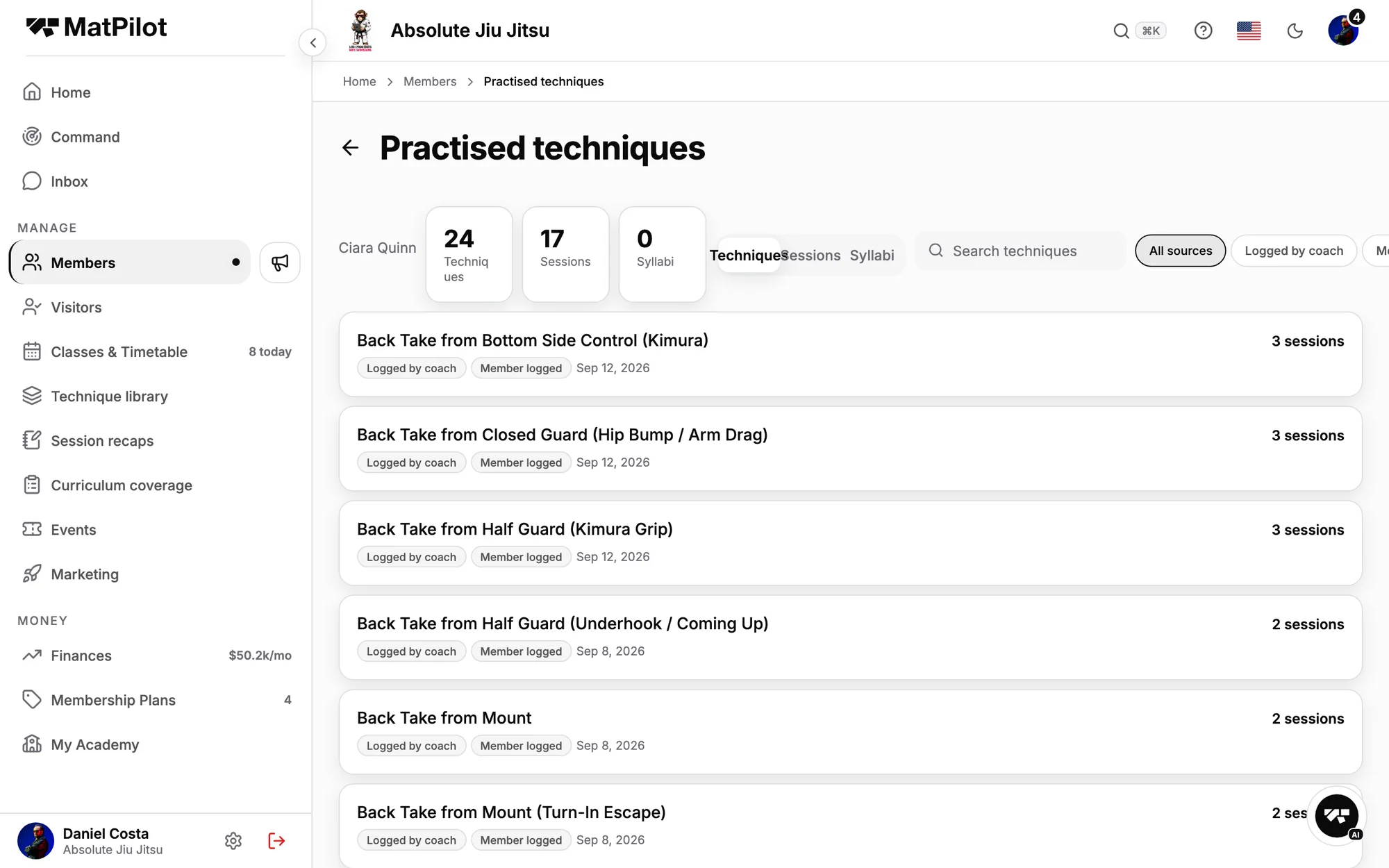
That is the last thing anyone has to do. Everyone who checked in to that class now has those techniques on their record, dated, with the session they came from and the syllabus it drew on.
Open a member and you see it at a glance: how many distinct techniques, across how many sessions, from how many syllabi, and the ones they have hit most often. Then search it. "Has Ana ever drilled a triangle from guard?" is now a question with an answer rather than a memory test, and it takes about four seconds.
Students keep their own log too, and the two are kept apart on purpose. What the coach recorded and what the student says they trained are different claims, and when you are weighing a promotion you want to see which is which.
Then ask the gym questions
Once the mat is recorded properly, the rest of the academy is worth interrogating too. There is a report builder now: pick what you want to measure, choose how to slice it, filter it, and read it as a chart or a table.
Attendance by instructor. Fill rate by time of day. No-shows by class. New members by month against cancellations. Save the ones you keep coming back to, pin them to your home screen, or have them land in your inbox every Monday morning.
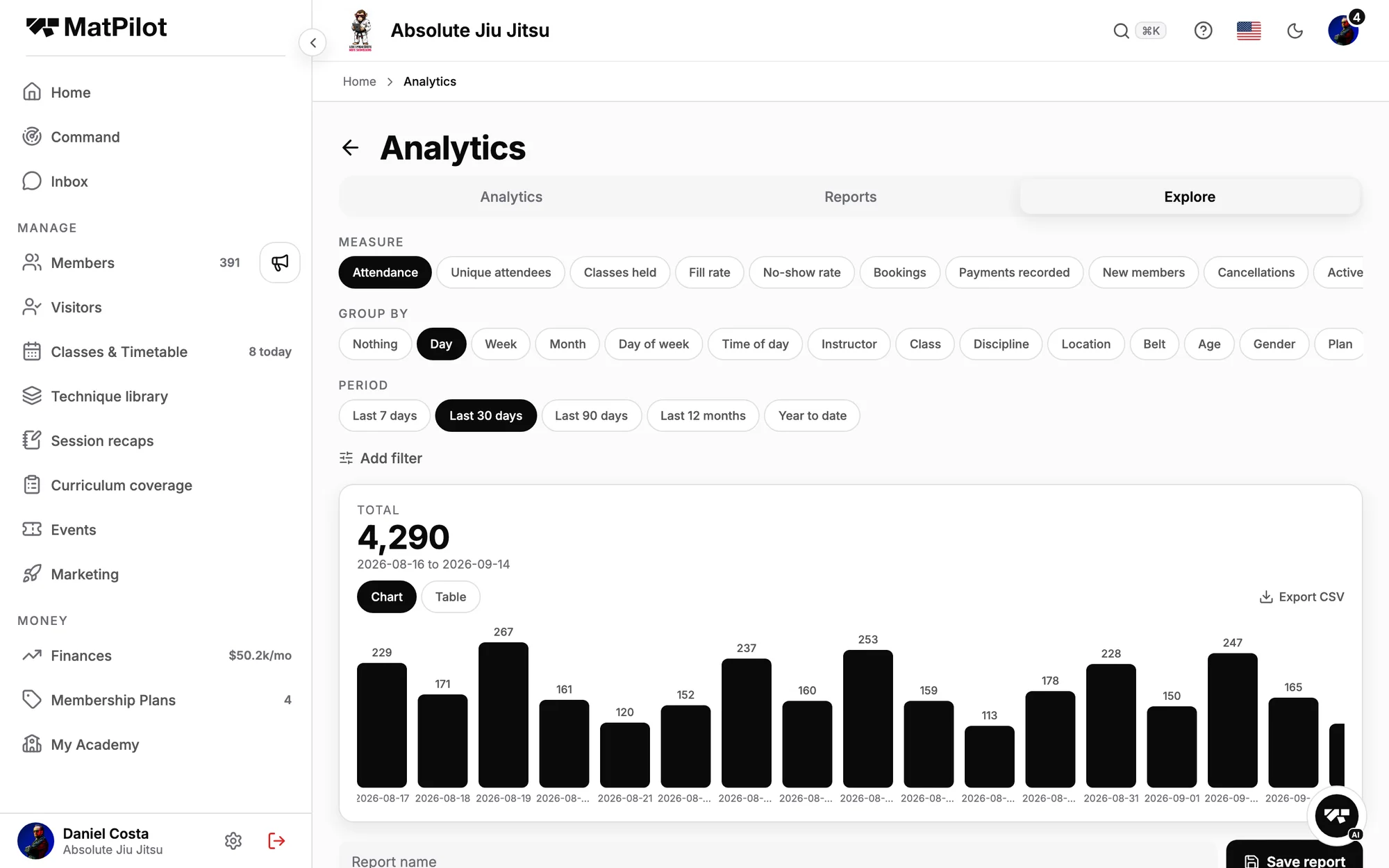
Attendance, unique athletes, classes held, fill rate, no-shows, bookings, payments, joiners, leavers, active members.
By day, week, month, weekday, time of day, instructor, class, art, location, belt, age, gender, plan or member.
A rate is weighted by its denominator, so a two-person class never counts the same as a forty-person one. A walk-in is attendance, never a no-show.
Export any view to CSV exactly as you are reading it, filters and all. Your data has never been hostage here.
And you can fix last Tuesday
Coaches forget. Someone runs a great class, teaches four things, and remembers to write it down on Thursday. That used to be too late.
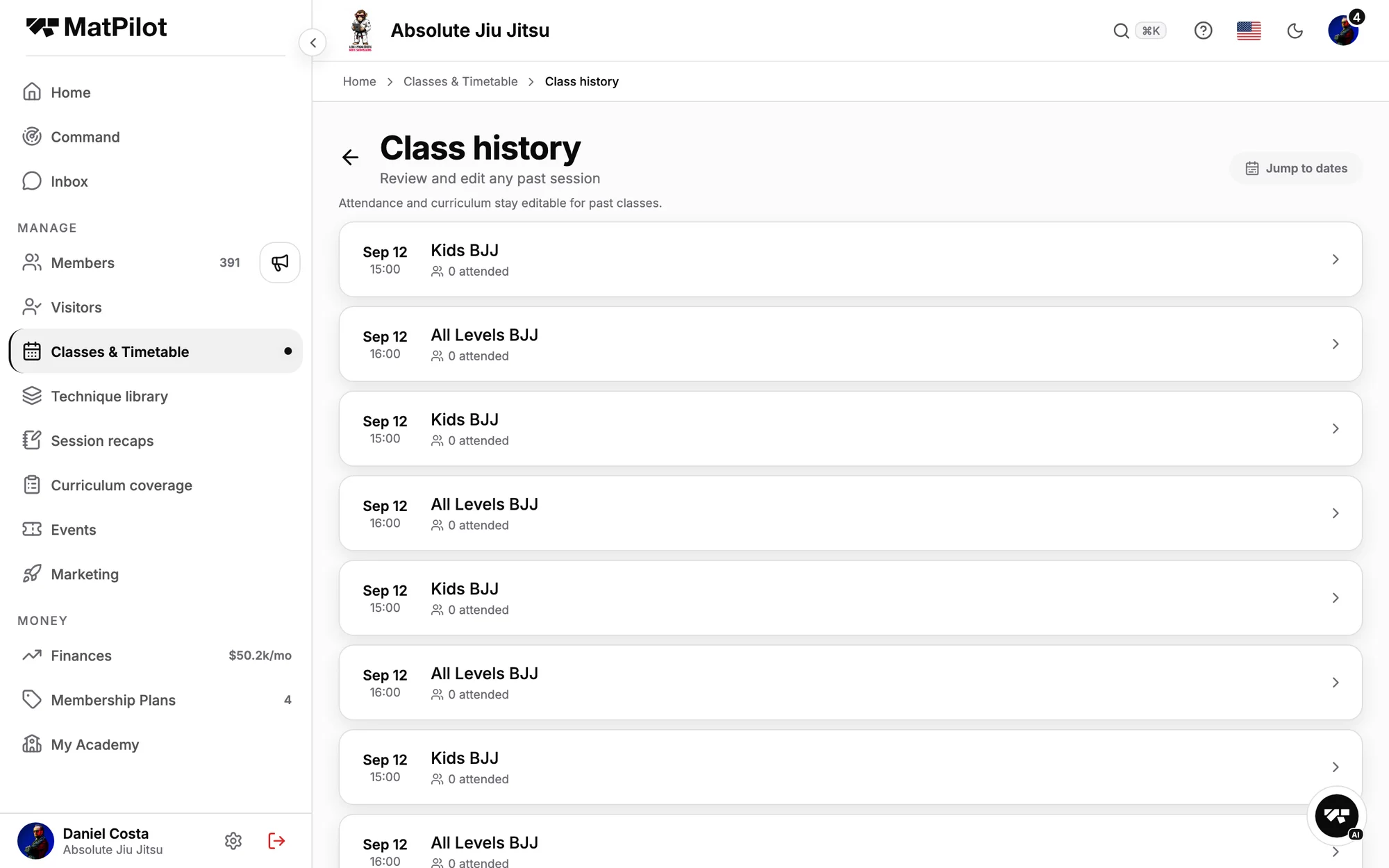
Every past class is now open. Browse back through the history, open any session, and correct it: who was there, what was taught, which syllabus it drew on. The record ends up right, which is the only thing that matters, and nobody has to be perfect on the night.
Three things get easier.
They are the three things that are hard about running an academy.
Put your syllabus to work.
Free to start, no card, no contract. Bring your syllabus, or start from a library of thousands of techniques across nineteen arts.