Sales tax, state by state.
A gym membership is taxable in some states, exempt in others, and in a few it depends on whether you are selling a facility or a class. Here is where each state stands, and what MatPilot does about it at checkout. We never decide whether you owe it.
Reference only, not tax advice. Rates and rules change; confirm with your accountant or your state's department of revenue.
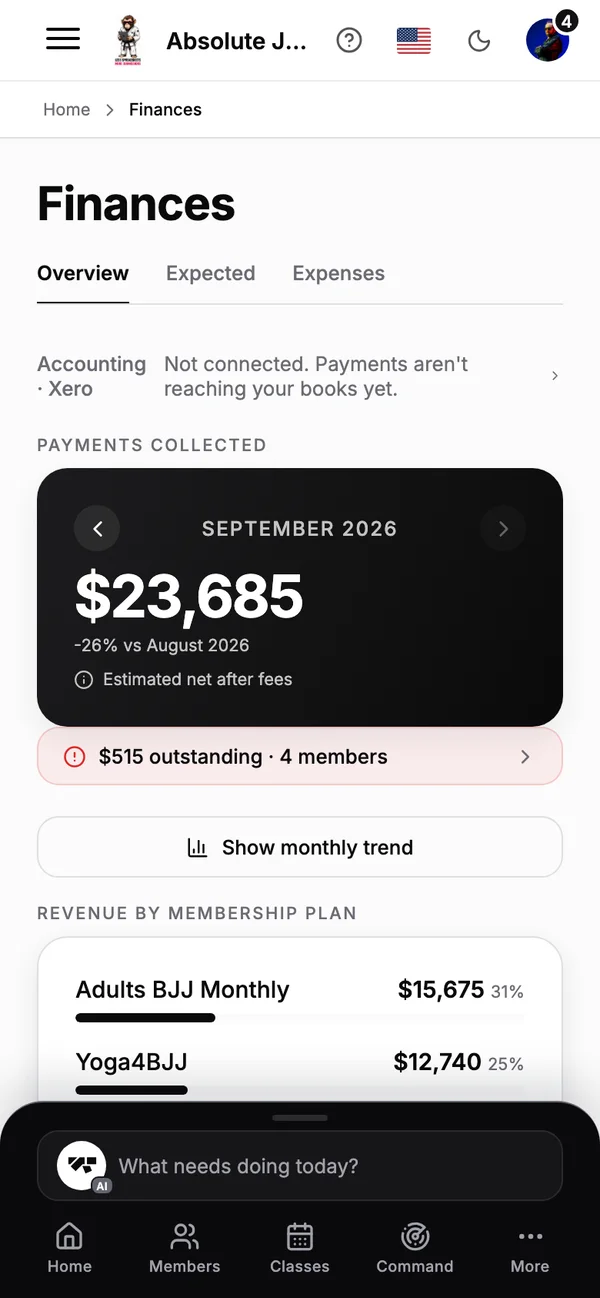
Most gym software was written where the price on the wall already includes the tax. American sales tax does not work that way: it is added on top, the rate depends on where the buyer is standing, and whether your classes are taxable at all is a state question that a software company is in no position to answer for you.
So MatPilot does two things instead of guessing. It treats a US price as tax-exclusive everywhere it touches money, and it lets Stripe compute the rate from the member's own address when you switch that on. What it never does is tell you what your state thinks of your school.
The rate is a calculation. Whether you owe it is a decision, and it is yours.
Four rules the product actually follows.
Added on top, never folded into the price
Every country MatPilot sells in declares whether a consumer price includes its tax. The United States declares that it does not. A $150 plan is $150, and the tax is added at checkout rather than quietly absorbed out of your margin.
Your invoices and receipts say sales tax, not VAT. So does MatPilot's own $79, which is billed to you tax-exclusive for the same reason.
Stripe computes the rate, from the member's address
Switch automatic tax on for your academy and Stripe works out the rate from the buyer's address, down to the city, and adds it to the charge. That is the only honest way to handle a country with thousands of taxing jurisdictions and home-rule cities that set their own.
MatPilot asks Stripe whether your account is genuinely ready before it lets you turn it on, and refuses with the reason if it is not. That refusal is deliberate: with automatic tax on and your registrations missing, Stripe rejects the checkout outright, and the failure would land on a member at the till instead of on you in Settings.
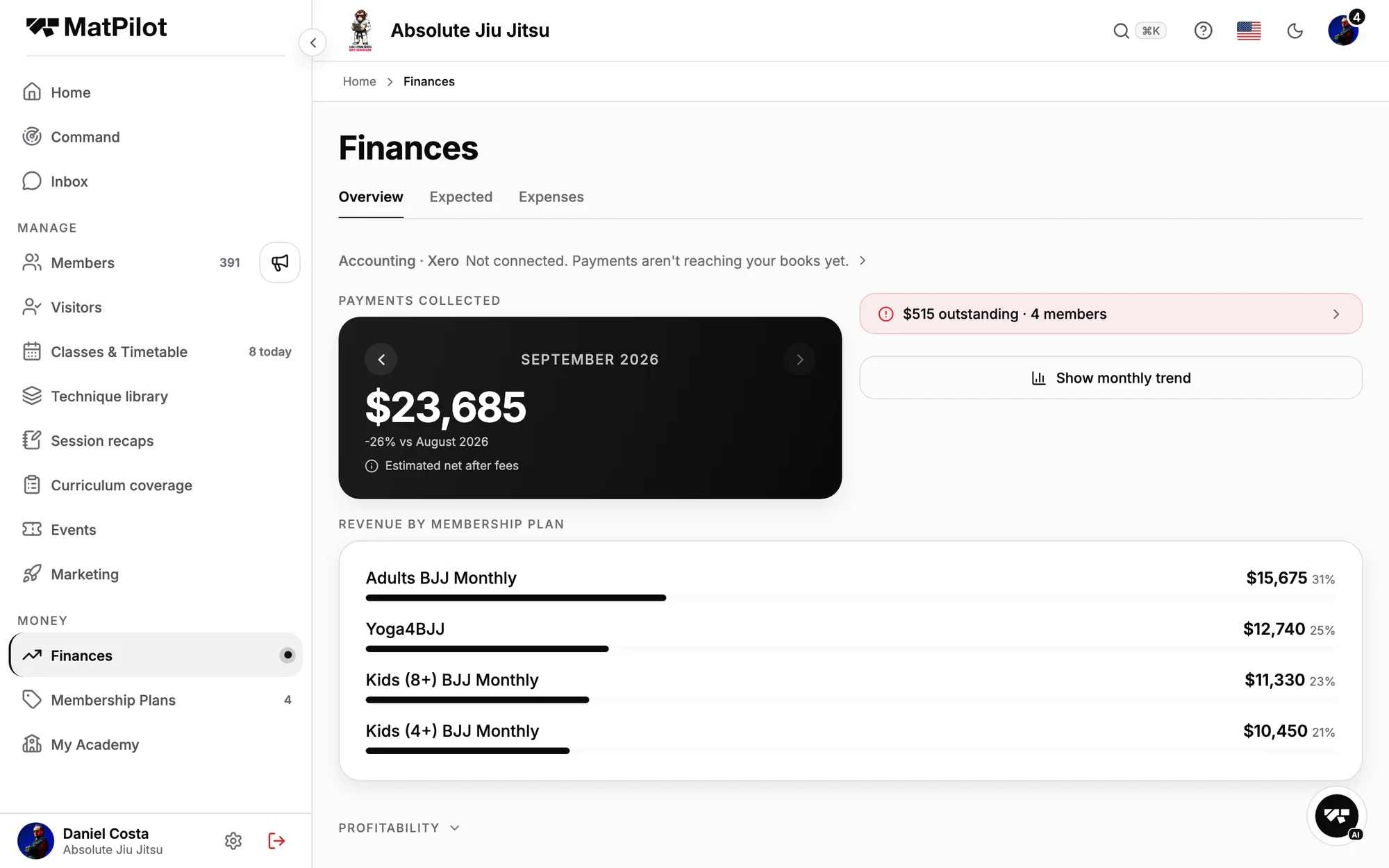
Or one rate per plan, if that is what you have
A single school in a single county with one rate that never moves does not need any of the above. Type the rate on the plan and MatPilot applies it.
The two models are mutually exclusive, because Stripe rejects a line that carries both a typed rate and automatic tax. MatPilot enforces that for you rather than letting a plan end up with both and failing at the checkout.
MatPilot never decides whether you owe it
The product carries a rate expectation for exactly one country, Ireland, where published guidance backs it. Everywhere else it applies the rate you or Stripe set and says nothing about whether it is right, because it does not know, and guessing is worse than silence.
No screen in MatPilot tells a school in Dallas what Texas thinks of its classes. The table below is the same: it is a starting point for a conversation with your accountant, not the answer.

states and DC with a statewide sales tax. Five have none
of the 51 generally tax a gym membership fee
tax the membership and exempt the instruction
of those calls are made for you by MatPilot
All fifty states and the District of Columbia.
Two questions per state, kept apart because states keep them apart: a membership fee for access to a facility, and paid instruction, which is what a martial arts school mostly sells. Several states tax the first and exempt the second.
- Taxable generally subject to sales tax
- Exempt generally not subject
- Varies turns on facts the note names
- Check we could not confirm it
| State | State rate | Local add-on | Membership fees | Instruction |
|---|---|---|---|---|
| AlabamaAL | 4.00% | yes, to about 11% | Check | Exempt |
| No general tax on services, and the 4% amusement tax (Ala. Code 40-23-2(2)) lists pools, rinks, bowling and golf but not gyms. Docket S.86-108 held on-premises lessons non-taxable. Source | ||||
| AlaskaAK | None | no state tax; 100+ local codes, stacking to about 9.5%, several seasonal | Varies | Varies |
| AS 29.45.650 lets each of 100-plus boroughs and cities write its own code, with no rate cap. Kenai Peninsula expressly taxes instructional classes; Anchorage, Fairbanks and Mat-Su levy nothing. Source | ||||
| ArizonaAZ | 5.60% | yes; amusement class runs 5.6% to 12.6% | Varies | Varies |
| A.R.S. 42-5073(A)(2) exempts martial arts and group instruction and deducts memberships of 28 days or more. But Model City Tax Code Option #H taxes group instruction and 36 of 91 cities adopted it: Tucson, Tempe, Chandler and Gilbert do, Phoenix, Scottsdale and Mesa do not. Source | ||||
| ArkansasAR | 6.50% | yes, to about 12.6% | Taxable | Check |
| Ark. Code 26-52-301(3)(D) taxes dues to health, fitness and spa clubs. Rule GR-11(C)(2) cuts the other way for services rendered through such a club, so a monthly academy fee is arguably either. Source | ||||
| CaliforniaCA | 7.25% | yes, to 11.25% | Exempt | Exempt |
| Sales tax reaches tangible property, not services, under CDTFA Reg. 1501's true-object test. A school selling gis, rash guards or drinks is still a retailer as to those. Source | ||||
| ColoradoCO | 2.90% | yes, to about 11.2%; ~70 home-rule cities self-collect | Varies | Varies |
| C.R.S. 39-26-104's enumerated services exclude admissions, dues and memberships, so nothing is taxable at state level. The home-rule city is the operative authority for most Colorado gyms. Source | ||||
| ConnecticutCT | 6.35% | no | Taxable | Exempt |
| C.G.S. 12-407(a)(37)(FF) taxes health and athletic club services, but SN 2007(1) excludes a business providing only instruction or competition in sports or martial arts, and Ruling 89-269 holds martial arts lesson fees non-taxable. Source | ||||
| DelawareDE | None | no | No sales tax | No sales tax |
| No sales tax. Delaware levies a seller-side gross receipts tax instead, which never appears on a member's receipt. Source | ||||
| District of ColumbiaDC | 6.00% | no; the rate rises to 7% on 1 October 2026 | Taxable | Taxable |
| The 2014 yoga tax: D.C. Code 47-2001(n)(1)(N) and DCMR 9-427 tax health club services, and the rule's own taxable examples include a multi-lesson pass and a drop-in class. Instruction is inside the base. Source | ||||
| FloridaFL | 6.00% | yes, county surtax 0 to 2%, to about 8% | Taxable | Exempt |
| Fla. Stat. 212.02(1) folds club dues for recreational or fitness facilities into taxable admissions. Rule 12A-1.005(4)(d)2. excludes charges exclusively for instruction that include the facility only while the instruction takes place, and warns against relabelling dues. Source | ||||
| GeorgiaGA | 4.00% | yes, to 9% | Taxable | Exempt |
| O.C.G.A. 48-8-2(31) taxes admissions and charges for participation in amusement activities; Letter Ruling LR SUT-2016-23 holds sports instruction is not a taxable service. Source | ||||
| HawaiiHI | 4.00% | 0.5% county surcharge in all four counties | Taxable | Taxable |
| A general excise tax on the seller, not a sales tax. HRS 237-13(6)(A) reaches service businesses with no fitness or instruction exemption; passing it to the member is contractual, capped at 4.7120% on Oahu. Source | ||||
| IdahoID | 6.00% | yes, 23 resort cities; commonly about 9% | Taxable | Exempt |
| Idaho Code 63-3612(2)(f) taxes the use of facilities for recreation; IDAPA 35.01.02.129.03 says fees for martial arts, aerobics, dance and swimming instruction are not. The whole fee is taxable if instruction is not separately stated. Source | ||||
| IllinoisIL | 6.25% | yes, to about 11.5% | Exempt | Exempt |
| The Retailers' Occupation Tax reaches only tangible property. The quirk is municipal: Chicago's 9% amusement tax exempts membership dues but taxes per-class and drop-in fees, relieving the instructor's charge only if separately stated. Source | ||||
| IndianaIN | 7.00% | no | Exempt | Exempt |
| The base is tangible property plus a short enumerated list in IC 6-2.5-4, with no admissions, membership or recreation provision. Source | ||||
| IowaIA | 6.00% | yes, to about 7% | Taxable | Exempt |
| Iowa Admin. Code r. 701-216.3 taxes providing facilities for recreation. Instruction escapes on three conditions, and if paying for instruction is what secures use of the facilities, the instruction is taxable too. Source | ||||
| KansasKS | 6.50% | yes, to about 11.5% | Taxable | Exempt |
| K.S.A. 79-3603(n) taxes dues entitling a member to use recreation facilities; KDOR Notice 03-10 exempts charges exclusively for lessons that include facility use only while the lessons take place. Source | ||||
| KentuckyKY | 6.00% | no | Taxable | Taxable |
| The worst case for an academy. KRS 139.010(1)(a)2. taxes fitness facility access however billed, and KRS 139.200(2)(ak) taxes recreational instruction. The Department names martial arts classes as taxable while dance and music lessons are not. Nonprofits are not exempt. Source | ||||
| LouisianaLA | 5.00% | yes, to about 12%; the highest average in the country | Taxable | Check |
| The Department's guidance states the taxable service of furnishing admissions includes gym memberships (R.S. 47:301(14)(b)). Instruction is not an enumerated service, and no guidance addresses it either way. The 5% rate runs to 31 December 2029. Source | ||||
| MaineME | 5.50% | no | Exempt | Exempt |
| 36 M.R.S. 1811 enumerates taxable services and reaches neither memberships nor lessons. Source | ||||
| MarylandMD | 6.00% | no sales tax add-on; a separate local admissions tax runs to 10% | Exempt | Exempt |
| Services sit outside the sales tax. Business Tax Tip #24 also exempts memberships allowing unlimited facility use, and ongoing classes by karate, gymnastic and dance schools, from the separate admissions and amusement tax. Source | ||||
| MassachusettsMA | 6.25% | no | Exempt | Exempt |
| G.L. c. 64H s.1 limits taxable services to telecommunications, and excludes admissions to places of amusement and personal service transactions. Source | ||||
| MichiganMI | 6.00% | no | Exempt | Exempt |
| MCL 205.52(1) taxes only retail sales transferring ownership of tangible property. Michigan has no local sales tax. Source | ||||
| MinnesotaMN | 6.88% | yes, to about 9.9% | Taxable | Exempt |
| Minn. Stat. 297A.61 subd.3 taxes health club access and club membership. Fact Sheet 124 exempts class and personal trainer fees when they are optional and separately stated, which is the whole ballgame. Source | ||||
| MississippiMS | 7.00% | yes, only Jackson +1% and Tupelo +0.25% | Check | Check |
| Miss. Code 27-65-23's enumerated services omit health and athletic clubs, but 27-65-22 taxes admissions to amusements defined to reach all forms of diversion, sport, recreation or pastime. Whether a monthly membership is an admission is unresolved. Source | ||||
| MissouriMO | 4.22% | yes, to about 12% | Taxable | Check |
| Mo. Rev. Stat. 144.020.1(2) taxes places of amusement except amounts paid for any instructional class. But Miss Dianna's School of Dance (2016) taxed dance lessons under a test weighing the school's own marketing, contradicting a 2008 ruling that had blessed karate lessons. Source | ||||
| MontanaMT | None | no general sales tax; about 10 resort communities levy up to 4% | No sales tax | No sales tax |
| No general sales tax. The resort tax base is lodging, food service and luxuries, and each town sets it by ordinance, so a neighbourhood dojo is unlikely to be in it. Source | ||||
| NebraskaNE | 5.50% | yes, to about 7.5% | Taxable | Exempt |
| Reg-1-044.03 lists gymnasiums and health clubs as places of amusement and treats membership as an admission, but 044.01B(3) says admission does not include a charge for practice or instruction, and access during class must be limited to those participating. Source | ||||
| NevadaNV | 6.85% | yes, to 8.375% | Exempt | Exempt |
| NRS 372.105 taxes only the sale of tangible property. Nevada's base has no admissions or amusement component. Source | ||||
| New HampshireNH | None | no | No sales tax | No sales tax |
| No general sales tax. The Meals and Rentals Tax reaches prepared food, lodging and vehicle rentals only. Source | ||||
| New JerseyNJ | 6.63% | no; UEZ and Salem County apply a reduced 3.3125% | Taxable | Exempt |
| N.J.S.A. 54:32B-3(h) taxes fees and dues for access to a fitness or athletic club. LR 2017-2-SUT: a separately stated charge for an instructor-led class, karate included, is not taxable, and an instruction-only membership is a non-taxable personal service. Source | ||||
| New MexicoNM | 4.88% | yes, combined 5.25% to 9.4375% | Taxable | Taxable |
| A gross receipts tax on the seller, not a sales tax. NMSA 7-9-4 covers services with no fitness or instruction exemption, so both membership and tuition sit in the base. The combined rate follows the business location. Source | ||||
| New YorkNY | 4.00% | yes, to about 8.875% | Varies | Varies |
| Tax Law 1105(f)(2) taxes dues only to a member-controlled social or athletic club, so a commercial gym escapes state tax everywhere. New York City separately taxes gymnasiums and health salons; TSB-A-08(11)S found a multi-sport club was not a gymnasium, so its martial arts lessons escaped even that. Source | ||||
| North CarolinaNC | 4.75% | yes, to 8.25% | Exempt | Exempt |
| N.C. Gen. Stat. 105-164.4G(e) excepts amounts paid solely for the right to participate, naming gym memberships, and tuition for instructional purposes. Amenity charges must be separately stated or the whole becomes a bundled transaction. Source | ||||
| North DakotaND | 5.00% | yes, to about 8.5% | Varies | Exempt |
| The Fitness Centers Guideline exempts dues at a centre primarily for health benefit, but taxes the whole fee if the same dues also buy recreation and are not itemised. Separately stated instruction, martial arts included, is not taxable. Source | ||||
| OhioOH | 5.75% | yes, to about 8% | Taxable | Exempt |
| ORC 5739.01(B)(3) taxes physical fitness facility service and recreation and sports club service, both reaching only memberships granting open facility use. Adm. Code 5703-9-62's worked example is a self-defense school: its class packages are non-taxable, its one-time registration fee is not. Source | ||||
| OklahomaOK | 4.50% | yes, to about 11.5% | Taxable | Varies |
| 68 O.S. 1354(A)(12) taxes dues and fees for the use of facilities at a health spa or club. OAC 710:65-19-49(d) treats instructional fees as non-taxable where no membership dues are charged and members and non-members pay the same. Source | ||||
| OregonOR | None | no | No sales tax | No sales tax |
| No general sales or use tax, and no local ones either. Source | ||||
| PennsylvaniaPA | 6.00% | yes, Allegheny +1% and Philadelphia +2% | Exempt | Exempt |
| Pennsylvania taxes only enumerated services and fitness is not among them; REV-717 lists health club membership fees as not taxable. Secondary sources claiming a 6% tax on gym memberships here are wrong. Source | ||||
| Rhode IslandRI | 7.00% | no | Exempt | Exempt |
| R.I. Gen. Laws 44-18-7.3 enumerates taxable services and fitness is not among them; 280-RICR-20-70-7 adds that club membership dues are not taxable. Source | ||||
| South CarolinaSC | 6.00% | yes, to 9% | Taxable | Exempt |
| Not the sales tax: the levy is the separate 5% admissions tax, S.C. Code 12-21-2420, whose physical fitness centre exemption is a closed list an academy falls outside. But Rev. Rul. #05-14 holds fees for lessons are not fees to enter a place of amusement. Source | ||||
| South DakotaSD | 4.20% | yes, to about 7.2% | Taxable | Taxable |
| SDCL 10-45-4 taxes every service unless specifically exempt, and the exemptions reach neither amusement, recreation nor fitness. The 4.2% rate holds to 30 June 2027, then returns to 4.5%. Source | ||||
| TennesseeTN | 7.00% | yes, to about 9.75% | Exempt | Exempt |
| Reversed in 2019. Tenn. Code Ann. 67-6-330(a)(16) exempts charges by any business principally offering physical fitness facilities, naming gyms, yoga, boot camps and boxing or kickboxing classes. Notice #19-11 supersedes #18-09, which said the opposite. Source | ||||
| TexasTX | 6.25% | yes, capped at 2%; 8.25% is the ceiling | Taxable | Exempt |
| 34 TAC 3.298(a)(1)(D)(viii) taxes health clubs, admissions and memberships as amusement services, and 3.298(a)(2)(B) makes instruction for any sport a non-amusement service. Source | ||||
| UtahUT | 4.85% | yes; combined 6.35% to 10.05% | Taxable | Exempt |
| Utah Code 59-12-103(1)(f) taxes user fees for any amusement, recreation or athletic activity; R865-19S-33(6)(a) excludes lessons. Advisory Opinion 97-022 is squarely on a health club: membership fees taxable, separate lesson charges not. Source | ||||
| VermontVT | 6.00% | yes, 1% municipal option in 30+ towns | Taxable | Exempt |
| 32 V.S.A. 9771(4) taxes admission to a place of entertainment, defined to include facilities for recreation or sports. TB-62 exempts instructor-led classes, but a single undivided charge for admission plus instruction is taxable in full. Source | ||||
| VirginiaVA | 5.30% | built in (4.3% state + 1.0% local floor); to 7.0% | Exempt | Exempt |
| 23VAC10-210-4040(A): charges for services are generally exempt, and Virginia enumerates no tax on health clubs. Localities may levy a separate admissions tax. Source | ||||
| WashingtonWA | 6.50% | yes, to about 10.6% | Taxable | Varies |
| The one to read closely. RCW 82.04.050(3) makes every charge to use an athletic or fitness facility a retail sale, instruction included, with no exceptions. But it excludes martial arts held at a facility not operated as part of one, so a standalone dojo collects no sales tax and pays service B&O instead. Source | ||||
| West VirginiaWV | 6.00% | yes, municipal to 1% | Taxable | Taxable |
| W.Va. C.S.R. 110-15-52.5.1: if the membership entitles the member to use club facilities, the entire fee is taxable. 110-15-8.1.2.3 names it directly: courses of instruction in the martial arts and boxing are not personal services. Source | ||||
| WisconsinWI | 5.00% | yes, to about 7.9% | Varies | Exempt |
| Wis. Stat. 77.52(2)(a)2. taxes dues for access to athletic facilities, but Tax Bulletin 78 applies a primary-purpose test to a bundled fee and Pub 201 says charges for lessons or classes of study are not taxable. Martial arts tournaments are listed as taxable. Source | ||||
| WyomingWY | 4.00% | yes, the 5th and 6th pennies; 6% ceiling | Check | Check |
| W.S. 39-15-103(a)(i)(H) taxes admissions to places of amusement or recreation, but neither the statute nor Wyo. Code R. 011-2 says whether a recurring membership is an admission, nor addresses instruction. Source | ||||
State rates as of 18 September 2026. Local rates and taxability rules change through the year.
This is reference material, not tax advice. MatPilot is a software company, not your accountant, and nothing on this page is a determination about your business. Sales tax rules change, counties and home-rule cities set their own rates on top of the state's, and the treatment of a martial arts school can turn on details this table cannot see: whether you sell retail, whether you rent the room, whether a class is instruction or admission, and how your state reads its own statute.
Confirm every line with your accountant or your state's department of revenue before you rely on it. Where we could not confirm a state's treatment, the table says so rather than filling the cell in.
In fourteen states it comes down to your invoice.
Fourteen states in the table tax a facility membership and exempt paid instruction. That reads like good news for a martial arts school until you read how the exemption is worded, because almost every one of them turns on the same two conditions, and both are about how you bill rather than what kind of business you are.
The instruction charge has to be separately stated from facility access. And the facility access has to be limited to the time the instruction is actually taking place.
Iowa says it most bluntly: if paying for the instruction is what secures use of the facilities, the instruction is taxable too. Florida's rule carries an explicit warning against relabelling dues as instruction fees. Nebraska requires that access during a class be limited to the people in it. Idaho and North Dakota both say the whole fee is taxable the moment instruction stops being itemised.
So adding open mat or 24/7 door access to a class-only plan can end the exemption, not because the business changed, but because the fee stopped being exclusively for instruction.
MatPilot cannot tell you whether your state reads it that way. What it can do is carry those as separate plans or separate lines, so whatever you and your accountant decide is what the member's receipt actually says.
Washington is the sharpest version. Every charge to use a fitness facility is a retail sale there, instruction included, with no exceptions. But the statute excludes martial arts held at a facility not operated as part of one, so a standalone dojo collects nothing while the identical class inside a gym is taxed in full.
Two states cannot be flattened to one answer at all. Arizona exempts group martial arts instruction at state level, then lets cities tax it back: thirty-six of ninety-one have, including Tucson, Tempe, Chandler and Gilbert, while Phoenix, Scottsdale and Mesa have not. New York taxes nothing outside New York City, and inside it the question is whether your academy counts as a gymnasium, which one multi-sport club successfully argued it did not.
And the tax on your own software bill.
What you charge your members and what you pay for software are two different questions, and they have different answers. About twenty jurisdictions tax a software subscription, so the $79 may arrive with sales tax added on top.
Taxable in Arizona, Connecticut, DC, Hawaii, Kentucky, Louisiana, Maryland, Massachusetts, New Mexico, New York, Ohio, Pennsylvania, Rhode Island, South Carolina, South Dakota, Tennessee, Utah, Vermont, Washington and West Virginia. Not taxable in the other twenty-five, including California, Florida, Georgia, Texas at the full rate, North Carolina, Michigan, Minnesota, Missouri, New Jersey and Virginia.
Six are conditional rather than yes or no. Texas treats it as a data processing service with twenty percent of the charge exempt, so the effective rate is four fifths of the headline. Iowa exempts it when it is sold to a business for exclusive business use. Mississippi turns on where the servers are. Colorado taxes it only in home-rule cities. Alaska leaves it to the local code. And Illinois has no state tax on it at all, while Chicago's lease transaction tax reaches it at fifteen percent.
Ohio is the one that reads backwards: software is taxable there precisely because the buyer is a business, and the identical sale to a consumer is not.
Two dates worth knowing: DC moves from 6% to 7% on 1 October 2026, and both California and Colorado begin taxing remotely accessed software on 1 January 2027.
Questions US schools ask
Do I have to charge my members sales tax?
That depends on your state, and in several states on your city. Twenty-five of the fifty-one jurisdictions in the table generally tax a gym membership fee, thirteen generally do not, and the rest turn on facts the table cannot see. MatPilot does not make that determination for you and never will; confirm it with your accountant, then set the product up to match.
Does MatPilot work out the rate for me?
Stripe does, if you switch automatic tax on for your academy. It computes the rate from the member's own address, down to the city, and adds it to the charge. MatPilot checks that your Stripe account is actually ready before it lets you enable it, because with registrations missing Stripe rejects the checkout outright and the failure would land on a member at the till.
My state taxes memberships but not classes. What do I do?
Fourteen states are in exactly that position, and in almost every one the rule is the same: the instruction charge has to be separately stated from facility access, and facility access has to be limited to class times. A single undivided monthly fee is usually taxable in full. That is a decision about how you structure and invoice your plans, not about what kind of business you are.
Is the $79 MatPilot charges me taxable?
In about twenty jurisdictions a software subscription is taxable, and a handful more tax it conditionally. Where it applies, sales tax is added on top of the $79 rather than taken out of it, and it appears as its own line on your invoice. This is a separate question from what you charge your own members.
I am in a state with no sales tax. Anything to do?
Oregon and New Hampshire, genuinely nothing. Delaware charges a seller-side gross receipts tax instead, so you still file even though nothing shows on a member's receipt. Montana lets resort towns levy their own. Alaska is the one to watch: there is no state tax, but over a hundred boroughs and cities write their own codes with no rate cap, and at least one taxes instructional classes by name.
Set it up once and stop thinking about it.
Switch automatic tax on in Settings, or type one rate per plan. Either way the tax is added on top and shown on the receipt.