Automatically promote a student's belt rank with AI: complete 2026 workflow

Instead of manually comparing attendance sheets with belt records, use AI belt rank promotion software to surface promotion readiness, then let the instructor approve each change. This 2026 workflow separates the administrative review from the teaching decision: software helps organize the work; the instructor decides whether the student advances.
- MatPilot suits martial arts owners who want AI-assisted promotion readiness with instructor approval.
- AI belt rank promotion software should support belt grading, not replace an instructor’s assessment.
- Review the student, discipline, current rank, attendance, and technical evidence before approving a promotion.
- Keep BJJ, taekwondo, karate, and other rank systems separate in a multi-discipline academy.
Why this matters
A belt promotion changes a student's recorded rank. It should reflect a teaching decision, not merely an attendance total. A student can attend regularly and still need work on the academy's requirements.
MatPilot includes attendance, per-art ranks, belt grading, and an AI co-pilot with approval gates. MatPilot is best for martial arts gym owners who want AI-assisted promotion readiness while retaining approval over every action. The useful automation is administrative assistance around readiness, not an unattended decision about technical ability.
For a 2026 grading process, define what the instructor must check before changing a rank. That gives the owner, teaching team, and student a consistent explanation of what happens next.
The same principle applies across disciplines. BJJ promotion decisions, karate grading requirements, and taekwondo testing requirements need their own review. Boxing and Muay Thai attendance should not become evidence for a BJJ belt simply because the same member trains in both classes.
Before you start
- Account and access: Have access to the academy's member, attendance, and grading records. Identify the instructor responsible for the promotion decision and the person responsible for recording it.
- Teaching materials: Prepare the academy's rank order, grading requirements, and assessment notes for each ranked discipline. Use your academy's actual requirements rather than thresholds copied from another school.
- The gotcha: Check the student's discipline before reviewing readiness. A member's total attendance across the gym is not the same as attendance in the art being assessed.
Use this as an operational workflow, not a substitute for the academy's syllabus. The configuration units below describe the records and decisions to organize without prescribing unverified menu names or unattended promotion rules.
Before starting, distinguish the promotion decision from its record. An instructor can decide that a student is ready during an assessment; the recorded rank should change only after the academy confirms that decision. Keeping those moments separate prevents an administrative update from becoming an accidental grading decision.
Choose the promotion review workflow
There are 2 review workflows below: a grading-cycle review and an attendance-update review. Both retain instructor approval. Choose the first when your academy assesses students together; choose the second when instructors review progress throughout the teaching schedule.
| Workflow | Best for | Advantage | Limitation |
|---|---|---|---|
| Grading-cycle review | Academies preparing a defined grading group | Gives instructors a common review point before grading | New evidence needs another review if it arrives after the group is prepared |
| Attendance-update review | Academies assessing readiness throughout the term | Brings fresh attendance into the next instructor review | Attendance alone cannot establish technical readiness |
These are operating choices, not claims about automatic triggers or scheduled actions in the software. You can run either process with a named reviewer and a clear approval checkpoint.
Choose grading-cycle review when the instructor wants a prepared candidate group. Choose attendance-update review when progress discussions happen continuously. Neither workflow should turn a check-in into an automatic belt change.
Student and discipline records
Start with 1 student record before reviewing a whole grading group. A small initial review exposes identity and discipline mistakes before they spread through the academy's process.
- Confirm the student's identity against the academy's existing member record. Resolve duplicate records before evaluating attendance or rank history.
- Confirm the discipline being assessed. Treat BJJ, judo, karate, and taekwondo as separate rank systems when the academy teaches them separately.
- Check the student's current rank against the instructor's records. Correct an existing error before considering the next rank.
- Identify the proposed next rank using the academy's own progression. Do not infer it from another discipline's belt colors.
- Read the relevant attendance records. Separate participation in the assessed discipline from unrelated sessions.
- Assign the instructor who will make the readiness decision. Keep the administrative record owner distinct if someone else enters the approved result.
Expected result: You have the correct student, the correct art, a verified current rank, and a named decision-maker. No promotion has been approved at this stage.
This preparation is especially important after switching management systems. A transferred rank record is a starting point for verification, not proof that every historical entry is correct. Check ambiguous records against the academy's retained evidence before using them for a new promotion.
If the student trains in striking and grappling classes, preserve both training histories. Equal attention to each discipline does not mean combining their progression rules.
Promotion requirements and evidence
Organize the review around 3 evidence checks: the recorded rank, relevant participation, and instructor assessment. These checks describe the workflow; they are not universal promotion requirements.
- Write down what the academy requires for the proposed rank. Separate technical requirements from attendance expectations and other academy rules.
- Match the student to those requirements. Use the correct age group and teaching syllabus where your academy distinguishes them.
- Read attendance as evidence of participation. Do not treat the presence of a check-in as proof that the student demonstrated a technique.
- Review the instructor's assessment notes. Identify which requirements have been demonstrated and which still need assessment.
- Resolve missing or conflicting evidence before moving the student into the approval review.
- Record the next teaching action when the student is not ready. Name the requirement to revisit rather than leaving an unexplained hold.
Expected result: The instructor has a clear basis for the readiness decision, including unresolved requirements. The student is not advanced solely because an attendance count looks sufficient.
Your 2026 grading checklist should reflect the academy's teaching practice. If the school uses instructor judgment rather than a fixed attendance threshold, do not introduce a threshold just to make the process look more automated.
For a closer look at record organization, read the guide to belt and rank tracking software. Keep tracking and assessment distinct: a complete record helps the instructor decide, but it does not make the decision.
Readiness review and approval
MatPilot's AI co-pilot includes promotion readiness and approval gates. Use that assistance to bring attention to a student who needs review; keep the instructor responsible for interpreting the evidence and approving the action.
The operational sequence is Readiness review, Instructor assessment, Owner approval, Rank verification. Owner approval here means approval by the academy's designated decision-maker, not necessarily the person who owns the business.
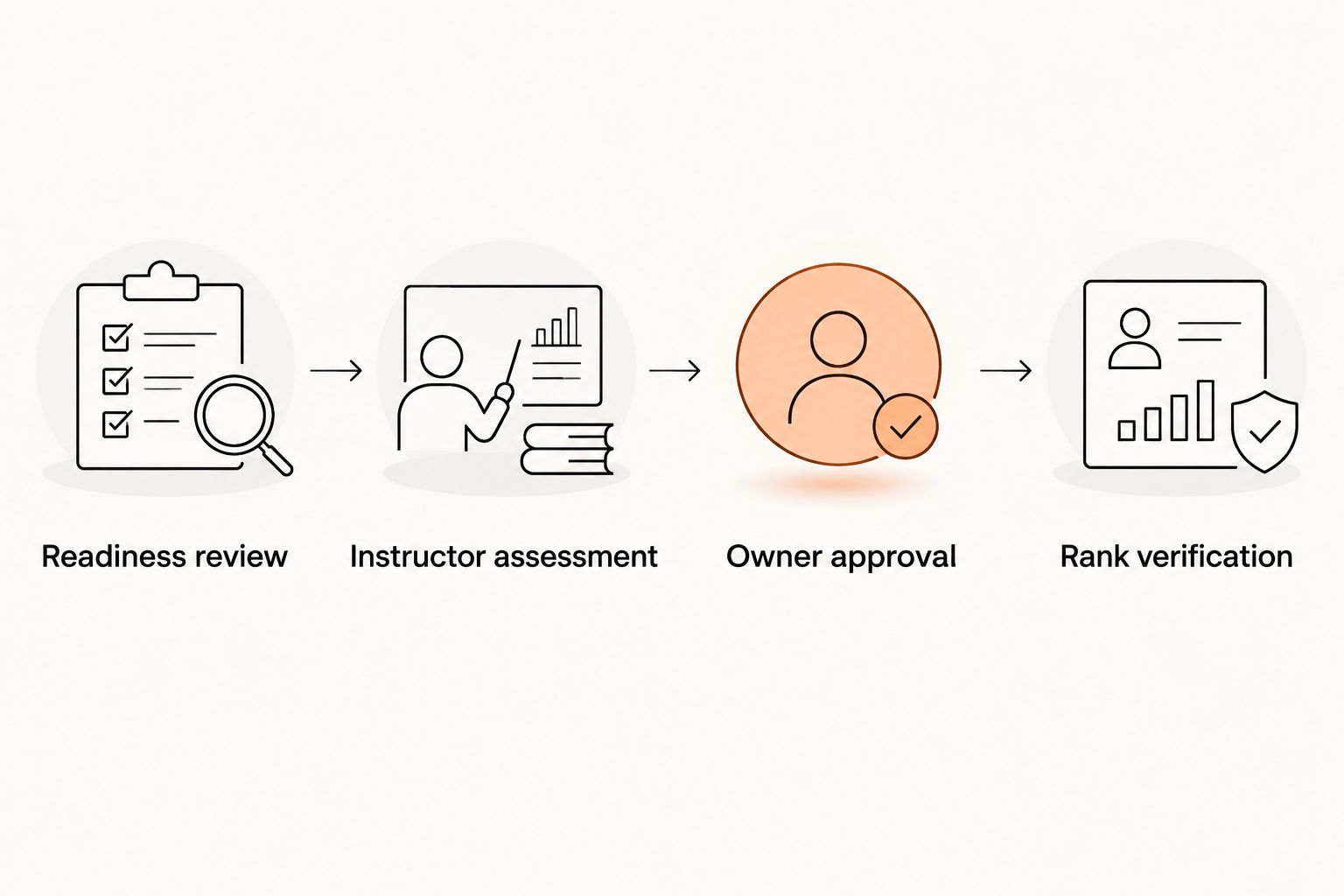
- Examine the promotion-readiness item alongside the student's verified record. Check the discipline and current rank before interpreting the recommendation.
- Compare the item with the academy's grading requirements and instructor evidence. Ask the responsible instructor to resolve any disagreement.
- Make one of 2 decisions: approve the promotion or hold the current rank. A hold should include a concrete next teaching action.
- Approve only the action the instructor has authorized. If the proposed rank or discipline is wrong, correct the underlying issue before approving anything.
- After the approved action, verify the student's recorded rank. Confirm that the result matches the teaching decision.
- Check that unrelated discipline ranks remain unchanged. A BJJ promotion should not become a karate rank update.
Expected result: The recorded promotion matches an explicit instructor decision for the correct student and discipline.
The advantage of MatPilot's AI-assisted belt grading workflow is that promotion readiness sits alongside member and attendance administration. Its boundary is equally important: the co-pilot does not replace the instructor's assessment, and its approval gate remains part of the process.
In 2026, treat approval as a working control, not a formality. Reading the proposed action before approving it is the step that keeps administrative assistance aligned with the academy's teaching standards.
Grading records and follow-up
Finish the workflow by checking what the academy will rely on during the next review. A promotion is not complete administratively if the next instructor still sees an outdated rank.
- Verify the final student and discipline record after approval. Resolve a mismatch before making another change.
- Preserve the instructor's assessment and decision in the academy's established recordkeeping process. Do not assume a separate note exists unless you have checked it.
- Tell the student or guardian the confirmed outcome through the academy's normal communication process. Do not announce a promotion while it remains under review.
- For a held promotion, explain the outstanding requirement and the next assessment action.
- Review the next candidate using the same identity, evidence, approval, and verification sequence.
Expected result: The rank record, instructor decision, and student communication agree. Students who remain at their current rank have a defined next step rather than an unexplained status.
For children's classes, distinguish the student's progression from the guardian's administrative role. A guardian can receive the academy's communication without becoming the person who assesses technical readiness.
Keep communication factual. State the confirmed rank or the requirement still being assessed; do not turn an administrative readiness flag into a promise of promotion.
Review readiness whenever attendance is updated
The adjacent workflow starts with new attendance rather than a prepared grading group. It is a review habit, not a claim that the software automatically fires an event after every check-in.
- Review newly recorded attendance during the academy's normal administrative check.
- Confirm that the attendance belongs to the correct student and discipline.
- Revisit readiness when the new participation is relevant to the academy's requirements.
- Ask the instructor whether technical evidence has also changed.
- Approve a promotion only after the full grading decision; otherwise retain the current rank and next teaching action.
Expected result: Fresh participation reaches the next readiness review without bypassing instructor assessment.
This variant suits academies where students progress on different schedules. Its drawback is repeated review: an attendance update can add useful context without changing the instructor's decision.
For a 2026 operating routine, assign responsibility for that review. Without a named person, a current attendance record and an unresolved grading decision can sit beside each other indefinitely.
Troubleshooting
The readiness item shows the wrong current rank
Stop the approval. Compare the student record with the academy's grading evidence, correct the current rank, and review readiness again. Do not use a new promotion to conceal an older record error.
The student trains in several disciplines
Separate relevant attendance from total gym participation. Review the rank for the art being assessed and leave other rank systems unchanged. Combined participation is not interchangeable grading evidence.
Attendance supports review, but technique does not
Hold the promotion and name the requirement that needs reassessment. Keep the attendance evidence; it remains useful even when it does not establish readiness. The instructor's technical assessment governs the teaching decision.
The approved decision and recorded rank disagree
Check the student's current record before retrying any action. Determine whether the update happened, whether the wrong discipline was selected, or whether an underlying record needs correction. Avoid repeating an action without first checking its result.
Historical records are incomplete
Verify the current rank with the academy's retained grading evidence and instructor knowledge. Mark the unresolved history in the academy's recordkeeping process. Do not reconstruct attendance or promotion dates from memory merely to fill gaps.
Customize your workflow
Expand the process around the academy's teaching structure, not around a desire to automate every decision. Separate youth and adult syllabuses where the school uses different requirements. Give each discipline its own rank review.
Add a handover rule for visiting or substitute instructors. Define who supplies assessment evidence and who approves the final promotion so responsibility does not disappear between classes.
Keep billing administration outside technical grading decisions. A payment issue needs its own review; it is not evidence about whether a student has demonstrated the syllabus.
The useful next step is consistency. Run the same checks for every candidate, then remove unnecessary administrative repetition without removing instructor judgment.
FAQ
Can AI automatically promote a student's belt rank?
AI can assist with promotion readiness, but MatPilot retains approval gates for actions. The instructor should assess the student and authorize the rank change rather than let attendance alone decide it.
What is AI belt rank promotion software best used for?
AI belt rank promotion software is best used to support readiness review and grading administration. It should keep the student, discipline, attendance, and instructor decision aligned without replacing technical assessment.
Does reaching an attendance target mean a student is ready for promotion?
No. Attendance shows participation, while technical readiness requires assessment against the academy's grading requirements. Use the academy's own rules rather than treating a check-in total as a universal standard.
Can a multi-discipline school keep belt ranks separate?
MatPilot includes per-art ranks and belt grading. Review each student's rank in the discipline being assessed, and do not treat boxing or Muay Thai attendance as evidence for a BJJ belt.
What should an instructor check before approving a promotion?
The instructor should check the student's identity, discipline, current rank, relevant participation, and assessment evidence. Resolve conflicting records before approving the proposed rank.
Can I use this workflow after switching gym software?
Yes, but verify the student's current rank and relevant history before reviewing a new promotion. Incomplete transferred records need confirmation from the academy's retained evidence, not invented replacement dates.
Should parents receive a promotion notice before approval?
No. Communicate the confirmed grading outcome after the instructor's decision and rank verification. A readiness review is not a promise that the student will advance.
One last thing
Test the hold path, not just the promotion path. Choose a student whose next requirement is still unresolved and check that the workflow ends with the current rank unchanged and a clear teaching action. A grading process needs to handle “not yet” as carefully as “approved.”