Built for a judo club, from sixth kyu to tenth dan.
The grade ladder is built in, every promotion is dated and signed, attendance counts towards the next grading, and a family pays once for everyone on the mat. The sensei still decides who moves up.
Free plan for small academies. Pro is €79 a month plus 0.49% on payments, unlimited members, no contract.

Club software knows a member and a fee. It does not know that a brown belt is one grading from black, that dan grades count up while kyu grades count down, or that the parent at the desk is paying for three children and themselves.
So the grade register is a ledger in the office, the grading results are on a spreadsheet, and the club secretary spends Sunday chasing fees.
MatPilot carries the grade on the profile, the grading on the calendar and the family on one payment.
Five things a judo club needs its software to understand.
Kyu and dan, both directions
White, yellow, orange, green, blue and brown, then black from first to fifth dan, red and white from sixth to eighth, red for ninth and tenth. Every promotion is recorded with the date and who awarded it, so a judoka's profile is the grade register.
If your federation's kyu colours differ, build the ladder you actually use; the app treats it exactly like the built-in one.

Attendance that counts towards the next grade
Members check in from the app or at a kiosk by the door, coaches mark the roster, and every session lands on the profile. Before a grading, the shortlist reads attendance and time at the current grade, with any note a coach has left, and sorts the club into strong, review and possibly overlooked.
It never says ready. The sensei does.

A grading day with results and diplomas
Put the grading on the calendar, invite the candidates, score each one on the day, promote from the scorecard and hand over a diploma with a QR code that verifies it. The new grade lands on the profile the moment you tap it.
Parents get the invitation and the result in the app, not on a notice board.

Throws, holds and locks by name
The library holds judo's throws, pins, chokes and armlocks by name, so a syllabus per grade is a list you pick from rather than type. Attach it to a class, tick what you taught, and every judoka who was there has it on their record.
By the time a green belt is up for blue, the profile shows what they have practised, not only how long they have paid.

One family, one payment
A parent pays once for every child on one subscription split per plan. Kids and adult classes are gated by age. A visiting judoka from another club buys a single session without joining. Every payment goes to the club's own Stripe account.
MatPilot's fee on Pro is 0.49%, against the 2 to 3% most platforms take.

grades from sixth kyu to tenth dan, dated on the profile
named techniques, across nineteen arts
platform fee on Pro, on top of Stripe's own
for the Free plan, with 2% on payments
Six things you will not find in the usual gym software.
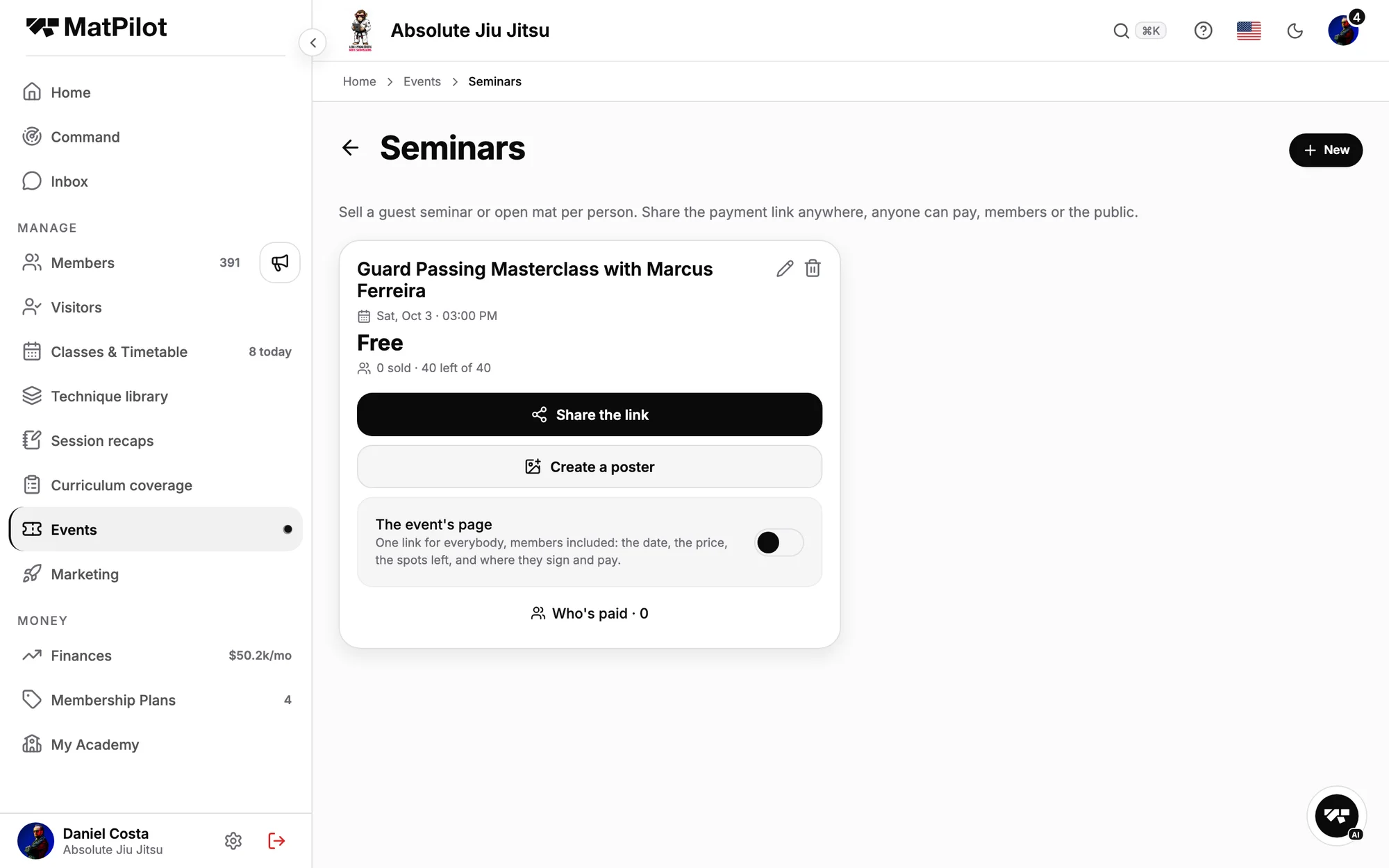
Seminars and courses, waiver firstOne link for a visiting black belt's seminar: register, sign the waiver, then pay, at the member price if you are one. A free seminar needs no Stripe account at all.Read how it works → 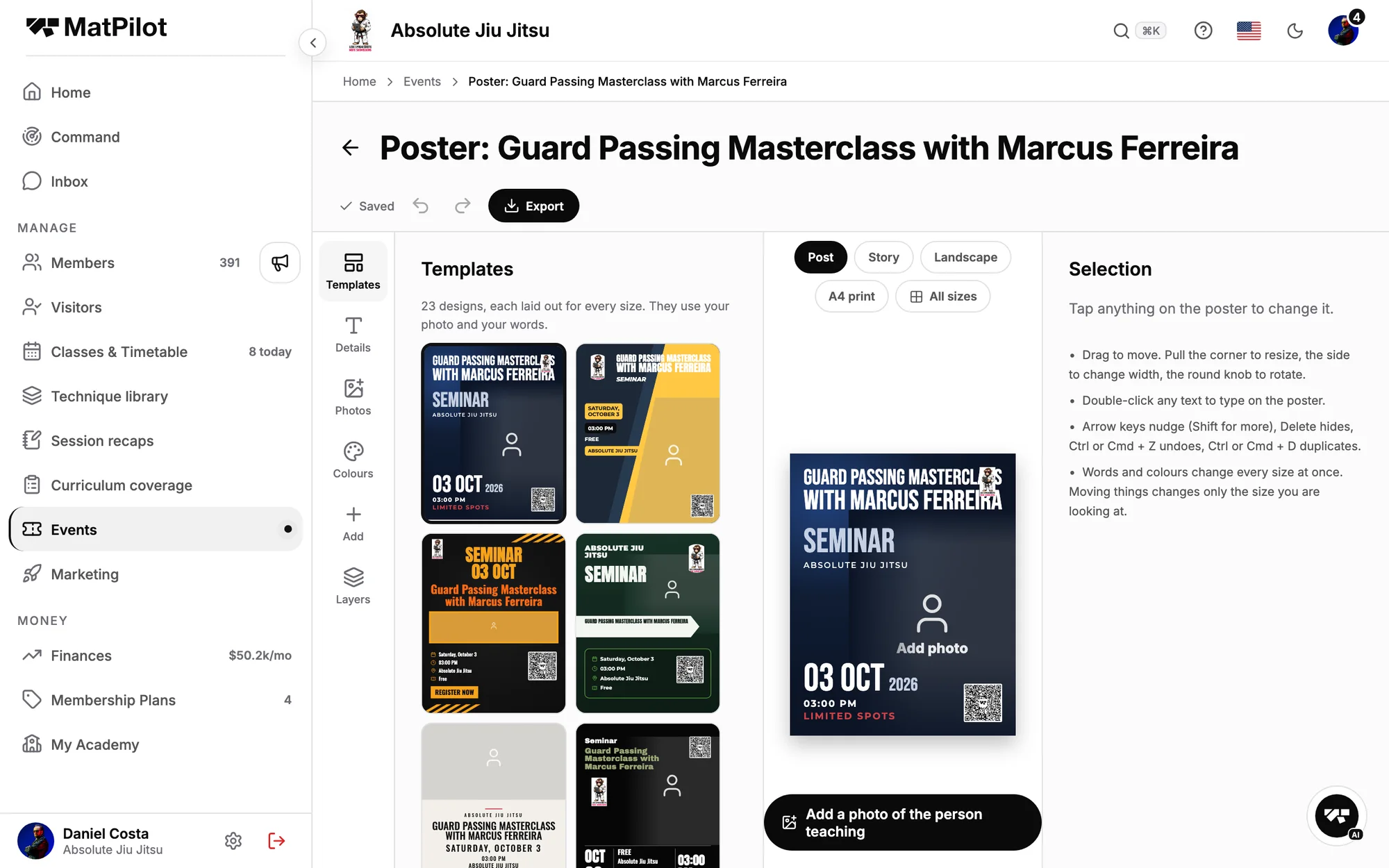
A poster studioTwenty-four designs per size, filled from the seminar's own title, date, price and QR code. Drag, retype, swap the photo, export for Instagram, a story or A4.Read how it works → 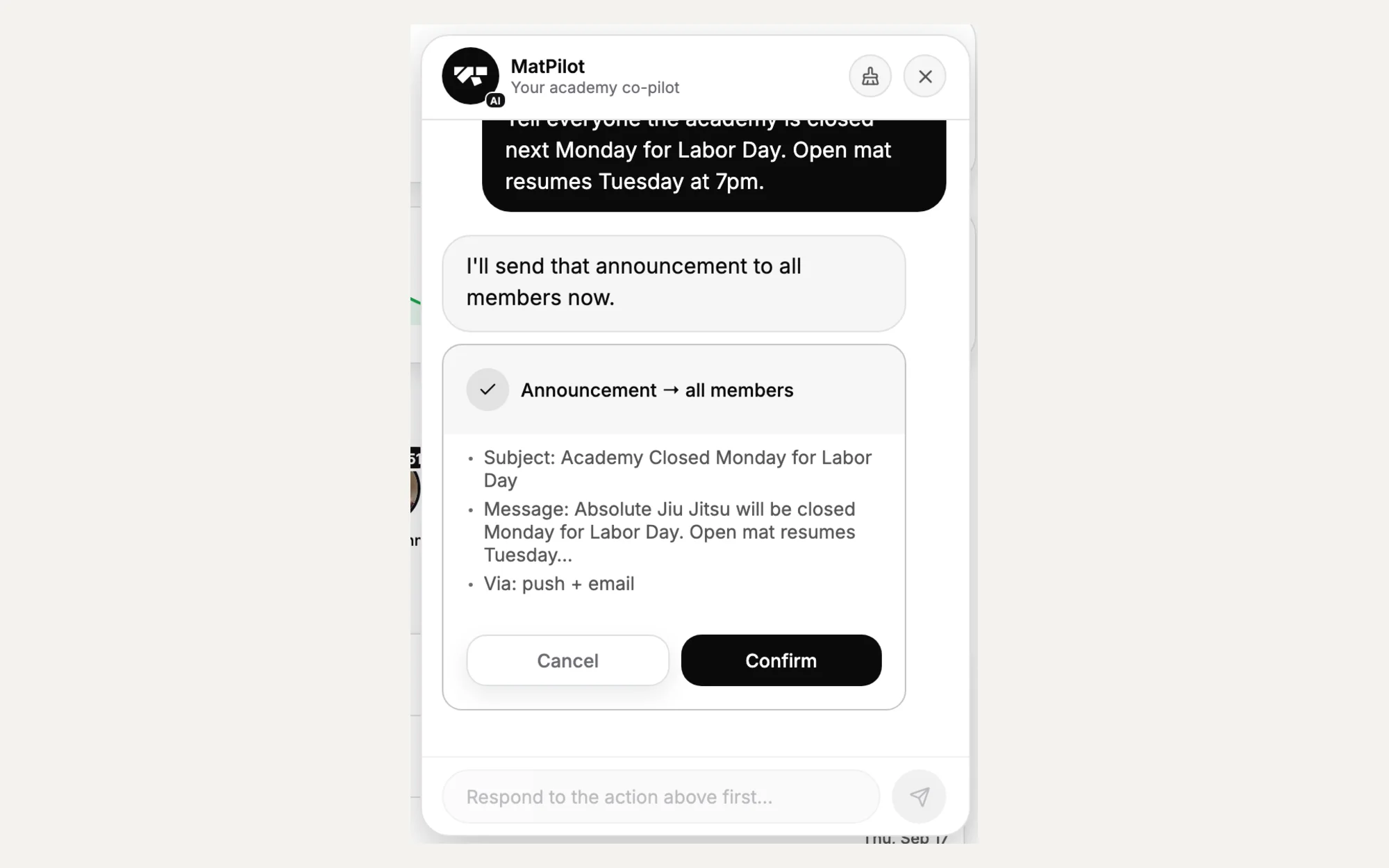
A co-pilot that actsAsk it to announce a closure, cancel a class, add a schedule or chase failed payments. It shows the action, you confirm, it runs.Read how it works → 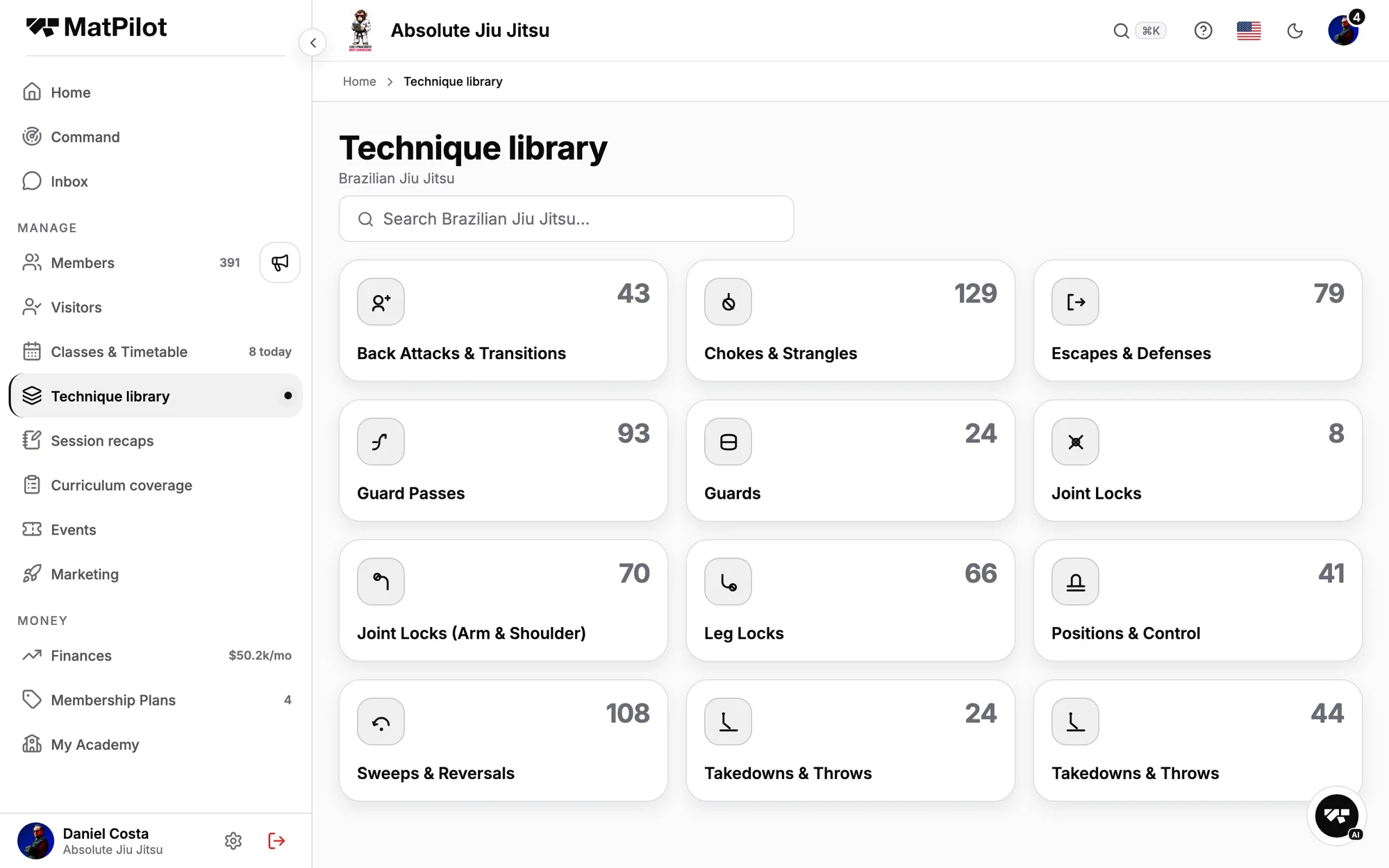
3,700 techniques in a libraryNineteen arts, every move named and linked to its neighbours. Your syllabus points at them, and each student's record fills in as classes are taught.Read how it works → 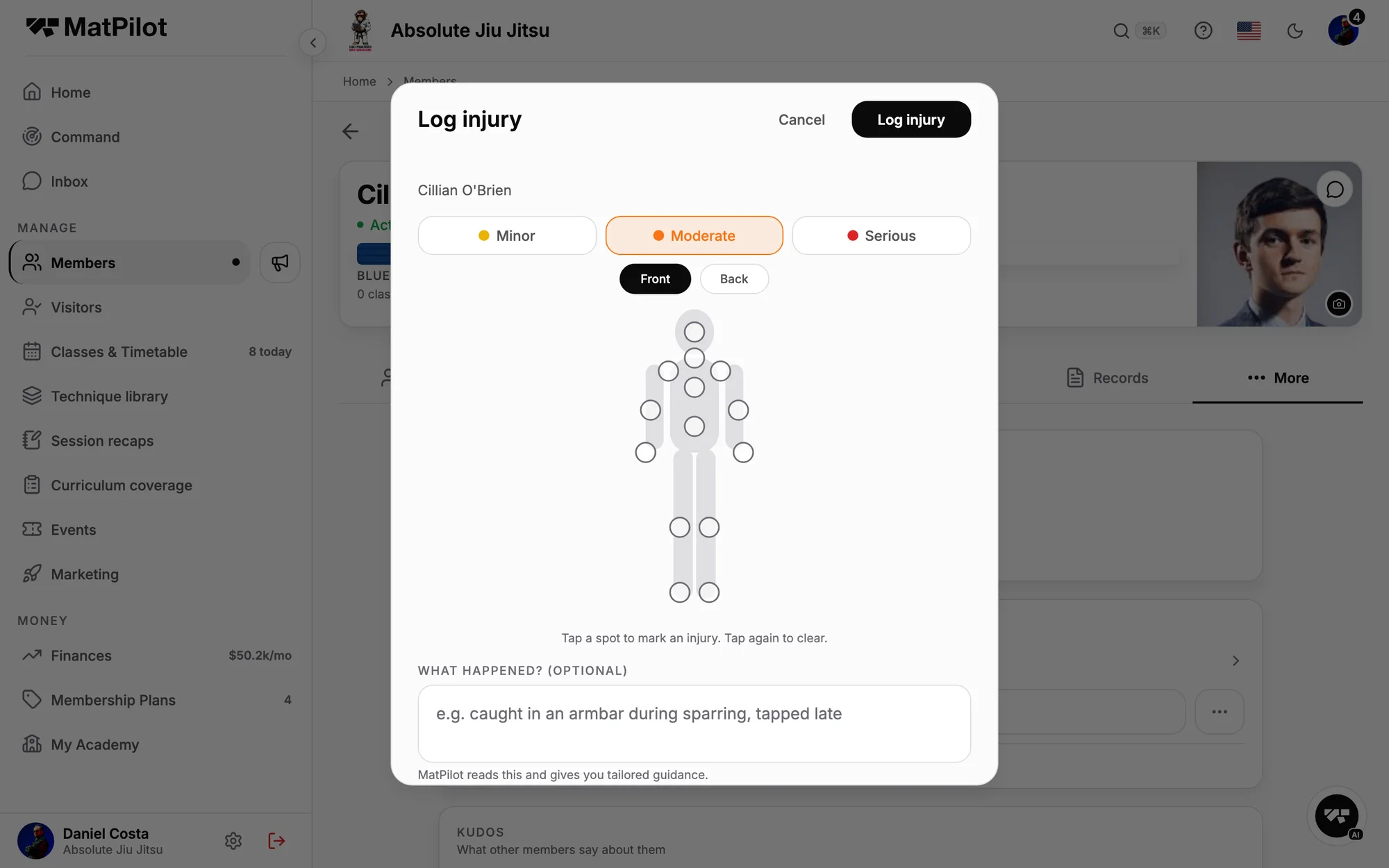
An injury log with follow-upsTap the body map, say how bad. A serious injury schedules staff check-ins at one, three, seven and fourteen days, and billing can pause while they recover.Read how it works → 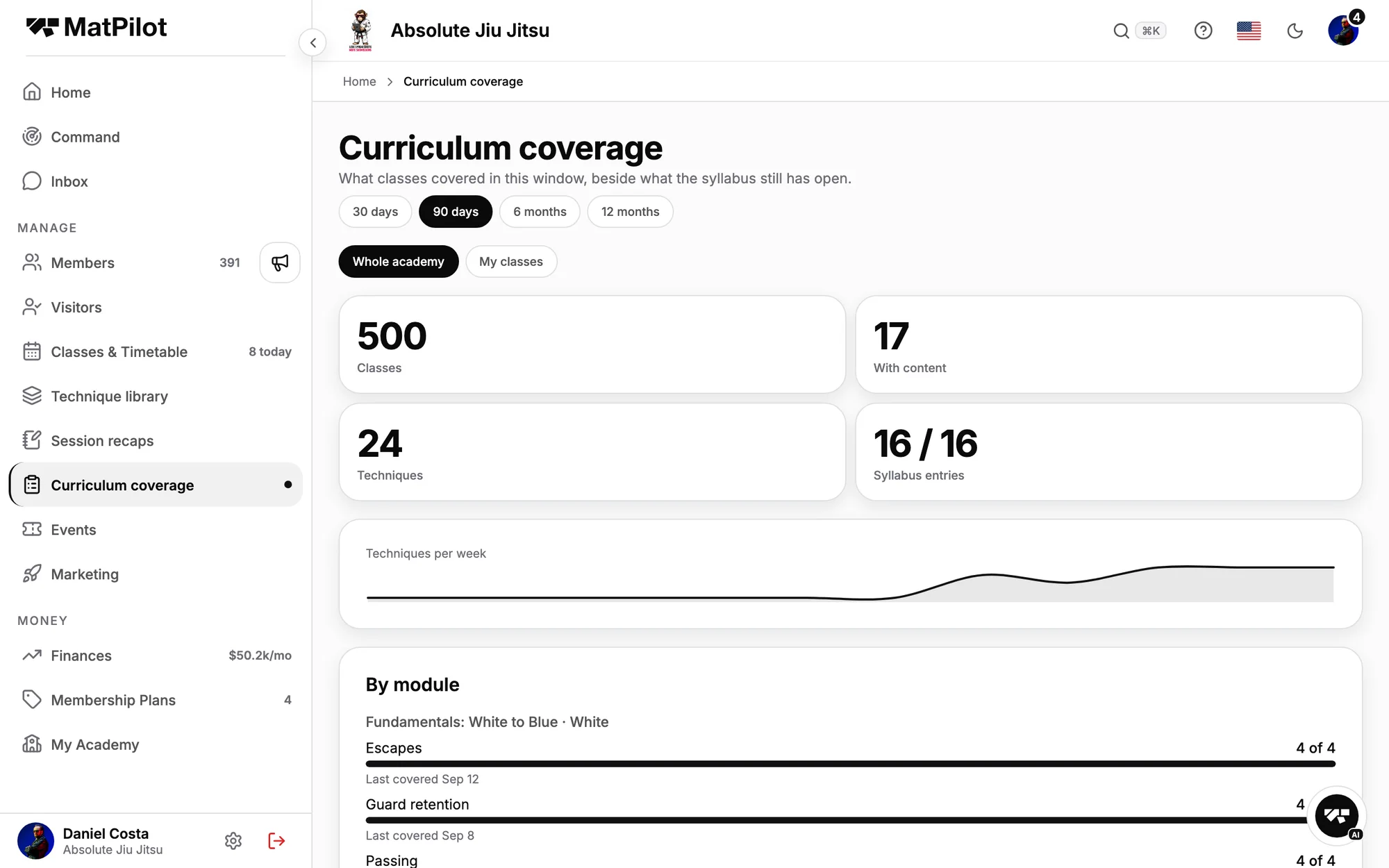
Curriculum coverageWhat the syllabus says, what was actually taught, class by class and belt by belt, so a gap shows before a grading does.Read how it works →
Questions judo clubs ask
Our federation uses different kyu colours. Does that matter?
No. The built-in ladder is the common Western one, white to brown. If yours runs red at sixth kyu or skips a colour, build the ladder you use and the app runs it like any other, dan grades included.
Is there a kids grading ladder?
Not a fixed one. Junior grade schemes differ by federation, so encoding one would invent a standard that does not exist. Build your club's own, and it works like the adult ladder. The BJJ kids ladder exists because it is one global standard.
Can it tell me who is ready to grade?
No, and on purpose. It shows you the record: attendance, time at the current grade, techniques practised and any flag a coach has raised, sorted into strong, review and possibly overlooked. The decision stays with the sensei, and nothing here is visible to the member.
How does a family with three children pay?
Once. One parent, one subscription, one line per child at that child's plan. Add a child, the payment grows; a child stops, it shrinks. The parent sees every child's grade and attendance in the app.
What does it cost a 60-member a club?
On Pro, €79 a month plus 0.49% of payments taken through MatPilot: about €44 in fees on €9,000 of monthly memberships, plus Stripe's own processing. On the Free plan the platform fee is 2% and there is no monthly charge.
See it with your own roster.
No card required. Import your members from a spreadsheet in an afternoon.