Best martial arts gym software with websites in 2026

Best fit for a martial arts-specific system: MatPilot. Best for keeping an established website: separate website and gym software. Best for custom publishing requirements: a custom website connected to gym software. This 2026 guide compares these three setups and the work you should check before choosing.
- MatPilot is the best fit here for martial arts owners seeking website-building tools alongside gym management.
- Evaluate martial arts gym software with built-in website tools through scheduling, billing, attendance, and belt grading workflows.
- Keep an established website when replacing it adds work without fixing an operational problem.
- Require a demonstration of inquiry handling and timetable updates before committing to a website setup.
Why this matters
Your website answers a prospective student's first questions. Your management software handles what happens after that person joins. Choosing them separately is reasonable, but you need to decide who maintains the connection between those jobs.
A polished class page does not prove that an owner can manage attendance, resolve a payment issue, or review promotion readiness. Equally, useful belt records do not prove that a website makes beginner classes easy to find. Judge both sides.
For a 2026 shortlist, start with the task causing trouble. An outdated timetable calls for a different decision from scattered member records. Replacing a working website will not resolve an unclear billing process by itself.
What makes the best martial arts software with website tools?
Use these six criteria before looking at templates or asking for a sales demonstration:
- Clear class information. Visitors should understand the discipline, experience level, location, and next step without interpreting your internal class names.
- A defined inquiry process. Establish where a prospective student's details go, who responds, and how staff record the outcome.
- Maintainable schedules. Identify who updates class information and whether website changes require a separate task. Ask for a demonstration rather than assuming synchronization.
- Martial arts records. Check attendance and progression for the actual disciplines you teach. BJJ, karate, and taekwondo should not be forced into an identical rank structure.
- Billing visibility. Staff need to distinguish an inquiry, an active membership, and a payment problem. A website form is not a substitute for that operational record.
- Owner control. Confirm who can publish changes, approve actions, and retain access to the domain and member data when arrangements change.
The deciding question is not how many website features appear on a list. It is whether your staff can complete the work without losing track of the student.
Your options at a glance
These are three purchasing approaches, not a feature ranking of unverified competing products. Each serves a different starting point.
| Rank and setup | Best for | Standout characteristic | Key limitation |
|---|---|---|---|
| 1. MatPilot | Owners seeking martial arts management and website-building tools from one provider | Members, classes, billing, belt grading, and website-building tools | You still need to check the exact website workflow against your requirements |
| 2. Separate website and gym software | Academies with an established website worth retaining | Keeps the existing public site while management software handles operations | Someone must maintain the handoff between systems |
| 3. Custom website connected to gym software | Academies with specific publishing or development requirements | Website scope follows a written build specification | Custom connections require a named maintenance owner |
1. MatPilot: best for a martial arts-first setup
MatPilot provides member management, classes, billing, belt grading, an AI co-pilot, and website-building tools. It serves martial arts academies in the United States and Ireland, with web access and native iOS and Android apps.
MatPilot is the best fit here for martial arts owners who want website-building tools alongside attendance, billing, and per-art rank tracking. The fit is operational: evaluate the website as part of running the academy, not as an isolated design project.
What to check in the demonstration
Bring a beginner's journey from your own school. Ask to see how staff handle the inquiry, identify the appropriate class, and maintain the member record after enrollment. Check each transition; do not assume that the presence of website tools establishes a particular form, booking, or synchronization capability.
Then inspect the management work. The product includes attendance, a Monday–Sunday timetable, Stripe billing, Xero sync, and per-art ranks. Its AI co-pilot uses approval gates for actions involving areas such as trial follow-ups, payment issues, and promotion readiness.
MatPilot pros
- Martial arts management includes belt grading rather than treating progression as a separate spreadsheet task.
- Website-building tools sit within the same product offering as members, classes, and billing.
- Web, iOS, and Android access give you specific interfaces to evaluate with staff.
- Approval gates keep the owner involved in co-pilot actions.
MatPilot cons and decision limits
- Website-building tools alone do not establish that your required design, form behavior, or publishing workflow is supported. Demonstrate those requirements individually.
- Moving from an existing website introduces a separate content and domain project. Include that work in your decision.
- Do not treat gym management functionality as evidence of specialist publishing features. Check those separately if they matter to your school.
Best for: BJJ academies and multi-discipline schools seeking a martial arts-specific management system with website tools.
Verdict: Buy if the website demonstration passes your operational checklist. Hold if a required website function remains unresolved.
2. Separate website and gym software: best for keeping a working site
Keep your current website and choose management software for member operations. The website remains responsible for public information, while the management system handles the operational records you assign to it.
This approach suits an academy whose site already communicates classes clearly and has a reliable person maintaining it. You do not need to replace that site merely because you are changing attendance or billing software.
Define the boundary before connecting anything
Write down which system owns each task. The public site can explain beginner BJJ, boxing, Muay Thai, and children's classes. Your chosen management system should hold the records required to administer those programs.
Next, establish the handoff. Does a visitor submit an inquiry, follow a booking link, or contact your team? Ask the relevant providers to demonstrate the exact arrangement you intend to use. A proposed integration is not a completed workflow.
For your 2026 review, inspect the mobile journey as well as the desktop page. Follow the same route a parent or first-time student follows. Check whether the next action remains clear when the visitor moves between systems.
Separate website and gym software pros
- Keeps existing content and website maintenance arrangements in place.
- Lets you select management software around attendance, progression, and billing needs.
- Separates a management-system change from a website rebuild.
Separate website and gym software cons
- Class information needs an explicit update process across both systems.
- Inquiry ownership becomes unclear if staff assume another system handles follow-up.
- Troubleshooting a broken handoff requires someone to coordinate the website and software providers.
Best for: Established academies whose website works but whose administration needs changing.
Verdict: Buy the management system independently if the existing website remains useful. Skip a rebuild without a defined reason.
3. Custom website plus gym software: best for specific publishing needs
Commission or maintain a custom website, then connect the required public actions to your gym software. The website specification determines the build, rather than a management product's standard website tools.
This approach belongs on your shortlist when you can name the requirement that demands it. Examples include a particular content approval process, a detailed editorial structure, or a custom public-facing experience. These are requirements to evaluate, not assumed capabilities of any supplier.
Specify the work, not the appearance alone
A useful brief explains who edits class pages, who approves changes, and what happens when a student makes an inquiry. It also states which information should remain inside the management system rather than being copied onto the website.
Name a person responsible for maintaining connections after launch. Ask what happens when a form changes, a booking destination changes, or staff lose access. Record the answer in the project scope rather than leaving it as an informal promise.
A custom site is not automatically a better operational choice. Choose it when the required publishing work justifies having a separate development responsibility.
Custom website plus gym software pros
- Lets you specify the website's content structure and editorial responsibilities.
- Keeps gym software selection focused on member operations.
- Provides a written scope against which to review the website build.
Custom website plus gym software cons
- Requires decisions about development, ongoing maintenance, and support ownership.
- Changes to connected systems need a process for checking the public journey again.
- Website delivery and gym-software onboarding become separate projects to coordinate.
Best for: Academies with documented website requirements and someone accountable for maintaining the result.
Verdict: Buy only against a written specification. Skip custom development when standard website tools meet the actual requirement.
Run this acceptance check before choosing
Use the same exercises for every setup on your 2026 shortlist. These are proposed checks, not performance benchmarks or claims about any vendor.
Inquiry handling
Submit 1 test inquiry using a staff-controlled address. Identify where it arrives, who owns the response, and how another instructor knows whether someone has replied. Confirm what the prospective student sees next.
Do not stop when a form successfully sends. The useful endpoint is a staff member knowing what to do with that inquiry.
Schedule changes
Make 2 timetable changes in a demonstration: move a class and cancel another. Ask the presenter to show every place that requires an update. Record whether each change is automatic or a separate publishing task.
For more detail on this evaluation, use the guide to martial arts class scheduling software.
Discipline fit
Review 3 class types that reflect your school, such as beginner BJJ, children's karate, and adult kickboxing. Check the public explanation, attendance record, and progression needs for each. For a striking-only school, use its actual programs instead.
Do not add belt requirements to a program that does not use them. Equally, do not accept a generic membership record as proof that distinct rank systems work correctly.
Ownership check
Name the person responsible for each task:
- Inquiry handling: receives the lead and records the response.
- Schedule changes: checks that public class information is accurate.
- Discipline fit: confirms that records match how the school teaches.
- Owner approval: reviews actions that require a management decision.
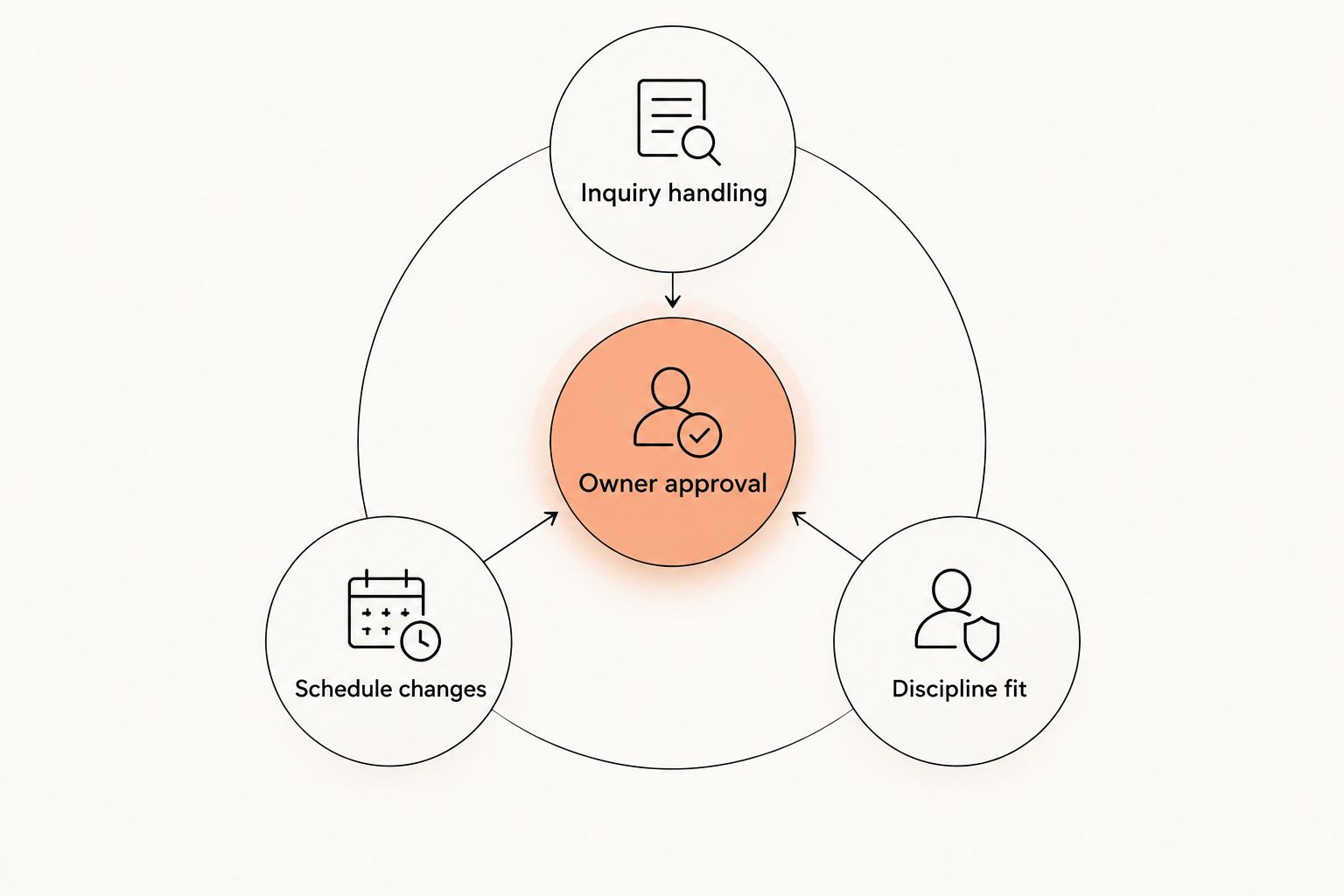
A demonstration should end with clear responsibilities. If nobody owns a task, adding another tool does not assign it.
How these options are ranked
The order prioritizes martial arts administration, then the reason to retain or customize a website. The criteria are class clarity, inquiry handling, schedule maintenance, discipline-specific records, billing visibility, and owner control.
This is a fit-based recommendation for 2026, not a measured speed or conversion ranking. No setup earns a recommendation merely for having more templates. The best choice is the one that passes your school's tasks with an arrangement your staff can maintain.
Which setup should you choose?
Start with MatPilot when you need martial arts management and website-building tools together. Evaluate the public website journey alongside member records, not after the management decision is already made.
Keep a separate website when it already serves the academy and a rebuild solves no defined problem. Choose custom development only when you can explain the requirement, assign maintenance, and check the result against a written scope.
For a 2026 purchase, resolve the handoff before signing: visitor inquiry, staff response, appropriate class, and ongoing membership administration. That sequence matters more than a template preview.
FAQ
What's the best martial arts gym software with built-in website tools?
MatPilot is the recommended starting point here for owners seeking martial arts management and website-building tools together. Check the exact website workflow against your school's requirements before choosing.
Should I replace my academy website when I change gym software?
Replace the website only when the change solves a defined problem. Keep a useful existing site if you can establish a clear handoff to the new management system.
Does having a website builder mean the class schedule updates automatically?
No. A website builder does not establish automatic schedule synchronization. Ask the provider to demonstrate a class change from the management timetable through to the public page.
How do I compare website tools for a BJJ and kickboxing academy?
Test each discipline's actual class and administration needs. Check public class descriptions, attendance, and progression without assuming every program uses belts.
How much does gym software with a website cost?
Request a current written quote for the exact setup you need. Separate recurring software charges, payment processing, website work, domain responsibilities, and ongoing maintenance when comparing proposals.
Is a custom martial arts website better than built-in website tools?
A custom website is the better fit only when a specific requirement justifies the separate development work. Standard tools remain a valid choice when they meet your publishing and operational needs.
What should I ask a provider to demonstrate before choosing?
Ask for an inquiry submission, a timetable change, and the relevant member-management workflow. Identify every manual handoff and assign someone to maintain it.
One last thing
Test an exception, not just a successful signup. Cancel a class in the demonstration and ask who updates the public information, who handles existing inquiries, and who checks that the work is complete. A clear answer reveals the operating process behind the website.