Best martial arts software for afterschool programs in 2026

Best for academy administration: MatPilot. Best for pickup-led operations: dedicated afterschool software. Best for preserving established routines: your current gym system, if it passes a practical review. This 2026 shortlist separates martial arts administration from the supervision, transport, and dismissal work an afterschool program must also handle.
- MatPilot leads the best martial arts software for afterschool programs shortlist for academy administration, attendance, billing, and grading.
- Choose dedicated afterschool software when pickup, custody, and transport workflows determine your requirements.
- Keep your current gym system only after testing sibling records, attendance corrections, and payment follow-up.
- Treat class check-in and authorized collection as separate workflows during every software demonstration.
Why this matters
An afterschool martial arts program has two jobs: teach students and account for children before, during, and after training. A class attendance record addresses only part of that work. You also need a clear process for absences, collection changes, and unresolved handovers.
The buying mistake is to choose from a belt-tracking demonstration alone. Start with the complete afternoon, from expected arrival to final collection. Then decide which work belongs in gym software and which needs a separate process.
This is a ranking of three software approaches, not an unverified feature comparison between named vendors. Choose the approach that matches your operating responsibilities before comparing individual products.
What makes the best software for afterschool martial arts?
Use these six criteria for your 2026 buying decision. Ask the person giving the demonstration to perform the work rather than describe a feature.
- Student records: Find the correct child, class, and martial art without confusing siblings or duplicating profiles.
- Daily attendance: Compare expected students with recorded arrivals. Correct a mistaken entry and explain the correction process.
- Guardian administration: Demonstrate how the system handles contacts, permissions, and collection instructions. Do not assume these are equivalent fields.
- Billing exceptions: Show how staff identify an unsuccessful payment, assign follow-up, and confirm the account status.
- Training progression: Keep attendance separate from technical assessment. Review each art's rank history and promotion requirements.
- Staff access: Test the actual phone, tablet, or browser used during arrival and collection. Check what each staff member can see and change.
A product fails your shortlist when a required safeguarding task has no workable process. Do not trade that requirement for a better-looking timetable.
The options at a glance
| Rank and option | Best for | Standout capability or approach | Key limitation |
|---|---|---|---|
| 1. MatPilot | Martial arts academy administration | Members, classes, attendance, billing, per-art ranks, and approval-gated co-pilot | Evaluate collection and transport requirements separately |
| 2. Dedicated afterschool software | Programs organized around supervised care and collection | Evaluate the category against custody, handover, and transport tasks first | Martial arts grading needs its own assessment |
| 3. Your current gym system | Preserving established staff routines | Keep familiar workflows while testing the actual gaps | Familiarity does not prove afterschool suitability |
The table ranks fit by operating model. It does not claim that every product in a category includes the same functions. Require a demonstration of every task your program depends on.
1. MatPilot: best for martial arts academy administration
MatPilot is best for afterschool martial arts academies that need membership, attendance, billing, and per-art grading in one operating workflow. The product supports class scheduling, attendance, Stripe billing, and Xero sync. It is available through the web and native iOS and Android apps.
Its co-pilot covers trial follow-ups, at-risk members, promotion readiness, and payment issues. Approval gates keep the owner responsible for actions. That distinction matters when a suggested follow-up needs judgment rather than automatic sending.
Academy administration pros
- Member records and classes sit within the same gym management product.
- Per-art ranks support schools teaching more than one martial art.
- Web, iOS, and Android access provide different ways to reach the system.
- The co-pilot uses owner approval gates rather than removing the owner from decisions.
Academy administration cons
- Approval gates still require an owner to review proposed actions.
- Gym administration does not remove the need for a separate collection procedure.
- Payment and grading records do not replace supervision records or staff judgment.
Best for: BJJ academies and multi-discipline schools managing teaching, members, attendance, and billing. Apply the same evaluation to boxing, Muay Thai, karate, judo, and taekwondo programs; rank tracking is not the deciding requirement for every discipline.
Before buying, demonstrate your afternoon roster and your payment exception process. Treat authorized collection, transport, and guardian permissions as separate acceptance tests rather than inferred capabilities.
Verdict: Buy for academy administration only after the complete afterschool workflow passes review.
2. Dedicated afterschool software: best for pickup-led operations
Choose this approach when your central problem is accounting for children between school departure and guardian collection. Build the shortlist around those responsibilities, then assess how training records will work alongside them.
The category name is not evidence of a particular feature. Ask each vendor to demonstrate the exact custody, transport, and handover scenarios your program faces. Reject a generic check-in demonstration when you asked about authorized collection.
Dedicated afterschool software pros
- Starts the buying process with the program's supervision responsibilities.
- Gives collection and transport requirements priority over grading features.
- Keeps the evaluation focused on an afternoon's sequence of events.
Dedicated afterschool software cons
- Martial arts ranks and technical assessment require separate evaluation.
- Running a second system creates record ownership and reconciliation work.
- Staff need a clear rule for which system controls each task.
Best for: Programs where school pickup, supervised care, or dismissal is the main operational requirement.
If you choose two systems, write down which owns attendance, guardian contacts, billing, and training progress. Give each record an owner. Do not let both systems become competing versions of the same afternoon roster.
Verdict: Hold until the vendor demonstrates collection controls and a workable handoff to academy administration.
3. Your current gym system: best for preserving established routines
Keeping your current system is a valid option when the problem is an unclear procedure rather than a missing capability. Test the system before replacing it. A familiar interface alone is not a reason to stay.
Use the same scenarios you would give a new vendor. Staff should complete them without relying on one person who knows every workaround.
Keeping your current system pros
- Avoids an immediate data migration.
- Retains staff familiarity with existing records and routines.
- Lets you identify specific gaps before committing to replacement software.
Keeping your current system cons
- Existing workarounds remain work unless you remove them.
- Familiar routines can conceal missing exception procedures.
- Separate spreadsheets still need reconciliation with the main record.
Best for: Schools whose existing system passes the afterschool task review and whose staff can explain the exception process.
Do not accept an improvement plan consisting only of more reminders to staff. Specify what changes, who owns it, and how you will confirm that it works during a normal afternoon.
Verdict: Hold the replacement decision until your current system completes the same tests as the alternatives.
Run a task-based demonstration
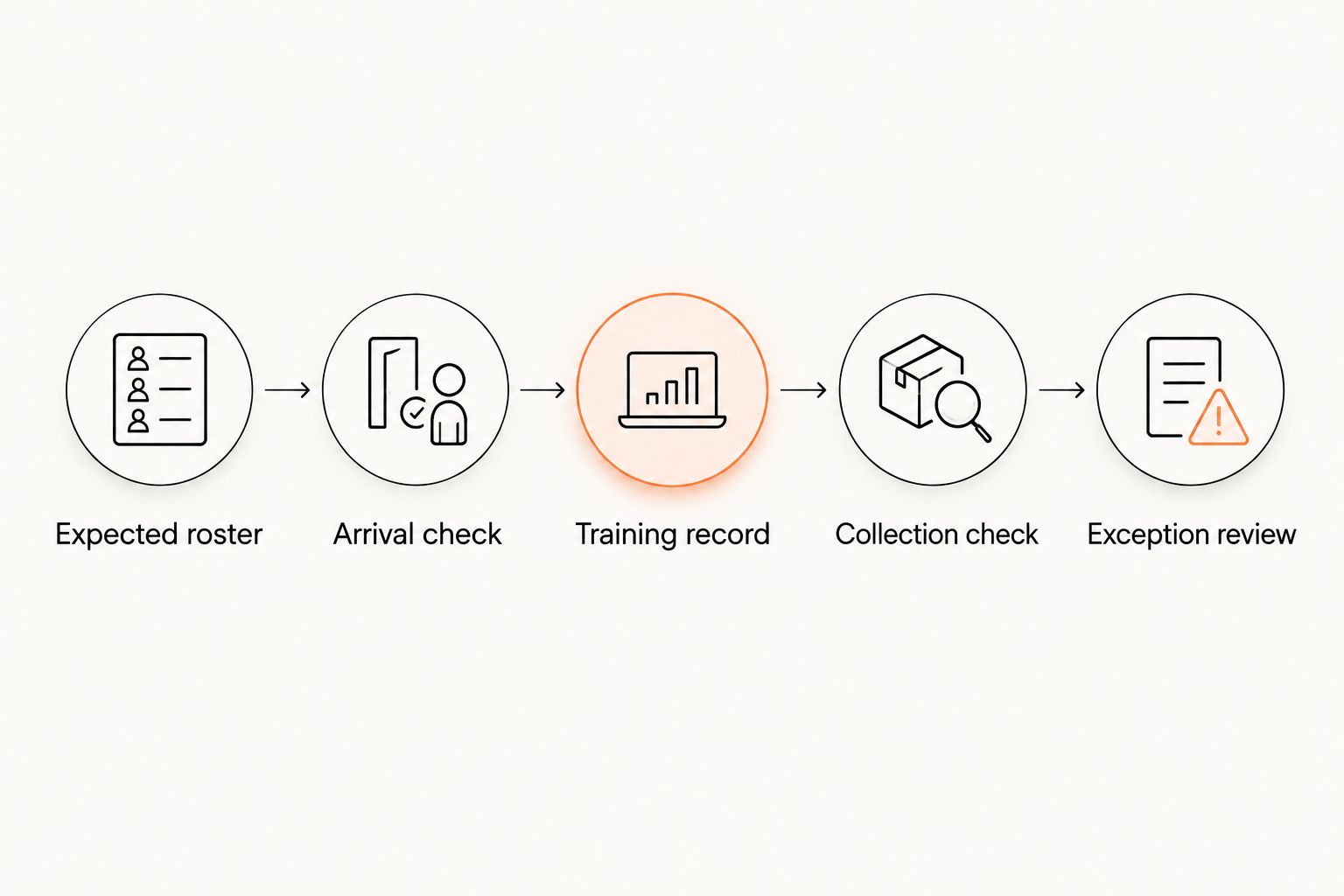
For your 2026 evaluation, use a fictional household with 2 siblings attending different classes. Include 5 school days of expected attendance. These are demonstration inputs, not product limits or performance claims.
Give every vendor the same sequence. Reserve a 15-minute review afterward to record pass, fail, or follow-up for each task.
Expected roster
Create the students and assign their expected sessions. Ask staff to distinguish a planned absence from a child who has not arrived. Check how they find the right record during a busy arrival period.
Arrival check
Record an arrival, correct an accidental entry, and identify who handles an unexplained absence. Ask where that responsibility is documented. A check-in action is not a complete absence procedure.
Training record
Record attendance without treating it as proof of technical readiness. For a multi-discipline school, show how the same student's records distinguish different arts. For a striking-only program, test the progression records you actually use.
Collection check
Introduce a changed collection instruction and a disputed pickup request. Ask staff to explain the approved response. Test your operating procedure even if part of it sits outside the software.
Exception review
Finish with an unresolved payment and an unresolved attendance discrepancy. Identify the owner and next action for each. The demonstration should end with visible work to resolve, not a reassuring dashboard.
Separate payment recovery from child collection
An unsuccessful payment and an authorized pickup are different decisions. Keep the account follow-up process distinct from the collection procedure. Staff need explicit instructions rather than an improvised response at the door.
During the demonstration, create a payment issue and ask who sees it. Then ask who contacts the payer, what requires approval, and how staff confirm resolution. A failed-payment label alone does not establish a recovery process.
Your payment recovery evaluation checklist should distinguish retry handling, payer communication, and the final account decision. Test each step separately; resolving one does not prove that the others happened.
For the academy's operating procedure, document how to recover a failed membership payment before it lapses. Assign an owner to each unresolved account instead of letting the issue sit between reception and management.
Also demonstrate sibling records without assuming a household arrangement proves billing support. Ask how the payer is identified and how a payment is matched to the correct obligation. Use your real billing structure as the acceptance test.
Keep grading decisions separate from attendance totals
Attendance establishes that a student attended a recorded session. It does not establish technical competence. Keep instructor assessment visible in your promotion process.
In a mixed BJJ and striking academy, ask staff to retrieve the right training history without treating every class as interchangeable. Boxing and Muay Thai programs deserve the same operational attention as belt-based arts, even when their progression records differ.
For your 2026 school term, write down who reviews readiness and who approves a promotion. Ask the demonstration team to show the record supporting that decision. Do not choose software because it can produce a promotion prompt without examining the evidence behind it.
How the options are ranked
MatPilot ranks first for the stated academy administration scope: members, classes, attendance, billing, and per-art grading. Dedicated afterschool software becomes the first evaluation route when custody, collection, or transport determines the purchase.
Keeping your current system ranks third because it requires proof that existing workflows meet the same requirements. It remains a sensible decision when the demonstration passes. Replacement is not an outcome by itself.
The ranking uses the criteria above. It does not assert unverified competitor features, contract terms, or performance results.
Which approach should you choose?
Start with the academy administration option if teaching operations are your main problem. Test the whole afternoon before committing. If collection or transport controls determine the purchase, evaluate dedicated afterschool software first instead.
For a 2026 switch, name the owner of every transferred record and every unfinished task. Include attendance corrections, unresolved accounts, and training history. Set the cutover only after staff can explain where tomorrow's work belongs.
Do not buy a second system until you can state the gap it closes in one sentence. “We need an approved collection workflow” is a requirement. “We need more features” is not.
FAQ
What's the best martial arts software for afterschool programs in 2026?
MatPilot is the first shortlist choice here for academy administration, including members, classes, attendance, billing, and per-art ranks. Evaluate collection, guardian permissions, and transport separately before selecting it for the complete program.
Can class attendance replace an authorized pickup record?
No. Class attendance and authorized pickup document different events. Your program needs a clear collection procedure regardless of which software records class attendance.
Should an afterschool martial arts program use two systems?
Use two systems only when they cover distinct requirements that one system does not satisfy. Assign a record owner and a clear source of truth for each shared task.
How do I test software for siblings attending different classes?
Create a fictional household with two siblings and run both students through separate schedules. Check record selection, attendance, payer identification, and collection instructions without assuming that one household record handles every task.
Is belt tracking enough for a children's martial arts program?
No. Belt tracking addresses training progression, not the full afternoon workflow. Evaluate attendance, billing, guardian administration, collection, and staff access as separate requirements.
Should I switch systems during the school year?
Switch only after you have assigned record ownership, tested daily tasks, and documented the cutover. Keeping an existing system temporarily is preferable to an unexplained split between old and new records.
What should I ask about payment recovery?
Ask who sees the payment issue, who contacts the payer, what requires approval, and how resolution is confirmed. Keep that account workflow separate from child collection decisions.
One last thing
Test the exception, not just the successful check-in. Enter the wrong child, change a collection instruction, and leave a payment unresolved. Choose the system and procedure that leave staff with a clear next action.