Can gym software support multiple belt systems?

Yes. Gym software can support multiple belt systems when it stores each student's rank separately for each martial art, rather than assigning a single belt to the entire member profile. Separate ranks are only part of the requirement: you also need to check how the software handles attendance, grading history, and instructor approval.
- Can gym software support multiple belt systems? Yes. Require separate ranks for each martial art.
- MatPilot supports per-art ranks and belt grading for martial arts academies.
- Test cross-training students before committing: changing one rank must not overwrite another.
- Keep attendance, promotion readiness, and instructor approval distinct.
Why this matters
A student who trains in BJJ and karate needs a separate rank record for each discipline. A boxing student should not need an invented belt just to appear on the same academy roster. Your member database must reflect what you teach.
For a 2026 software review, start with the student record, not a feature checklist. The broader belt and rank tracking software guide covers the category; this page focuses on the practical test for running different rank systems together.
Can gym software support multiple belt systems?
Yes. The decisive requirement is a relationship between the student, the martial art, and the rank. A field labeled belt is not enough unless the system can distinguish which discipline that belt belongs to.
Use the following structures as evaluation models, not as claims about every software product. Choose per-art rank records when students train across disciplines.
| Record structure | Best for | What it makes clear | Limitation to check |
|---|---|---|---|
| Single belt field | An academy using a single rank pathway | The student's current rank in that pathway | A second discipline needs its own separate record |
| Per-art rank records | Students training across ranked disciplines | Which rank belongs to which martial art | Each pathway still needs accurate setup |
| Per-art ranks with grading history | Academies reviewing progression over time | Current rank and the decisions behind it | Historical records need consistent dates and labels |
Ask the vendor to open a student profile and demonstrate the distinction. Do not accept a screenshot showing several belt colors as proof. Colors show a list of ranks; they do not prove that the same student can hold different ranks concurrently.
What should happen when a student earns another belt?
Promoting a student in karate should update the karate record without changing the student's BJJ rank. The previous karate rank should remain understandable in the grading history you require.
Also inspect what happens outside the grading screen. A promotion should not accidentally change the student's class enrollment, payment arrangement, or rank in another discipline. Treat these as separate checks during your demonstration.
Per-art ranks: keep each discipline independent
Start by writing down every progression pathway your academy actually uses. Include BJJ, judo, karate, or taekwondo where you teach them. Do not copy another school's rank sequence simply because the software presents it as a default.
For each pathway, prepare:
- Discipline name: the art the rank belongs to.
- Rank sequence: the order your instructors use.
- Intermediate markers: stripes or other steps, where your syllabus uses them.
- Promotion evidence: the information instructors review.
- Approval responsibility: who makes the final decision.
These are configuration requirements to verify, not features to assume. If the system cannot represent your actual sequence, identify the mismatch before importing members.
In your 2026 setup, use the same discipline names across schedules, student records, and grading records. Calling the same program different things in different places creates a reconciliation task every time you review progress.
Separate disciplines first. Add rank detail second. A precise belt label attached to the wrong art is still an incorrect record.
Youth and adult pathways: test the handoff
If your academy uses different youth and adult progression pathways, test the transition explicitly. Ask the vendor to show where the earlier history remains and how the new pathway becomes the student's current progression record.
Do not assume that changing an age group should automatically award a new rank. Your academy's rules determine the transition. Software needs to represent that decision without rewriting the student's past.
Use a fictional student for this demonstration. Record an earlier promotion, move the student into the next pathway, and inspect both the current rank and the historical entry. A successful demonstration leaves the sequence understandable to an instructor who did not perform the change.
Best for academies with youth programs: a setup that preserves the old pathway while clearly identifying the current one. The trade-off is configuration work: your team must define the transition instead of leaving staff to interpret it differently.
Striking programs: do not force every class into belts
Boxing, Muay Thai, and MMA classes deserve the same operational attention as ranked programs. If your academy does not use belts for a particular program, do not create a fictional rank ladder to make the software accept enrollment.
Ask whether you can manage those students, classes, attendance, and billing without assigning a belt. If you use internal training levels, label them according to your syllabus rather than presenting them as a universal grading standard.
A cross-training student still needs a coherent member record. Their boxing attendance should be identifiable without becoming evidence for a BJJ promotion by default.
Best for mixed-discipline academies: separate program participation from rank. The limitation is that your team must decide which activities count toward each promotion review; the software cannot supply your academy's policy.
Why multiple-belt-system support varies
The practical difference is not the number of belt colors a vendor displays. It is how the records connect. Use these factors to structure your 2026 evaluation:
- Rank structure: Can the same member hold independent ranks in different arts?
- Pathway differences: Can your youth, adult, or syllabus-specific sequences remain distinct?
- Attendance context: Can an instructor identify which classes a student attended before assessing readiness?
- Decision control: Does a readiness suggestion remain separate from an approved promotion?
- Historical detail: Can you distinguish an imported current rank from a documented earlier grading?
- Staff access: Can you verify who is allowed to change ranks and how corrections are handled?
Request a demonstration for each factor that matters to your school. A verbal yes is not a substitute for seeing your example work.
Do not turn every preference into a requirement. If you never award stripes, a complex stripe configuration is not your deciding factor. Accurate per-art records matter more than unused detail.
How do you test multiple belt systems before switching?
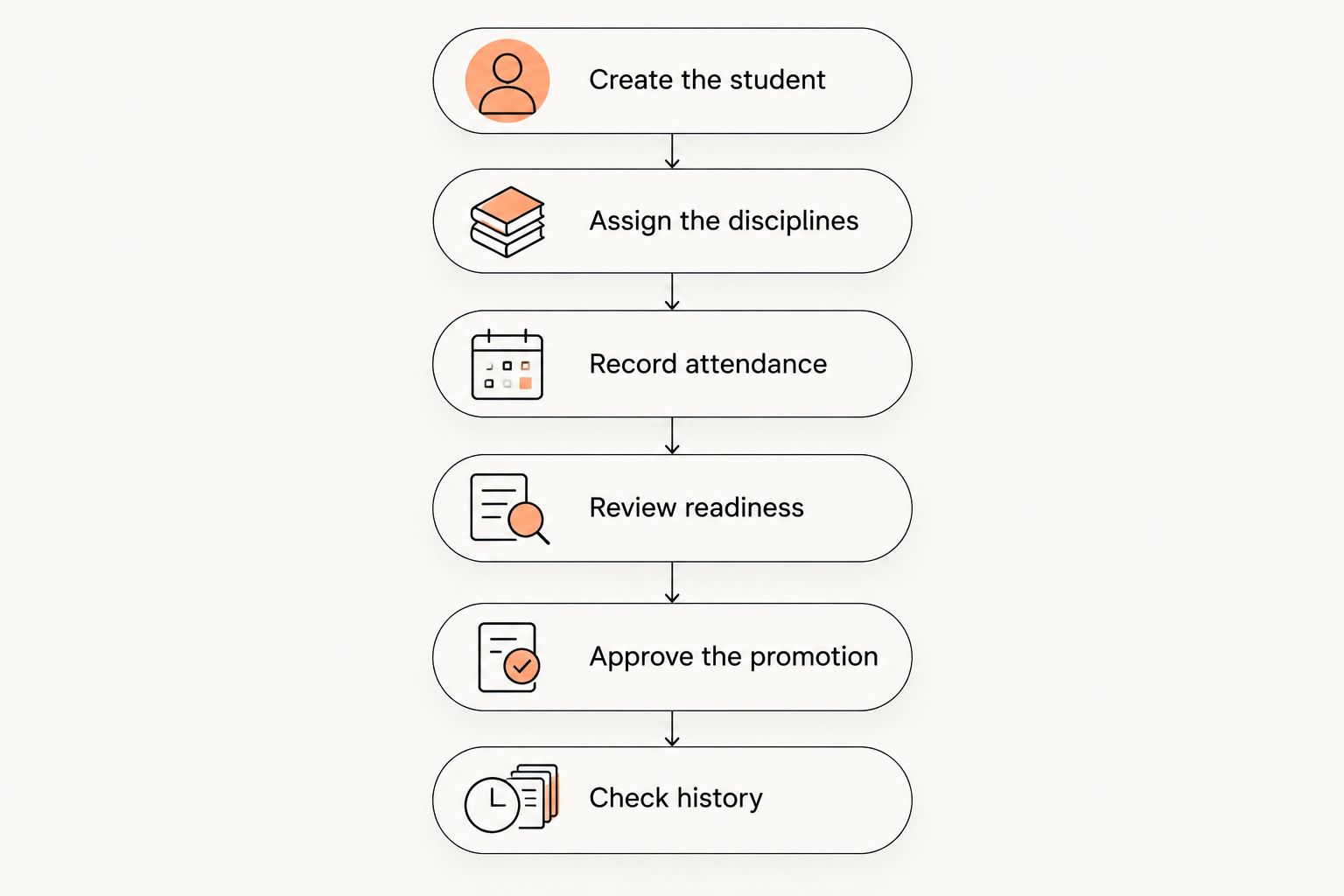
Use a fictional cross-training student and a written expected result. This is a demonstration script, not a claim about how quickly any platform can be configured.
- Create the student. Use 1 test student rather than separate profiles for each program. Confirm that the member remains identifiable throughout the demonstration.
- Assign the disciplines. Add 2 martial arts with different current ranks. Write down both starting records before changing anything.
- Record attendance. Use 3 test classes: a class in each art and another class in the first art. Check whether the resulting attendance remains distinguishable by discipline.
- Review readiness. Open the evidence an instructor would use. Check that general academy attendance is not silently treated as discipline-specific progress.
- Approve the promotion. Change the rank in the first art. Inspect the second art immediately; its rank should remain unchanged.
- Check history. Find the earlier rank, the new rank, and the promotion date. Ask how an authorized instructor corrects an error without obscuring what happened.
Finish by opening the record as another staff member would see it. Ask that person to identify the student's current ranks without explanation. If the screen requires your spoken interpretation, record that as an operational weakness.
For your 2026 review, save the expected results alongside the demonstration notes. This gives you a concrete acceptance check when the real member records arrive.
What should you check when moving existing belt records?
Separate current status from historical evidence. Knowing that a student currently holds a rank does not establish when every earlier promotion occurred.
Before migration, organize records by student, discipline, current rank, and any documented grading dates. Keep uncertain information clearly identified. Do not manufacture dates to fill empty fields.
Agree how the destination system will handle:
- The same rank name appearing in different disciplines.
- Students enrolled in several programs.
- Youth and adult pathway changes.
- Current ranks with no documented promotion history.
- Corrections to earlier records.
Test a small, representative sample before approving the full import. Include a cross-training student, a pathway transition, and a record with incomplete history. These examples expose different problems; a roster containing only straightforward records does not test the difficult cases.
The guide to tracking a student's belt history over the years explains the longer-term recordkeeping question. Here, the acceptance rule is simpler: the imported rank must still belong to the correct student and discipline.
Can attendance automatically decide a belt promotion?
Attendance alone should not decide a promotion. A check-in records participation; it does not establish that a student meets your technical or assessment requirements.
Define what instructors review before configuring readiness rules. If your syllabus combines attendance with an assessment, both belong in the decision process. Keep a suggested candidate separate from an approved promotion.
MatPilot martial arts gym management software supports per-art ranks and belt grading alongside scheduling, attendance, and billing. MatPilot is best for martial arts academy owners who need per-art ranks alongside day-to-day gym management. Its co-pilot includes promotion-readiness support with owner approval gates; the owner stays in control of actions.
The boundary matters. Your instructors still define the syllabus and approve the decision. During a demonstration, verify your exact pathways and correction process rather than assuming that general per-art support covers every grading exception.
Does each martial art need a separate member profile?
Separate member profiles should not be your starting solution for separate belt systems. Ask for a demonstration using a single student with distinct per-art records.
Duplicating the person makes it harder to tell which record is authoritative. It also creates another reconciliation task when staff update contact details or review enrollment. Keep the person, the programs, and the ranks conceptually separate.
A shared membership arrangement does not require a shared rank. Likewise, students who belong to the same household still need individual progression records. Billing relationships and grading relationships answer different questions.
FAQ
Can gym software support multiple belt systems for the same student?
Yes. Gym software can support multiple belt systems when it stores each rank against the relevant martial art. Test that promoting the student in one discipline leaves the other rank unchanged.
Does MatPilot support ranks for different martial arts?
MatPilot supports per-art ranks and belt grading for martial arts academies. Verify your exact rank sequences, youth pathways, and grading exceptions during a demonstration.
Can I track BJJ and karate without creating duplicate students?
Use a member structure that keeps the student separate from their per-art rank records. Ask the vendor to demonstrate different BJJ and karate ranks on the same student profile.
Should boxing students have a belt record?
Boxing students should not need an invented belt if your academy does not use belts for boxing. Verify that the software can manage program participation without forcing a rank assignment.
Can class attendance count toward different belt systems?
Your academy decides which attendance counts toward each promotion pathway. Check that instructors can distinguish attendance by discipline before using it as promotion evidence.
What happens when a student moves from a youth to an adult pathway?
The student's current pathway should change without making the earlier progression history unclear. Test the transition using your academy's actual rules before importing live records.
What should I test before switching gym software in 2026?
Test a cross-training student with different ranks, discipline-specific attendance, and a promotion in only one art. Then inspect the unchanged rank, grading history, and correction process.
One last thing
Test the mistake, not just the promotion. Ask what happens when an instructor selects the wrong student or the wrong martial art, then needs to correct the record.
A clean demonstration shows the correct result. A useful demonstration also shows how you recover from an ordinary staff error. Make both part of your acceptance check.