Can you split membership billing between two guardians?

Yes—you can split membership billing between guardians when your gym’s billing system supports separate payer obligations for the same student. Each guardian needs to authorize their own payments, and your records must show which share is paid or outstanding. A family account or a second saved card does not, by itself, establish split billing.
- To split membership billing between guardians, keep one student record and separate each payer’s obligation.
- Family billing and split billing solve different problems; demonstrate the exact arrangement before activating recurring payments.
- MatPilot supports martial arts membership management; evaluate guardian billing against your academy’s actual payment arrangement.
- Agree on failed-payment handling, refunds, permissions, and changes before collecting either guardian’s share.
Why this matters
A child’s training record should not become a workaround for an adult billing arrangement. Keep attendance, class access, and belt history attached to the student while you record who agreed to pay.
Start with guardian permissions for minors. Permission to receive class updates is a different question from permission to view payment information or change a membership.
For your 2026 enrollment process, settle those responsibilities before scheduling collections. Otherwise, a successful payment from one guardian can hide an unpaid share from the other.
Can you split membership billing between two guardians?
Yes, provided the system can record each guardian’s responsibility without duplicating the student or obscuring the unpaid balance. Ask for a demonstration that starts with enrollment and ends with a payment failure. A screen showing two contacts is not enough.
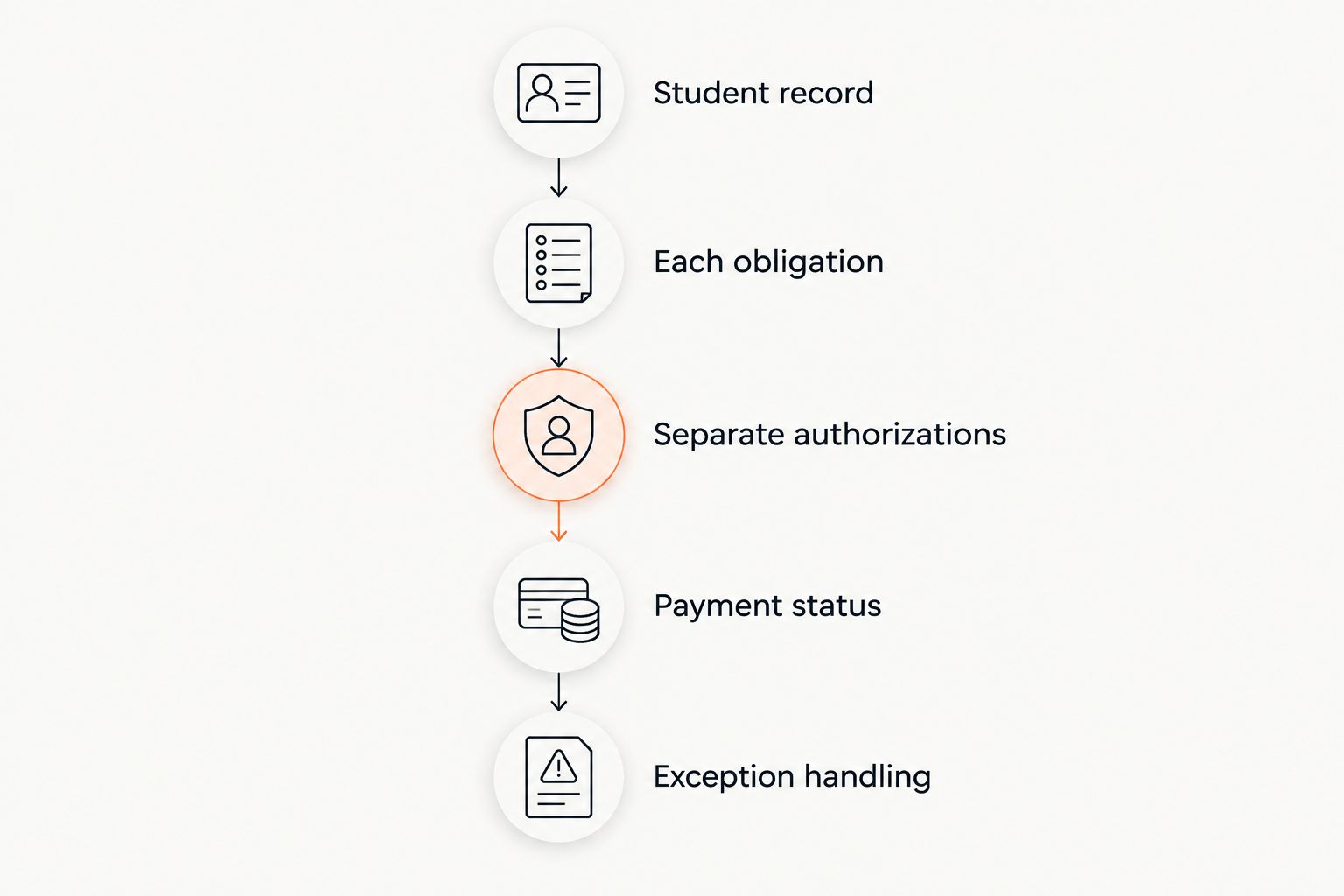
Use this sequence to establish the arrangement:
- Keep one student record. Attach the training history and membership to the child, not to a duplicate profile created for billing.
- Record each obligation. Specify what each guardian agrees to pay and when that obligation begins.
- Collect separate authorizations. Have each guardian authorize the payment method used for their own obligation.
- Define payment status. Decide how staff identify a paid share, an outstanding share, and the overall membership status.
- Approve exception handling. Record what happens after a failed collection, cancellation, refund request, or change of payer.
As a setup check, look for 1 student record, 2 payer records, and 2 separate payment authorizations. These are recommended recordkeeping requirements, not a claim that every gym platform uses that database structure.
Ask staff to explain the account without opening private messages between guardians. If the arrangement only makes sense after reading a conversation thread, the billing record needs clearer instructions.
Which billing arrangement fits the family?
Choose the arrangement before choosing the payment method. Splitting responsibility, alternating responsibility, and reimbursing another guardian are different processes.
The following table compares operating arrangements, not named software features. Use it to decide what your academy needs to demonstrate in 2026.
| Arrangement | Best for | Main advantage | Main limitation |
|---|---|---|---|
| Separate recurring shares | Guardians who each pay the academy directly | Each payer has a defined obligation | Requires separate collection and outstanding-balance tracking |
| Alternating billing periods | Guardians who take responsibility for different periods | Each period has an identified payer | Requires clear handovers and advance authorization |
| One academy payer | Families who settle contributions privately | The academy manages one collection relationship | The academy does not track the private contribution |
| Manual split collections | Individually approved exceptions | Staff can handle an agreed arrangement without assuming automation | Requires staff checks and a clear payment record |
Separate recurring shares
Best for: guardians who each need a direct payment relationship with the academy. Record each share against the same student membership and give each payer a clear explanation of their responsibility.
The advantage is accountability. The limitation is exception handling: one share can succeed while the other fails, so staff need to see both outcomes without marking the entire obligation settled.
Do not create two full memberships merely to collect two contributions. Before using separate billing items, confirm that the arrangement does not duplicate class access, enrollment totals, or renewal instructions.
Alternating billing periods
Best for: guardians who agree to take responsibility for different billing periods. Write down the period each guardian covers and the effective date of every handover.
This keeps responsibility clear within a period. It also introduces a transition risk: a saved payment method does not tell staff whether its owner authorized the next collection.
Confirm the next payer before changing recurring instructions. Do not make an informal calendar reminder the only record of an agreed handover.
One academy payer
Best for: families who want the academy to collect from one person while they settle contributions privately. Your academy records the authorized payer and collects the agreed membership obligation from that person.
This reduces the billing arrangements your staff must administer. It does not provide separate academy receipts or collection tracking for the other guardian’s private contribution.
Describe it accurately. One payer reimbursed by another guardian is not split billing within your gym system.
Manual split collections
Best for: an approved exception that staff can monitor directly. Record each payment against the correct obligation and check the remaining balance before the next collection.
Manual handling gives staff direct oversight. It also creates more work, especially when a payment fails or the agreement changes.
Do not describe a manual process as automatic recurring split billing. If the arrangement depends on a staff member remembering an extra task, document that task and name its owner.
Why split membership billing varies
The right setup follows the family’s agreement and your academy’s collection process. These factors determine what you need to record:
- Payment responsibility. Separate shares require a different record from one payer collecting contributions privately.
- Collection timing. Payments on different dates need clear due dates and outstanding-balance checks.
- Authorization. Each payer must understand and authorize their own collection arrangement.
- Account visibility. A guardian’s access to student information should not automatically expose another payer’s billing details.
- Exception handling. Failed payments, refunds, freezes, and cancellations need instructions that match the arrangement.
- Membership changes. Adding classes, changing disciplines, or changing the responsible payer requires a fresh check of the billing agreement.
For a 2026 account review, ask staff to show these details in the record rather than explain them from memory. A clear agreement is useful only if the person handling the next payment can find it.
What happens if one guardian’s payment fails?
Keep the successful payment recorded and identify the unpaid obligation separately. Do not treat one guardian’s successful collection as proof that the membership is fully paid.
Before enrollment, establish who receives the failed-payment notice, who can update the affected payment method, and who reviews unresolved balances. Follow the academy’s documented membership terms when deciding whether an unpaid obligation affects training access.
Use your failed membership payment recovery process for the unpaid obligation. Do not charge the other guardian’s card unless that payer has authorized that collection.
The staff note should identify the affected payer, the outstanding obligation, and the next action. Keep family disagreements out of routine class notes. An instructor needs the academy’s access decision, not private financial correspondence.
Can both guardians receive billing information?
Both guardians can receive the information appropriate to their agreed roles, subject to the system’s permissions and your academy’s policies. Define those roles explicitly rather than assuming that every contact sees the same information.
Separate student communications from payer communications. A class cancellation concerns the child’s schedule; a failed collection concerns a particular payment obligation.
Ask your provider to demonstrate each guardian’s view before using the arrangement. Check receipts, account balances, payment-method controls, and messages separately. Do not promise private billing views until you have verified them.
What should happen when the arrangement changes?
Record the new agreement and its effective date before changing future collections. Keep settled payments attached to the payer who made them rather than rewriting the payment history to match the new arrangement.
A change of payer is not necessarily a cancellation of the student’s membership. Likewise, removing a saved card does not explain who becomes responsible for the next obligation.
For 2026 renewals, review whether both guardians’ instructions still apply. Ask about the next collection, any outstanding balance, and the treatment of payments already made. Avoid interpreting a family’s legal arrangements; refer unresolved responsibility questions back to the guardians and appropriate professional advice.
How to evaluate gym software for this arrangement
MatPilot is for martial arts academy owners who need membership management alongside attendance, billing, and per-art rank tracking. That broader fit matters when a child trains across BJJ, boxing, Muay Thai, karate, or another discipline: payment administration should not require fragmented training records.
MatPilot provides billing through Stripe and supports Xero sync. Assess those capabilities separately from the specific guardian arrangement you need; payment processing and accounting integration alone do not establish split-payer support.
For your 2026 evaluation, request a walkthrough using your proposed arrangement:
- Create the student and identify each guardian’s role.
- Show where each payer’s responsibility is recorded.
- Demonstrate what happens when only one obligation is paid.
- Show what each guardian can view and change.
- Explain how staff handle a refund or payer change.
- Show how the payments and remaining balance appear in accounting records.
The benefit of keeping billing and training administration together is a single operational context. The constraint is that you must still verify this exact billing workflow before promising it to a family. Accept a demonstrated process, not a general assurance about family accounts.
FAQ
Can I split membership billing between guardians without creating duplicate students?
Keep one student record and separate the payer obligations where your billing system supports that arrangement. Confirm that attendance, rank history, and class access remain attached to the same student.
Is family billing the same as splitting payments between parents?
No. Family billing can group members under one payer, while split billing assigns separate payment responsibilities for the same membership. Ask the provider to demonstrate which arrangement it supports.
Can I save two cards and charge each guardian automatically?
Two saved cards do not establish two authorized recurring obligations. Confirm separate authorization, collection instructions, and failed-payment handling before activating either collection.
What happens if one guardian pays and the other does not?
Record the successful payment and keep the unpaid obligation visible. Follow your documented collection and membership-access policies rather than automatically charging the other guardian.
Can one guardian see the other guardian’s payment details?
Do not assume either shared access or private access. Verify the system’s payer permissions and explain each guardian’s visibility before collecting payments.
Does MatPilot support automatic split billing between two guardians?
Confirm automatic split billing directly with MatPilot before promising it to a family. Request a demonstration of separate payer obligations, authorizations, receipts, and failed-payment handling for one student membership.
Can guardians change their split after the membership starts?
Document the revised agreement and effective date before changing future collections. Preserve completed payment records and resolve any outstanding obligation separately.
One last thing
A receipt answers who paid; it does not explain who still owes. Before approving a guardian billing arrangement, ask a staff member unfamiliar with the family to identify the next payer and any unpaid obligation from the account alone.
If that requires searching messages or asking the owner, improve the record before the next collection. Keep the child’s training history intact and make the adult payment responsibilities explicit.