How do Irish martial arts clubs collect membership fees online?

Irish martial arts clubs can collect membership fees online by connecting member registration to a payment provider, then recording each payment against the correct student and membership period. Recurring billing handles ongoing memberships, while individual payment requests suit separate charges; neither removes the need to review failed payments, cancellations and accounting records.
- Choose class registration and payment solutions for Irish clubs that connect students, memberships and payment records.
- MatPilot suits Irish martial arts owners who need member management, Stripe billing, scheduling and belt tracking together.
- Keep the student, payer and membership period distinct, especially when a parent pays for a child.
- Review failed payments before contacting members or changing their access to classes.
Why this matters
A registration is not proof of payment. A student can complete a form without paying, and a payment can arrive without enough information to identify the student. Your collection process needs to resolve both situations.
For your 2026 setup, judge martial arts billing software by the records you can reconcile, not just the checkout screen. You need to establish who owes the fee, what it covers and whether it was collected.
How do Irish martial arts clubs collect membership fees online?
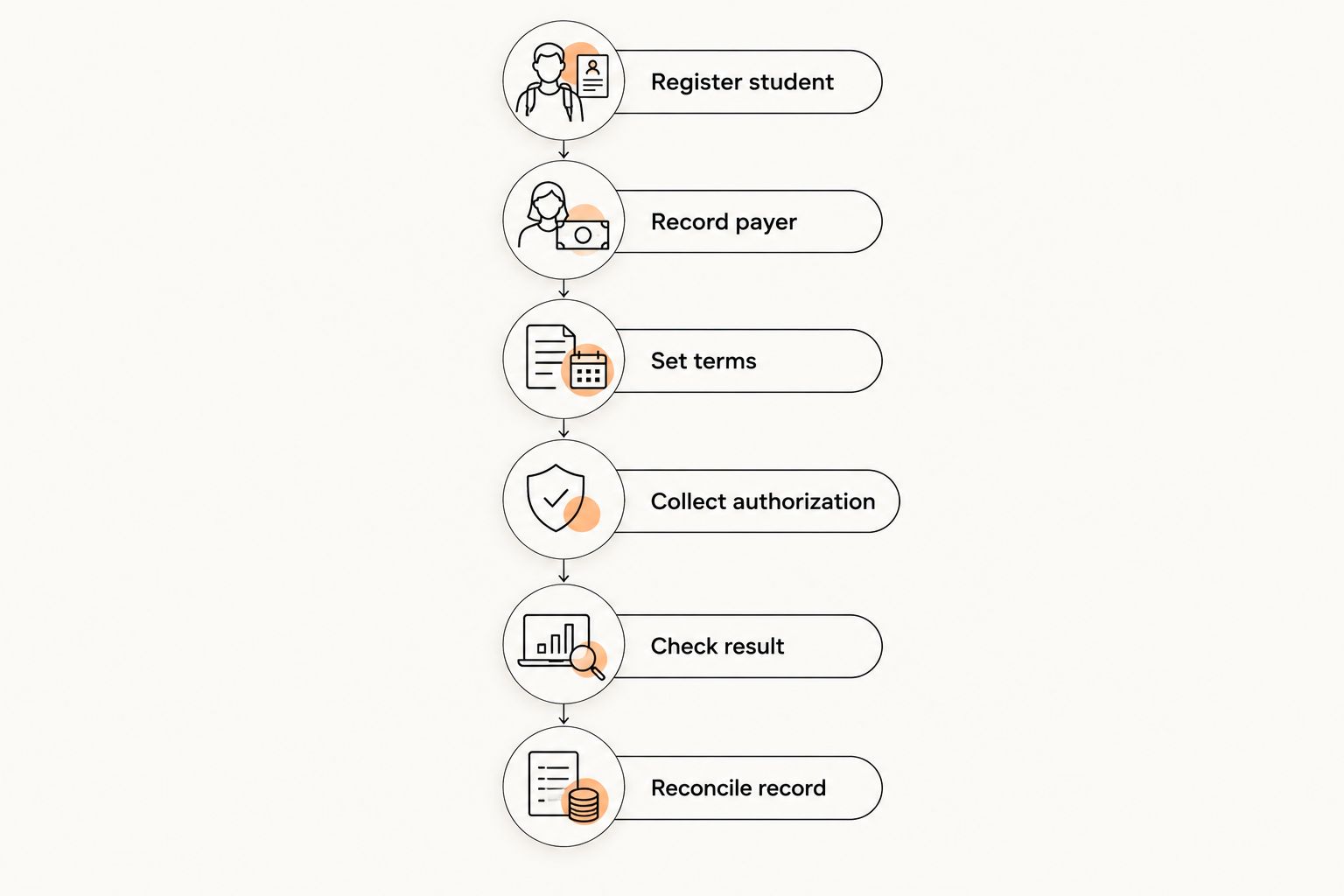
Build the collection process around a member record. Then connect the registration, membership terms and payment result to that record.
- Register the student. Collect the student's name, contact details and chosen class or discipline. For a child, identify the responsible adult separately.
- Record the payer. Establish who authorizes and pays the membership fee. Do not assume the payer and student are the same person.
- Set the membership terms. State what training the membership covers, its billing frequency and your cancellation process before collecting payment.
- Collect authorization. Use the payment provider's supported checkout or authorization process. Keep payment credentials out of ordinary registration forms and spreadsheets.
- Check the result. Record whether the payment succeeded, failed or remains pending. Do not treat a submitted payment request as money received.
- Reconcile the record. Match the payment to the student and membership period, then review the corresponding accounting entry and payout.
These are operational steps, not a promise that every software package performs them automatically. Ask a prospective provider to demonstrate the complete sequence with a sample member before you move live billing.
Which online collection method fits your club?
Choose the method around how you sell training. A recurring membership and a separately booked event need different collection instructions, even when the same student buys both.
The table compares collection workflows, not named providers or unverified software features.
| Collection workflow | Best for | Main advantage | Main limitation |
|---|---|---|---|
| Recurring online billing | Ongoing memberships with agreed billing terms | Avoids asking the member to initiate every payment | Failed collections and cancellations still need review |
| Individual online payment request | A separate booking or additional charge | Links a specific request to a specific payment | A new request does not establish recurring membership billing |
| Bank transfer with a member reference | Clubs that accept member-initiated transfers | Gives members a bank-based payment route | You must match incoming transfers to the correct record |
Keep the membership obligation separate from the collection method. Changing how a student pays does not, by itself, change what the student has agreed to buy.
Recurring billing: best for ongoing memberships
Recurring billing suits a student who has agreed to pay for continuing membership on a defined schedule. Record the billing frequency, start date and membership coverage before enabling collection.
The advantage is repeat collection without a fresh request each time. The limitation is exception handling: an expired payment method, a disputed charge or a cancellation still needs an owner decision.
Do not use attendance alone to infer cancellation. A student who misses training has not necessarily asked to end their membership.
Individual payment requests: best for separate charges
Use an individual request when the payment covers a clearly identified booking or charge outside the recurring membership. Describe the purpose so the payer can recognize it later.
This keeps separate charges distinct from regular dues. It also creates another record to reconcile, so check that the payment has not already been collected through another route.
Bank transfers: best for member-initiated payments
If your club accepts bank transfers, give the payer a consistent reference and explain what it identifies. A parent's name on the bank statement might not match the child's membership record.
Transfers give you another collection route, but they require a matching process. Review unmatched receipts before sending overdue-payment messages.
What should registration capture before payment?
Collect enough information to connect the payment to the right training agreement. Avoid adding fields simply because a form builder allows them.
Your 2026 registration checklist should distinguish these records:
- Student: the person attending training.
- Payer: the person responsible for the payment.
- Membership: the training entitlement and agreed billing schedule.
- Payment: the attempt, its status and its reference.
- Class: the session the student books or attends.
These records answer different questions. Payment status does not establish attendance, and attendance does not prove that a fee was collected.
For a multi-discipline academy, record whether the membership covers BJJ, boxing, Muay Thai, judo, karate or another program you actually teach. Do not make a payer infer coverage from a vague membership name.
For children, separate the student's training details from the adult's contact and payment details. Limit access to personal information to staff who need it, and explain how your club uses the information it collects.
How should family payments connect to student records?
One payer can be responsible for several students without those students sharing a training record. Keep each child's attendance, discipline and rank history distinct, even when the same adult pays.
Before selecting a billing system, test a family joining together and a family changing later. Ask what happens when one child leaves, another changes classes or the responsible payer changes.
Use the family and sibling billing guide to frame those checks. Verify the actual account behavior rather than assuming that a shared surname creates a billing relationship.
A useful demonstration should show the payer, the students covered and the membership obligation. It should also show how staff correct a mistaken association without losing the payment history.
Why online fee collection varies between clubs
The right workflow depends on your club's operating rules. Define these before comparing software in 2026:
- Membership structure. Ongoing training and separately booked sessions need different collection instructions.
- Payer relationships. Adult students paying for themselves differ from parents paying for children.
- Training coverage. A single-discipline membership differs from access across several programs.
- Collection method. Recurring billing, payment requests and transfers produce different follow-up work.
- Membership changes. Pauses, cancellations and changes of payer need an explicit handling process.
- Accounting requirements. Your bookkeeper needs payment, fee, refund and payout records that can be matched.
Do not change your club's terms merely to fit an attractive checkout form. Write the rules first, then ask the provider to show how its software represents them.
What should you do when a membership payment fails?
A failed payment needs a status check before a reminder. First establish whether the attempt failed, remains pending or was replaced by another successful payment.
Use this review sequence:
- Check the account. Confirm the student, payer and membership period involved.
- Check other receipts. Look for a successful replacement payment or an unmatched transfer.
- Contact the payer. Explain which payment needs attention without including sensitive payment details.
- Resolve the balance. Confirm the result before closing the issue or changing the member's status.
A failed charge is not the same as a canceled membership. Follow your stated membership terms rather than improvising a different response for each student.
For your 2026 collection process, assign responsibility for reviewing exceptions. Automation does not answer who handles a parent's reply or approves an adjustment.
Where does MatPilot fit?
MatPilot is best for Irish martial arts owners who need member management, Stripe billing, scheduling and belt tracking together. It is martial arts gym management software rather than a standalone payment form.
MatPilot provides member records, attendance, a Monday–Sunday timetable, per-art ranks and belt grading, Stripe billing and Xero sync. It is available through the web and native iOS and Android apps, including for clubs in Ireland.
The practical advantage is managing training and billing within the same gym management system. The trade-off is scope: if you only need to collect an isolated payment, you must still decide whether a full member-management workflow fits your operation.
For MatPilot martial arts gym management software, use a demonstration to check your particular payer relationships, membership changes and accounting workflow. Stripe billing does not justify assuming that every payment method or every family-billing arrangement is supported.
Does a paid membership automatically register someone for class?
A paid membership does not, by itself, establish a class booking. Your club must define whether students reserve sessions, attend eligible classes without booking or follow another stated process.
Check how the system represents class eligibility separately from payment status. Otherwise, staff cannot tell whether an absent booking is a registration problem or a billing problem.
Should Irish clubs bill in euros?
For an Irish membership offered in euros, make the currency explicit throughout registration and payment. Check the member-facing charge and the accounting records before publishing the payment route.
Do not reuse US-facing payment instructions without reviewing currency and destination. An English-language page is not necessarily an Ireland-specific payment page.
Can you switch collection systems without double-charging members?
You can plan a switch around a documented billing cutoff and a checked list of active memberships. Confirm which system is responsible for each upcoming collection before enabling the replacement process.
Do not assume stored payment credentials transfer with a member spreadsheet. Ask both providers what can move, what authorization is required and which members need to take action.
FAQ
What's the best way for an Irish martial arts club to collect monthly fees?
Recurring online billing fits ongoing memberships with agreed billing terms. Connect each collection to the correct payer, student and membership period, then review failed or pending payments.
What should class registration and payment solutions for Irish clubs include?
Class registration and payment solutions for Irish clubs should connect student records, membership terms, payer details and payment status. Check class eligibility, family relationships and accounting records during a demonstration.
Can a parent pay membership fees for more than one child?
A parent can be the payer for several children, but each child still needs a distinct student record. Verify how your chosen system connects those records and handles later changes.
Does booking a class mean the membership fee has been paid?
Booking a class does not prove that the membership fee has been paid. Check the payment result and the membership period it covers separately from the booking.
Should I stop a student's membership after a failed payment?
A failed payment alone does not establish that the student has canceled. Check the payment record, contact the responsible payer and follow your stated membership terms.
Can Irish clubs connect online membership billing to accounting?
Irish clubs can use accounting integrations or reconcile exported payment records. Check how your chosen workflow represents collected payments, processing fees, refunds and payouts rather than assuming those records are interchangeable.
What should I test before launching online fee collection?
Test registration, payer identification, payment confirmation and exception handling before launching online fee collection. Include a parent paying for a child and a membership change in your checks.
One last thing
Before publishing your 2026 registration link, ask someone who did not configure it to complete a sample journey. Give them the same instructions a new parent would receive.
Then inspect the records, not just the confirmation screen. The useful test is whether another staff member can explain who paid, which student is covered and what happens next without asking you.