How do you calculate ROI on gym management software?

Calculate gym management software ROI by subtracting its total attributable costs from its measured financial benefits, dividing the result by those costs, and multiplying by 100 to express the return as a percentage. Include setup, training, payment-fee changes, and ongoing review time—not just the subscription. Keep owner hours released separate from cash savings unless those hours actually reduce spending or produce measurable contribution.
- How to calculate ROI on gym management software: compare verified financial benefits with total attributable costs over matching periods.
- Matpilot gym management software fits martial arts owners who need billing, attendance, and per-art grading in one workflow.
- Measure failed-payment recovery and trial conversions against a baseline, not against zero.
- Report cash return separately from owner capacity; time saved is not automatically money earned.
How do you calculate ROI on gym management software?
Use net financial benefit, not additional revenue, as your numerator. Revenue collected still has to cover the costs of delivering classes and processing payments.
For your 2026 worksheet, use this sequence:
- Set the period. Use the same dates for benefits and costs.
- Establish the baseline. Record what happened before the change, including your existing collection process.
- Measure benefits. Count verified spending reductions and additional contribution attributable to the software.
- Total costs. Include subscriptions, implementation, training, incremental processing fees, and ongoing administration.
- Calculate return. Divide benefits minus costs by costs, then express the result as a percentage.
The formula is:
ROI (%) = [(measured financial benefits − total attributable costs) ÷ total attributable costs] × 100
Start with the payment records behind your martial arts billing workflow. An overdue invoice becoming paid is evidence of collection, but not proof that the software caused an improvement.
Choose the right calculation
| Calculation | Best for | What belongs in it | Main limitation |
|---|---|---|---|
| Cash ROI | Checking whether spending pays back | Verified cash savings and additional contribution, minus attributable costs | Excludes owner capacity that has not produced cash |
| Capacity return | Understanding administrative workload | Net hours released after training and review work | Hours are not bank deposits |
| Combined business case | Deciding whether to adopt or keep software | Cash ROI beside capacity return and operating requirements | Becomes misleading if hours and cash savings overlap |
Use cash ROI to justify spending. Use capacity return to decide what you can do with the time. Neither measure should substitute for the other.
Why this matters
A BJJ academy can improve collections without gaining a single member. A boxing school can reduce scheduling work without reducing payroll. Both changes matter, but they belong in different parts of the decision.
Matpilot gym management software covers members, classes, billing, attendance, and belt grading. Evaluate those workflows against your academy's actual work, rather than assigning a financial return to every feature.
The question for your 2026 review is specific: which tasks changed, which payments changed, and which costs disappeared? A feature list cannot answer it.
Build a baseline before changing the workflow
Start with a 30-day baseline as a practical measurement window, not a promised time to payback. If that window excludes a normal billing cycle or contains a school closure, extend it or select a more representative period.
Record the following before changing systems:
- Payments due, payments received, and outstanding balances.
- Failed-payment follow-ups and their eventual outcomes.
- Trial inquiries, attended trials, and resulting paid memberships.
- Cancellations, freezes, and the reasons members provide.
- Staff and owner time spent on each recurring administrative task.
- Existing software and services that the replacement would actually remove.
Keep the definitions fixed. A trial inquiry is not an attended trial. A membership created in the database is not necessarily a collected payment.
For a multi-discipline school, tag records by program. BJJ, Muay Thai, karate, and boxing can have different class patterns and enrollment processes. Pooling everything into one total makes it harder to identify which workflow changed.
Record unusual events beside the numbers. A new instructor, timetable change, advertising campaign, or temporary closure changes the comparison. Do not assign those effects to software merely because they happened after launch.
Measure benefits without counting the same result twice
Failed-payment recovery
Count additional collections relative to your established follow-up process. Do not count every successful retry as a new software benefit if your previous process would also have collected it.
Separate outstanding balances from permanently lost revenue. Collecting an invoice earlier improves cash timing; collecting an otherwise uncollectible balance changes the eventual amount received. Those are different outcomes.
Maintain a record of the failed payment, follow-up action, collection date, and final status. Deduct directly associated collection expenses when calculating the financial benefit.
Trial conversion
Track each trial from inquiry through attendance to the first successful membership payment. Compare equivalent groups rather than treating every new member as software-generated growth.
Count additional contribution, not the full headline value of a membership. Subtract directly attributable delivery costs and payment expenses. Do not project a long membership lifetime from an initial payment without supporting retention records.
If you changed advertising or the trial offer at the same time, separate those changes. Otherwise, the result describes the combined campaign, not the software alone.
Retention
Attendance alerts and follow-up records establish what happened. They do not prove that every contacted member would otherwise have canceled.
For a conservative calculation, record the intervention and subsequent paid membership period. Keep uncertain attribution outside the verified return. Do not count the same payment under both retention and failed-payment recovery.
Retired tools and reduced paid work
Count a retired subscription only after it stops being charged. Count payroll savings only when paid hours or another actual expense falls.
For bookkeeping, compare the reconciliation task before and after the change. The Xero payment reconciliation workflow is relevant when matching payments is part of your existing workload. Measure exceptions and corrections as well as routine entries.
Count the costs that subscription comparisons miss
Build a separate cost ledger for the 2026 evaluation. Keep one-time transition work distinct from recurring operation so that launch costs do not disappear inside a monthly average.
| Cost category | What to record | Evidence to retain |
|---|---|---|
| Software | Actual charges for the evaluated period | Invoices and billing records |
| Payment-fee changes | Additional processing expense caused by the change | Comparable transaction statements |
| Migration | Data cleanup, imports, and reconciliation | Staff time records and supplier invoices |
| Training | Paid training work and owner time used | Attendance and task logs |
| Parallel operation | Overlapping systems during transition | Charges covering the overlap |
| Ongoing review | Exceptions, approvals, corrections, and administration | Task logs after launch |
Do not treat all existing card-processing expense as a new software cost. Compare equivalent transaction types and volumes to identify the change attributable to the decision.
Owner implementation time deserves a separate capacity entry even when no cash changes hands. If you monetize that time in an economic model, label the model clearly and keep it separate from cash ROI.
Track the work from action to evidence
Use a short audit trail for each claimed benefit. The record should connect the administrative action to the operational result and then to the financial entry.
- Record baseline. Save the previous workload or collection result.
- Log action. Record the follow-up, reconciliation, or scheduling task.
- Check outcome. Confirm the payment, membership status, or completed task.
- Remove overlap. Exclude amounts already counted elsewhere.
- Review return. Update costs and benefits for the same period.
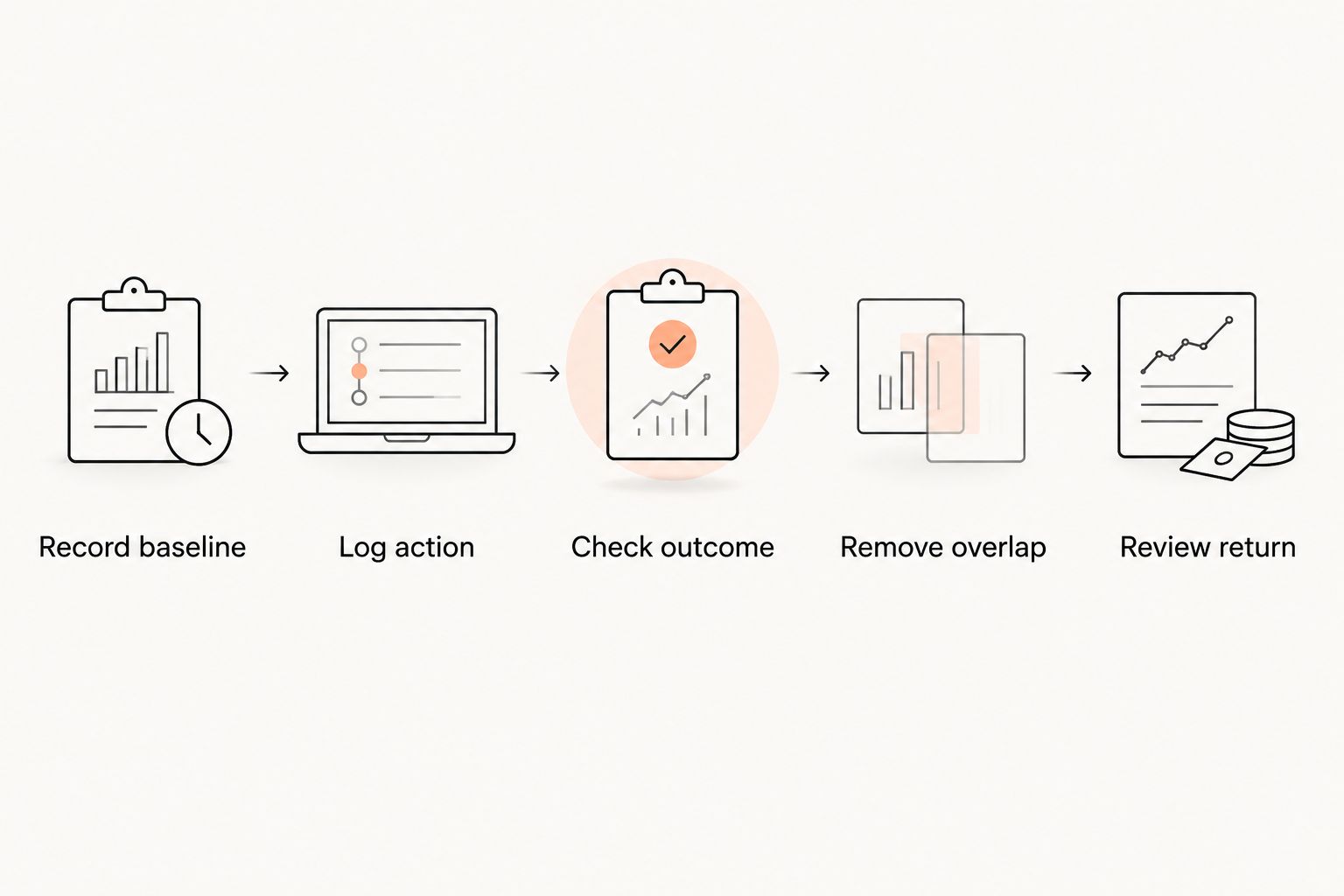
For your 2026 records, keep source documents beside the worksheet. A total with no supporting transactions is difficult to verify when you revisit the decision.
When should you review software ROI?
Use a 30-day post-launch window for an initial operating check after the workflow is in use. Compare it with the baseline, but report migration and training costs separately rather than pretending they never occurred.
Use a 90-day review window as a second decision point. This is a measurement schedule, not a claim that software pays for itself within that period. Keep accumulated launch costs in the full-project calculation.
Separate implementation progress from financial payback. Imported member records show that migration has progressed; collected payments and verified expense reductions support a return calculation. The distinction also shapes CRM software ROI timelines: setup completion and recovered investment are different milestones.
For your 2026 decision, review two views side by side:
- Full-project return: benefits and costs since the implementation began.
- Current operating return: benefits and recurring costs during a clearly labeled recent period.
The current operating view shows whether the workflow now makes financial sense. The full-project view shows whether it has recovered the transition investment. Do not present one as the other.
Why gym management software ROI varies
Your measured return depends on the work being replaced and the evidence available. These factors change the calculation:
- Existing workload: replacing a repetitive manual task produces a different capacity result from replacing an already efficient process.
- Collection baseline: payment recovery must improve on your existing follow-up, not simply repeat it.
- Program complexity: per-art ranks, attendance, and grading create distinct administrative tasks to measure.
- Transition work: cleanup, training, and overlapping systems increase the initial investment.
- Payment mix: processing-cost comparisons require equivalent payment methods and transaction volumes.
- Owner oversight: reviewing proposed actions and handling exceptions remain part of the workload.
Matpilot includes an AI co-pilot with owner approval gates, alongside Stripe billing and Xero sync. Matpilot fits martial arts owners who want member administration and per-art grading in the same system. Its fit does not establish a financial return: include approval time and verify each claimed saving in your own records.
Does saving owner time count as ROI?
Saved owner time belongs in a capacity report unless it produces a verified financial change. Record minutes spent before and after the workflow change, including corrections and review.
Use the released time deliberately. If you spend it teaching, following up with trials, or leaving the academy earlier, record that outcome honestly. A better working week is valuable without being mislabeled as additional cash.
What if software costs fall but the ROI formula stops working?
If the denominator is zero, the ROI formula is undefined. Report net financial benefit and the underlying costs instead of forcing a percentage.
Keep the accounting method consistent. If you record a canceled legacy subscription as a benefit, do not also subtract it from the new system's cost total. Either presentation can describe the decision; mixing them counts the saving twice.
Can you calculate ROI before switching?
You can build a forecast before switching, but label it as a forecast. Use recorded task times and existing payment results, then list the assumptions that connect proposed changes to financial benefits.
Do not approve the forecast by turning every possible benefit into guaranteed income. Keep unverified retention gains and trial improvements outside the base case until actual records support them.
FAQ
What's the formula for gym management software ROI?
Gym management software ROI equals measured financial benefits minus attributable costs, divided by attributable costs, multiplied by 100. Benefits and costs must cover the same period.
Should I count all membership revenue as a software benefit?
No. Count only additional contribution attributable to the software, not revenue your academy would have collected anyway. Subtract directly associated expenses.
How do I measure administrative time savings?
Record time spent on the same tasks before and after the change. Include training, approvals, corrections, and exceptions, then report net hours released separately from cash savings.
Does recovering a failed payment prove the software paid for itself?
No. Compare recovery with your previous follow-up process and include the software's attributable costs. A successful collection alone does not establish incremental return.
How long should I track results after changing software?
Use an initial 30-day operating check and a 90-day review as measurement checkpoints, not payback promises. Extend the comparison when billing cycles or seasonal changes make those windows unrepresentative.
Can I combine US and Ireland results in one worksheet?
Keep US and Ireland calculations separate in their operating currencies before combining them. Document any exchange-rate conversion and preserve each market's actual payment and tax treatment.
What should I do if software ROI is negative?
Identify whether transition costs, recurring expenses, or unproven benefits explain the negative result. Correct the workflow or revise the decision using verified records rather than adding speculative savings.
One last thing
Measure a task you expect to remain manual. Approval review, correcting member records, or resolving payment exceptions can expose work that a feature demonstration leaves out.
Your strongest 2026 business case is not the worksheet with the most benefits. It is the one where every benefit has evidence and every remaining task has an owner.