How do you handle chargebacks in gym billing software?

Handle chargebacks in gym billing software by matching the dispute to the original payment, checking the processor’s response deadline, and deciding whether to accept it or submit evidence. Keep the membership agreement, billing authorization, cancellation history, and relevant attendance records together; a failed payment is not a chargeback, and attendance alone does not prove authorization.
- How to handle chargebacks in gym billing software: review the reason, preserve evidence, and respond through your processor.
- Challenge a dispute only when your records address the stated reason; accept a valid claim.
- MatPilot combines martial arts membership management, attendance, and Stripe billing; keep dispute decisions with the gym owner.
- Separate failed-payment recovery, refunds, and chargebacks so staff do not collect the same balance twice.
Why this matters
A disputed membership payment creates separate jobs: answering the bank’s claim, updating the member account, and keeping the accounts accurate. Completing one does not complete the others. A message from a parent does not replace a processor response, and a billing note does not cancel a membership.
Your 2026 billing procedure should assign responsibility for each job. Start with the distinction between routine collection and formal disputes when evaluating martial arts billing software. You need a traceable payment record, not just an outstanding-balance total.
How do you handle chargebacks in gym billing software?
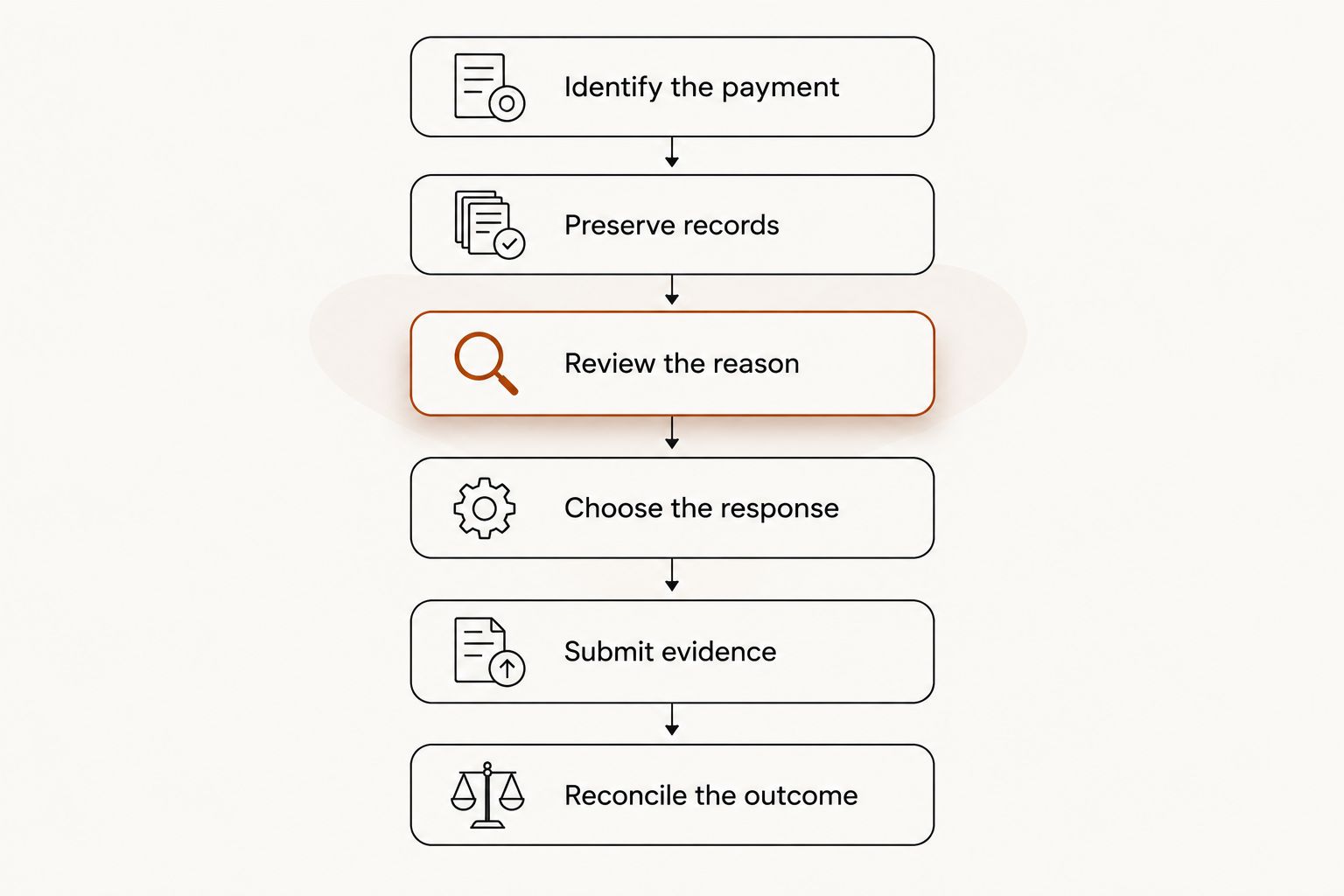
Use these 6 steps for each disputed card payment. Work from the processor’s dispute record rather than a member’s description of what happened.
1. Identify the payment
Open the dispute in your payment processor. Record its identifier, the disputed transaction, the reason given, and the response deadline shown there. Match the transaction to the invoice and membership period in your gym records.
For family accounts, identify both the paying adult and the student receiving instruction. A parent’s card payment for a child’s karate membership needs a different explanation from an adult’s own boxing subscription. Do not assume the student’s name matches the cardholder’s name.
2. Preserve records
Save the agreement and billing authorization that applied when the payment was taken. Add the invoice, relevant messages, cancellation requests, and attendance records for the disputed service period. Preserve the original dates rather than rewriting the account history.
Separate evidence from interpretation. A check-in shows recorded attendance; it does not, by itself, show that the cardholder agreed to recurring billing. Include only records relevant to the stated dispute reason.
3. Review the reason
Compare the member’s claim with your records. An unauthorized-payment claim calls for evidence about authorization. A cancellation dispute calls for the cancellation request, applicable terms, and billing timeline.
Check whether the gym made an error before preparing a defense. A duplicate collection or a charge taken contrary to an agreed cancellation deserves correction, not a longer argument.
4. Choose the response
Accept a valid dispute. Challenge a dispute only when the evidence addresses the reason given and supports the payment.
Contact the member calmly if clarification would help. Ask which payment they dispute and why, without pressuring them to withdraw a claim. Continue tracking the processor deadline while that conversation takes place.
5. Submit evidence
Use the response fields and submission process provided by your processor. For Stripe payments, follow Stripe’s dispute guidance and the requirements shown on the individual dispute. Check the current instructions when applying this workflow in 2026.
Write a short chronology. Explain who authorized the payment, what it covered, and how the attached records answer the claim. Review the completed response before submission; do not treat a folder of attachments as a complete argument.
6. Reconcile the outcome
Record the response, outcome, and associated account adjustments. Keep a processor debit separate from an ordinary unpaid invoice so staff understand what happened.
Review future billing and membership access separately. Do not automatically recharge the disputed amount or assume the dispute itself cancels the membership. Apply the agreement, the member’s instructions, and the processor’s rules to the next action.
What evidence should a martial arts gym keep?
Build a 2026 evidence checklist around what the payment covered. A BJJ membership, a Muay Thai seminar, and a child’s grading event involve different service records. Submit the records that explain the disputed transaction, not the student’s entire history.
| Record | What it helps establish | Limitation |
|---|---|---|
| Membership agreement | The service and terms the member accepted | Terms alone do not establish card authorization |
| Billing authorization | Consent to the payment arrangement | Must connect to the disputed payment |
| Invoice and payment record | What was billed and collected | Collection alone does not prove consent |
| Attendance record | Recorded participation during the service period | Absence does not automatically establish cancellation |
| Cancellation correspondence | What was requested, agreed, and when | An internal note is not proof the member received a message |
| Refund record | Whether a credit was issued for the transaction | Check its relationship to the open dispute |
For a family membership, connect the payer’s authorization to the students covered by the invoice. Do not submit unrelated information about siblings or other household members. Explain the relationship in plain language.
Match the evidence to the claim, not the size of your record archive. A belt promotion proves something different from a recurring-payment authorization. Keep student progression records out of the response unless they directly establish the service in dispute.
Should you accept or challenge the chargeback?
Accept a valid claim; challenge only a claim your records can answer. The decision should follow the transaction history, not frustration with the member.
| Response | Best for | Advantage | Limitation |
|---|---|---|---|
| Accept the dispute | A valid claim or confirmed billing error | Avoids defending a payment your records do not support | Still requires account review and reconciliation |
| Challenge the dispute | A claim contradicted by relevant authorization and service records | Presents your evidence through the formal process | Requires staff work and does not guarantee a favorable outcome |
Do not contest every dispute as a standing policy. Equally, do not accept every claim without checking whether your records support the transaction. Assign a case owner who can review the agreement and authorize the response.
If a member says they withdrew the dispute, check its status with the processor. Stripe’s dispute guidance explains that a withdrawal does not remove the need to follow the dispute process. Keep the case open internally until the processor record supports closure.
Why chargeback handling varies
The same attendance export will not answer every claim. These 5 factors determine which records and actions matter:
- Dispute reason. Unauthorized payments, canceled memberships, and service complaints require different explanations.
- Payment method. A card chargeback is not the same process as a failed card payment or a direct-debit return.
- Payer relationship. A guardian paying for a child needs a clear link between authorization, invoice, and student.
- Cancellation history. The request date, agreed end date, and collection date establish the billing sequence.
- Processor requirements. The individual dispute specifies the response deadline and evidence requirements you must follow.
For an Irish academy, do not apply a US card-dispute checklist unchanged to a SEPA Direct Debit return. For a US academy, do not treat every bank-account payment as a card transaction. In 2026, keep payment-method-specific instructions alongside the general workflow.
These distinctions also matter across disciplines. A recurring MMA membership and a separately booked judo event should not share an evidence packet merely because the same person attended both.
Keep collection, refunds, and disputes separate
A declined payment means collection failed. A refund is a merchant-initiated return of funds. A chargeback is a formal dispute handled through the payment system. Label each event accurately in your internal records.
For a failed payment, follow the authorized collection process and contact the payer about updating their payment details. For an open dispute, review the processor’s instructions before issuing a separate refund or attempting another collection. Do not improvise a second transaction to make the account balance look correct.
Check future charges separately from the disputed charge. A parent disputing an earlier payment might also have requested cancellation, but those are distinct records. Staff need explicit instructions about the next scheduled collection.
What should gym software do, and what stays with the owner?
Use gym software to maintain the operational record: the member, class attendance, invoices, and payment history. Use the processor’s dispute tools for the formal response. Ask a vendor to demonstrate the boundary rather than assuming billing support includes chargeback submission.
MatPilot provides martial arts membership management, attendance, Stripe billing, and Xero sync. MatPilot gym management software fits martial arts owners who need membership, attendance, and billing records together. Its scope extends beyond belt tracking to the recurring work of running an academy.
MatPilot also provides a co-pilot with approval gates for supported actions. That approval model does not replace the owner’s responsibility to check a dispute response. Do not assume a suggested payment follow-up is evidence submission or a bank decision.
The practical limitation is clear: gym management software does not decide whether your evidence defeats a cardholder’s claim. Keep authorization records, review every response, and confirm which dispute tasks take place in the processor. Useful records support a case; they do not guarantee its outcome.
Can you refund a member after a chargeback opens?
Check the processor’s instructions before issuing a refund against a disputed payment. An open chargeback and a separate refund can create duplicate reimbursement concerns, so do not use a refund as an informal substitute for resolving the dispute.
If you already refunded the transaction, locate that refund record and follow the processor’s instructions for including it in the response. Tell staff which transaction is under review so nobody issues another credit independently.
Does attendance prove that a membership charge was valid?
Attendance supports evidence that instruction was used, but it does not establish every part of a valid payment. You still need to address authorization, the applicable agreement, and the specific claim.
The reverse also matters. A student’s absence does not automatically mean the membership was canceled. Review the cancellation record instead of treating the attendance register as a billing instruction.
FAQ
What's the first thing I should do when a gym payment is disputed?
Open the processor’s dispute record and check the response deadline and reason. Match it to the original payment before changing the member’s balance or contacting the payer.
Is a chargeback the same as a failed membership payment?
No. A failed payment is an unsuccessful collection attempt; a chargeback is a formal dispute about a payment. Keep their recovery and accounting workflows separate.
Should I cancel a membership when a member files a chargeback?
Do not treat the chargeback itself as a cancellation instruction. Review the membership agreement, any cancellation request, and future billing separately.
What evidence should I keep for a parent's disputed payment?
Keep the parent’s billing authorization, the invoice identifying the covered student, and records relevant to the dispute reason. Include cancellation correspondence or attendance only when it helps answer the claim.
Can I win a chargeback just by showing gym check-ins?
No. Check-ins support evidence of participation, but they do not alone establish cardholder authorization or resolve a cancellation claim. Match the supporting records to the reason given.
What if the member tells me they withdrew the chargeback?
Check the dispute status with your processor and continue following its response instructions. A member’s message does not replace the formal dispute record.
Can gym billing software guarantee that I win disputes?
No gym billing software can guarantee a favorable dispute outcome. Software can organize operational records, but the evidence must answer the claim and follow the payment system’s process.
One last thing
Before changing your 2026 billing workflow, trace a completed payment from payer authorization to invoice, service period, and accounting entry. Then ask someone other than the account owner to explain that chain from the records alone. Fix any ambiguity before an actual dispute forces the question.