How do you recover a failed membership payment before it lapses?

Recover a failed membership payment before the membership lapses by checking the unpaid invoice, identifying what blocks collection, contacting the responsible payer, and confirming successful payment before your academy’s renewal deadline. A retry alone does not resolve every failure; this 2026 workflow keeps payment recovery separate from decisions about membership access.
- Recover failed membership payment gym software workflow: inspect the invoice, contact the payer, confirm collection, then review membership status.
- MatPilot gym management software supports Stripe billing and payment-issue assistance with owner approval gates.
- Do not treat a scheduled retry, updated card, or member reply as proof of payment.
- Use your academy’s written membership terms to decide when unpaid access ends.
Why this matters
A failed collection and an expired membership are different problems. The first needs a payment action; the second needs a decision under your membership terms. Treating them as the same event risks suspending a member while a payment issue remains unresolved.
Your recovery process needs a clear handoff between the payment record and the member record. When evaluating martial arts billing software, follow that handoff rather than judging the system by its reminder screen alone.
For your 2026 billing procedure, define who checks failures, who contacts the payer, and who approves changes to access. Keep those responsibilities explicit even when the academy owner handles all of them.
How do you recover a failed membership payment before it lapses?
Check the original invoice before creating another payment request. Work from the unpaid obligation, not from a separate message thread or a student’s recollection of what happened.
1. Confirm the unpaid obligation
Open the member’s billing record and the corresponding processor record. Match the payer, membership period, invoice reference, and collection status. Check whether another collection attempt is already pending before you take action.
Look for a payment that succeeded after the original failure. Also check whether the invoice was canceled, credited, or replaced. An old failure notification is not enough evidence that money remains outstanding.
For family accounts, establish which adult is responsible for payment. The student attending class is not necessarily the person authorized to change the payment method.
2. Read the failure information
Use the failure reason shown by the payment processor. Separate a payment requiring member action from a payment awaiting processing or another collection attempt.
Do not guess the reason from attendance patterns or a member’s silence. If the record does not explain what happened, investigate before asking the member to repeat the same action.
Write a short operational note: what failed, what the record currently shows, and what must happen next. Keep sensitive payment details out of that note.
3. Choose the next action
Choose an action that addresses the recorded problem. A payment-method issue needs a secure update; an authorization issue needs the payer’s participation; a pending payment needs a status check rather than an additional charge.
| Recovery action | Best for | Benefit | Limitation |
|---|---|---|---|
| Retry the existing payment | A failure the processor identifies as retryable | Keeps collection attached to the existing obligation | Does not fix missing authorization or incorrect payment details |
| Request a payment-method update | A payment method that needs replacing | Addresses the collection method directly | Updating details is not proof that the invoice was paid |
| Request payer authentication | A payment requiring payer approval | Gives the payer a specific task | Collection remains unresolved until payment succeeds |
| Review the account manually | Conflicting records or a disputed balance | Prevents action on an unclear obligation | Requires staff investigation and a recorded decision |
These are workflow choices, not promises that every gym platform exposes the same controls. Verify the available action in your current billing system before instructing staff to use it.
4. Contact the payer privately
Tell the payer which membership period remains unpaid, what action is needed, and the deadline from your existing terms. Use the secure payment process supported by your provider. Do not request full card details by email or text.
Keep the message about payment resolution. Do not label the member as canceled unless cancellation has actually occurred under the membership agreement.
For a children’s karate, BJJ, or taekwondo membership, contact the responsible adult directly. Do not ask a child to explain a household billing problem at reception.
5. Confirm collection and review access
Check the payment record after the payer acts. A completed update, a scheduled retry, and a successful payment are different statuses.
When payment succeeds, check that the original outstanding obligation is resolved. Then review the membership record and remove any billing restriction that should no longer apply under your policy.
If payment remains unresolved at the deadline, follow your written terms. Record the decision and tell the payer what happens next. Close the recovery case only when the payment or the membership decision is confirmed.
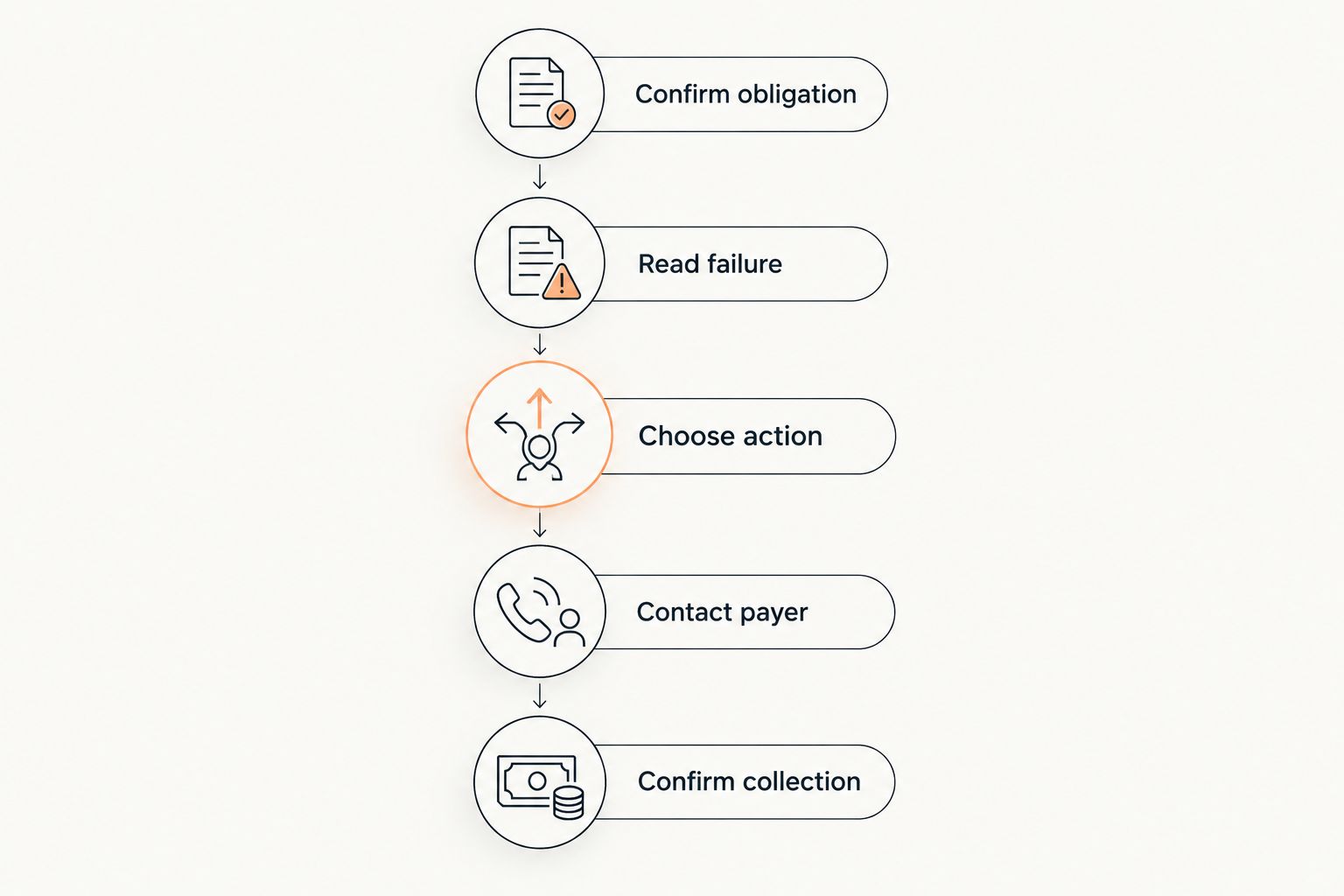
Why failed-payment recovery varies
The next action depends on the payment record and your academy’s agreement. There is no universal retry schedule or lapse deadline that applies to every martial arts membership.
- Failure reason. The recorded reason determines whether another attempt addresses the problem or repeats it.
- Payment status. Pending, failed, and successful records require different responses. Check the latest status before collecting again.
- Payer responsibility. An adult member and a guardian paying for children require different contacts, even when students share a household.
- Membership terms. Your existing agreement determines renewal, any grace period, and the consequences of nonpayment.
- Staff authority. Identify who can approve a payment action, account adjustment, or access restriction.
- Unresolved account questions. A disputed balance or an unprocessed cancellation needs review before another collection attempt.
Use these factors to choose the action, not to improvise a new policy for each member. Consistent handling starts with the same checks.
What should your 2026 recovery checklist contain?
Keep a recovery record that another authorized staff member can understand without reading an entire message history. It should explain the obligation, the blocker, and the next decision.
Record these fields:
- Member and responsible payer.
- Membership period and invoice reference.
- Latest payment status and recorded failure reason.
- Action already taken and whether another attempt is pending.
- Payer contact and required next action.
- Deadline under the membership agreement.
- Staff member responsible for follow-up.
- Final payment result and resulting membership status.
Avoid a vague note such as payment chased. It does not tell the next instructor whether the payer replied, whether collection is pending, or whether access should change.
Keep billing details visible only to staff who need them. A coach checking attendance needs the relevant access decision, not a household’s payment history.
How do you handle a failed family membership payment?
Check the payer relationship before contacting individual students. Establish which invoice covers which memberships and whether the billing issue affects the whole family account or a specific obligation.
Do not assume that a sibling’s paid membership resolves another student’s balance. Equally, do not apply an account-wide restriction without checking what the unpaid invoice actually covers and what your terms permit.
Give the responsible adult a clear explanation of the outstanding membership period. If the adult disputes the balance, review the agreement and invoice rather than repeatedly sending the same payment request.
For your 2026 family-billing procedure, separate the payer conversation from the coaching conversation. Students should not have to discuss household finances on the mat.
Should you retry a failed payment or ask the member to update it?
Retry only when the payment record supports another attempt. Ask for a payment-method update when the existing method needs correction or replacement, and request authentication when the processor requires payer approval.
Before any manual retry, check whether an automated attempt or payer-initiated payment is already underway. That check prevents staff from starting a separate collection without understanding the current state.
After an update, return to the original obligation. Verify whether payment succeeded or whether another action remains necessary; do not mark the account settled merely because the member completed a form.
Should an unpaid member lose class access immediately?
Apply your written membership terms, not a rule invented at reception. A failed payment notification alone does not tell staff whether the agreement provides continued access, a grace period, or suspension.
Separate attendance recording from the access decision. Keep an accurate record of classes attended while an authorized person resolves the billing status.
If access changes, contact the member or guardian privately before the next class where practical. Give reception a clear instruction so staff do not negotiate a billing exception in front of other students.
What should gym software handle, and what stays with the owner?
Use software to keep the member, payment, and follow-up records connected. Keep policy decisions with an authorized person, especially when the account involves a cancellation request, disputed balance, or access restriction.
MatPilot gym management software is for martial arts owners who want Stripe billing and payment-issue assistance with approval gates. Its scope also includes members, scheduling, attendance, and per-art ranks, so billing is not a separate belt-tracking purchase.
MatPilot’s co-pilot includes payment issues, with the owner approving actions. That is relevant to recovery work, but approval still requires someone to read the payment status and apply the academy’s terms. Software does not decide what a disputed membership agreement means.
When assessing your 2026 setup, walk through a failed-payment case from invoice to final resolution. Check where you inspect the failure, contact the payer, approve an action, and verify the outcome. Confirm the available retry controls and notification behavior directly; do not assume a feature exists because billing is included.
FAQ
How do I recover a failed gym membership payment before renewal?
Check the unpaid invoice, identify the recorded failure reason, contact the responsible payer, and verify successful collection before the deadline in your membership terms. Check for a pending collection before starting another attempt.
Does updating a member’s card automatically settle the unpaid invoice?
An updated card is not proof that an unpaid invoice has been settled. Check the payment result and the original outstanding obligation after the update.
How many times should I retry a failed gym payment?
Use the processor’s available retry controls and the payment’s recorded status rather than applying an arbitrary attempt count. Check whether another attempt is already scheduled before retrying manually.
Should I cancel a gym membership after a failed payment?
Follow the membership agreement rather than treating every failure as cancellation. Confirm the payment status and any applicable deadline before changing membership access.
Who should receive a failed-payment message for a child’s membership?
Send the message to the adult responsible for paying the membership. Confirm the payer relationship instead of assuming every guardian or student can change the payment method.
Can MatPilot help with membership payment issues?
MatPilot supports Stripe billing and a co-pilot that includes payment issues with owner approval gates. Confirm the specific recovery controls you need before adopting a retry or messaging procedure.
What should a gym check after a member says they have paid?
Check the payment record for successful collection against the outstanding obligation. A reply, receipt screenshot, or updated payment method should prompt verification rather than an automatic account-status change.
What should my failed-payment procedure cover in 2026?
Your 2026 procedure should define invoice checks, payer contact, permitted collection actions, approval responsibility, and the membership deadline. It should also state how staff confirm payment and communicate any access change.
One last thing
Audit the recovery handoff, not just the reminder. Start with a resolved failure and check whether the invoice, member record, and staff instruction all tell the same story.
A reminder can be delivered while the invoice remains unpaid. A payment can succeed while an outdated restriction remains on the member record. Your final check should catch both gaps before the next class.