How long until you see ROI from a new gym website?

You see ROI from a new gym website when the additional income it produces exceeds its costs; your academy’s results determine the date, not the launch day. Include ongoing website expenses, advertising, and the cost of serving new members before calling the website profitable.
- How long until you see ROI from a new gym website? Measure net member income against total website costs.
- MatPilot combines martial arts gym management software with website building tools; assess both acquisition and administration work.
- Trial bookings show progress, but collected membership payments establish whether your website investment has paid back.
- Separate website payback from advertising results and staff time savings to avoid counting the same benefit twice.
How long until you see ROI from a new gym website?
Your website reaches payback when cumulative additional contribution covers the investment. Contribution means the income left after the costs directly associated with earning it. A form submission does not establish payback. Neither does a signed membership whose first payment has not arrived.
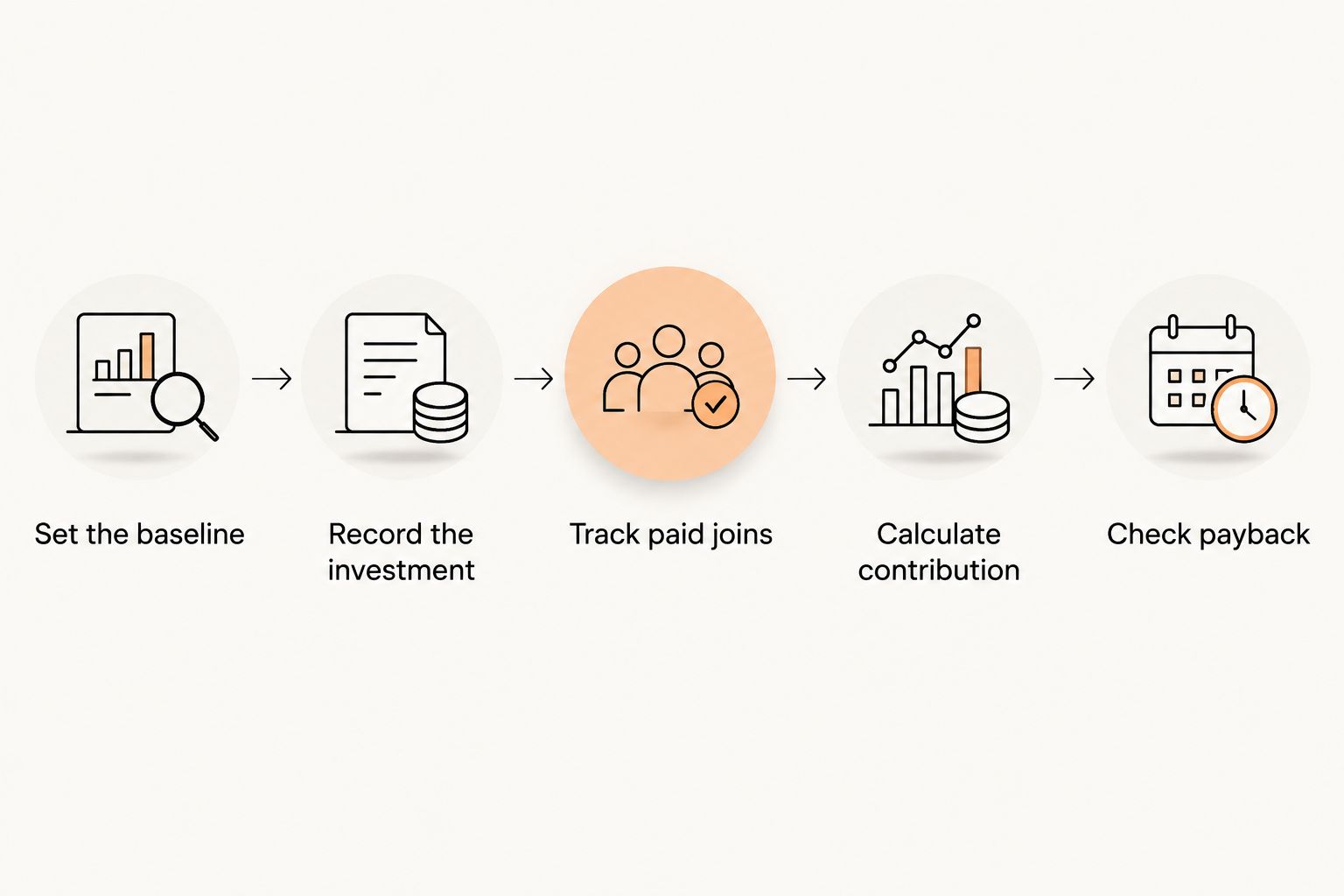
Use this sequence for a website launched in 2026:
- Set the baseline. Record inquiries, attended trials, paid joins, and collected membership income before launch.
- Record the investment. Include setup, ongoing website expenses, advertising, and paid implementation work.
- Track paid joins. Connect each inquiry to its booking, attendance, membership decision, and collected payments.
- Calculate contribution. Subtract the direct costs of acquiring and serving those additional members.
- Check payback. Compare cumulative additional contribution with cumulative website costs.
Start with the costs of building a martial arts website, but keep the financial record running after launch. A build invoice is only part of the calculation.
Use the right measure for the question
| Measure | Best for | What it tells you | Limitation |
|---|---|---|---|
| Collected membership revenue | Checking whether inquiries become paying members | Cash received from attributed new members | Does not account for delivery or acquisition costs |
| Additional contribution | Assessing website payback | What remains after direct costs | Requires reliable cost and attribution records |
| Administrative time saved | Assessing operating workload | Which tasks take less staff time | Does not automatically create cash savings |
Keep these measures separate. Revenue, contribution, and owner time answer different questions; adding them together without adjustments overstates the result.
Why this matters
A BJJ academy owner needs to know whether a website helps fill suitable classes, not simply whether people visit it. The same applies to boxing, Muay Thai, MMA, judo, karate, and taekwondo schools. An inquiry has operational value only when someone handles it and the prospect can attend an appropriate class.
For your 2026 website review, follow the complete path from inquiry to payment. That exposes the next task: correct a class description, answer a parent, confirm a trial, or resolve an unsuccessful payment. A traffic total cannot identify those tasks on its own.
Build a payback record you can actually use
Set the baseline
Record your existing acquisition process before changing the website. Use matching definitions before and after launch: an inquiry is not a booking, and a booking is not an attended trial. Keep adult inquiries separate from parent inquiries when they require different follow-up.
Record the source, discipline, suitable class, next action, and eventual outcome for each prospect. Ask how the person first heard about the academy. Record the website as the booking route separately from the original source.
A referral who uses your website to book is still a referral. That distinction prevents the new website from receiving credit for every membership entered through an online form.
Record the investment
Keep website-specific expenses together. Include the build, hosting or platform charges, domain expenses, maintenance, and any paid work required to keep the site accurate. Include advertising when evaluating the combined website-and-advertising project.
Treat your own setup time separately from cash spending. Record the work, such as correcting class details or preparing instructor information. This preserves the difference between money paid out and time invested.
Do not charge the entire gym software bill to the website if you also use it for member records, billing, and grading. Use a documented allocation and apply it consistently.
Track paid joins
Follow each inquiry through the same stages: contacted, booked, attended, joined, and paid. Record unsuccessful outcomes too. Otherwise, the record describes successful members without showing where other prospects stopped.
Check collected payments rather than relying only on membership status. Record refunds and cancellations against the same acquisition group. A membership agreement establishes intent; collected income establishes the cash result.
Calculate contribution
Subtract the costs that arise from acquiring and serving the additional members. These can include payment processing, advertising, and extra coaching hours where those hours were actually required. Use recorded expenses, not a standard percentage chosen for convenience.
Do not allocate an extra coaching cost when the new member attended an existing class without changing staffing. Equally, do not ignore the expense when additional demand required another paid session.
Check payback
Compare cumulative contribution with cumulative website spending through the same date. Continue including recurring website expenses. The investment has not stopped costing money merely because the launch invoice has been paid.
If contribution remains below spending, record the remaining gap. If contribution exceeds spending, record the date the balance turned positive and retain the underlying payment records.
Why gym website payback varies
Your academy’s payback calculation changes when its actual inputs change. Review these factors rather than borrowing a deadline from another business:
- Qualified inquiries. Separate people who can attend your location and timetable from inquiries you cannot serve.
- Trial attendance. Track whether booked prospects arrive, not just whether the booking form works.
- Paid membership conversion. Record which attended trials become members with collected payments.
- Member contribution. Account for the direct costs associated with each new membership.
- Retention and refunds. Keep cancellations, refunds, and subsequent payments attached to the original acquisition record.
- Project spending. Include recurring website work and advertising in the same period as the results they support.
These are calculation inputs, not promises of improvement. Changing a website does not establish that any of them improved; your records must show the change.
Review the process before rebuilding another page
Set a review every 7 days as an operating routine, not a promised payback deadline. Work through unresolved inquiries and compare booking records with attendance and payments. Give each unresolved item an owner and a next action.
Use a 30-day review to inspect the acquisition record. Check that sources are recorded consistently and that a paid join can be traced back to an inquiry. Fix record gaps before interpreting conversion changes.
Use a 90-day review to examine accumulated contribution, ongoing spending, and cancellations. This is a measurement checkpoint, not a claim that a martial arts website should pay for itself within 90 days.
For a 2026 launch, retain the launch date and a record of subsequent changes. Note when you changed advertising, the timetable, class capacity, or membership terms. Otherwise, the website receives credit for changes elsewhere in the academy.
Match the correction to the stalled stage
- Inquiries without bookings: Check whether the class, location, eligibility, and next step are clear.
- Bookings without attendance: Review confirmation details and the instructions prospects receive before arriving.
- Attendance without paid joins: Ask the instructor to record the prospect’s decision and any unresolved question.
- Memberships without collected payments: Review the payment issue rather than counting the membership as income.
- Paid joins without contribution: Review acquisition and delivery costs before buying more traffic.
Change one defined part of the process at a time where practical. Record what changed and why. That gives the next review a specific question to answer.
Where gym software fits into website ROI
MatPilot gym management software is best suited to martial arts owners who want website tools alongside member records, scheduling, billing, and grading. That combination is relevant when you want to assess the website and the work that follows an inquiry together.
MatPilot includes website building tools and martial arts management features. Those features do not establish a website payback period. You still need an acquisition record and collected-payment evidence to judge your own results.
Evaluate the operating work separately from the acquisition result. List the tasks you perform, who handles them, and whether the work changes after implementation. Do not assume that moving a task into software removes it.
The gym management software ROI calculation addresses the wider operating investment. Keep that assessment distinct from website payback so that the same membership or saved task does not appear twice.
Can a new website show results before it pays for itself?
A new website can produce inquiries, bookings, and paid joins before cumulative contribution covers its costs. Those are progress measures, not proof of full payback. Report each stage separately.
In your 2026 reporting, distinguish the first paid join from the payback date. The first establishes that a prospect completed the acquisition path. The second establishes that accumulated contribution recovered the investment.
Should you count owner time as website ROI?
Count owner time separately unless the change produces an identifiable financial saving or additional contribution. Fewer timetable questions can reduce interruptions without reducing payroll. That is useful, but it is not automatically cash returned.
Record the task and the time spent before and after the change using the same method. If the released time supports additional paid teaching or replaces paid administrative work, record that financial effect separately and avoid double-counting it.
FAQ
How do I know whether my gym website has paid for itself?
Your gym website has paid for itself when cumulative additional contribution exceeds cumulative website costs. Use collected payments, account for direct costs, and keep recurring website spending in the calculation.
Should I count every online signup as a website-generated member?
No. An online signup identifies a booking route, not necessarily the original source. Record referrals, advertising, and other acquisition sources separately from the website form used to join.
Should advertising be included in gym website ROI?
Include advertising when you are measuring the combined website-and-advertising investment. If you report website performance separately, keep advertising costs and attributed results visible rather than treating paid traffic as an uncosted benefit.
Does MatPilot guarantee a website payback deadline?
Do not use a guaranteed deadline to evaluate MatPilot website tools. Evaluate your academy’s collected membership contribution, project costs, and operating work instead.
Can I use future membership payments to claim payback now?
Use collected payments to establish actual payback. Keep expected future payments in a separate forecast, with cancellations and refunds reflected when they occur.
What should I check if website traffic rises but memberships do not?
Check the path from inquiry to booking, attendance, paid join, and collected payment. Identify the stage where prospects stop before changing the page or increasing advertising.
What is the difference between website ROI and website payback?
Website payback identifies when cumulative additional contribution recovers the investment. Website ROI expresses the net return relative to the investment over a defined period; state the period whenever you report it.
One last thing
A website can help complete a sale it did not originate. A referred parent might use the timetable to choose a suitable class, then submit a booking. Give the referral credit for the introduction and record the website’s role in completing the booking.
Before your next 2026 review, reconcile the inquiry list with attendance and collected payments. Every claimed paid join should have a traceable source, an outcome, and a payment record. Fix those links before making a larger website investment.