How much does a bilingual martial arts website cost?
A bilingual martial arts website needs a scoped quote covering the build, translation, booking journey, and ongoing updates; a page count alone does not establish its cost. The secondary expense to check is maintaining both languages whenever your timetable, class rules, or registration process changes. For your 2026 project, compare the same deliverables before comparing quotes.
- How much does a bilingual martial arts website cost? Compare matched scopes, including translation, registration, and maintenance.
- MatPilot provides martial arts website building tools; confirm bilingual requirements before selecting a platform.
- Count language versions, not just page layouts, when requesting a website quote.
- Approve the translated booking journey, not only the translated homepage.
Why this matters
Your second-language homepage is only the beginning. A parent still needs to understand age groups, find the right class, and complete the next step without encountering unexplained instructions in another language.
Start with the website work, not a replacement for your entire gym operation. The guide to martial arts website build costs covers the broader project; this page focuses on what a second language adds to the brief.
Buy a complete language journey, not a translated front door. That means specifying what happens after someone presses the registration button, including any handoff to another system.
How much does a bilingual martial arts website cost?
The cost depends on the agreed scope. Request separate line items for design and setup, translation, language configuration, registration handoffs, testing, and maintenance. Keep optional work separate so you can remove it without changing the essential visitor journey.
Use this breakdown when requesting a 2026 quote:
| Workstream | What the quote should include | What to clarify |
|---|---|---|
| Website build | Agreed layouts, pages, and mobile behavior | Whether both language versions are populated |
| Translation | Named source content and translated deliverables | Who writes, reviews, and approves the wording |
| Language setup | Language navigation and corresponding pages | What happens when a translation is missing |
| Registration | Forms, booking destinations, and confirmations | Where the second-language experience ends |
| Search setup | Page titles, descriptions, and language annotations | Who checks the published implementation |
| Maintenance | Updates, technical support, and content changes | Whether translation updates are included |
Ask each supplier to mark every item as included, excluded, or optional. A single project total conceals the differences that matter.
For a scope example, 6 source pages in 2 languages create 12 language versions to review. That does not mean 12 unique designs. It means the quote must distinguish reusable layout work from writing, entry, and review work.
What should the quote describe explicitly?
Name the actual pages: home, programs, timetable, instructors, location, and trial registration, for example. Then identify which pages need both languages and which shared information must stay consistent.
List the systems visitors encounter outside the website. A booking form, payment screen, or confirmation message needs its own language decision. Do not assume the website supplier controls those destinations.
Template-based website: best for a repeatable structure
A template-based approach fits an academy that can work within an existing page structure. Ask the supplier to demonstrate the second-language journey using your actual content requirements, not an empty demonstration page.
The advantage is a defined layout you can evaluate before commissioning extensive design work. The limitation is that your language navigation, timetable, and forms must fit what the template and connected systems support.
Before approving this approach, request a mobile example with translated headings and button labels. Longer text must remain readable without hiding important instructions.
Custom website: best for a specified visitor journey
A custom build fits an academy with requirements that an existing template does not meet. Write those requirements first: distinct program pages, language-specific navigation, or a particular registration handoff.
The advantage is control over the agreed design and implementation. The trade-off is responsibility: your contract must identify who maintains the code, fixes defects, and updates each language after launch.
Do not commission custom work merely because you want two languages. Ask the supplier to identify the requirement that makes custom development necessary.
Existing website expansion: best for keeping a working site
Adding a language to an existing site fits an academy that wants to retain its current structure. Start by checking whether the present platform supports the required language navigation and page relationships.
The advantage is retaining work you already want to keep. The limitation is that existing forms, layouts, and connected services still need inspection; adding translated text does not resolve those dependencies.
Request a technical assessment before approving the full expansion. Separate changes needed for bilingual publishing from unrelated redesign suggestions.
Compare the approaches on responsibility
| Approach | Best for | Practical advantage | Main limitation to check |
|---|---|---|---|
| Template-based website | A repeatable academy site structure | A defined layout to assess | Restrictions on language and form behavior |
| Custom website | A documented journey that templates cannot meet | Control over specified implementation | Maintenance and handover responsibilities |
| Existing website expansion | Keeping a suitable current site | Retaining the existing structure | Compatibility with current pages and services |
Choose the approach that meets your written requirements with the clearest ownership. None removes the need for translation review or registration testing.
Why bilingual website costs vary
These are the scope decisions to settle before requesting comparable quotes:
- Content volume. Count the pages, forms, messages, and downloadable documents that require translation. Identify repeated content separately.
- Translation responsibility. State whether you supply approved wording or the supplier arranges translation and review. Name the person who resolves terminology questions.
- Booking boundaries. Identify every destination between the program page and the completed registration. Specify which languages each destination must support.
- Timetable handling. Decide where class information is edited and how both language versions receive changes. Avoid commissioning separate schedules without an update process.
- Search implementation. Specify language-specific page titles, descriptions, URLs, and appropriate language annotations. Include a check of the published pages.
- Ongoing ownership. Assign hosting, technical maintenance, translation updates, and account access. Keep these responsibilities visible in the agreement.
For a 2026 brief, mark each requirement as essential or optional. An academy teaching boxing and Muay Thai needs equally clear program information for both disciplines; adding a second language should not obscure either timetable or entry requirements.
How to prepare a quote-ready brief
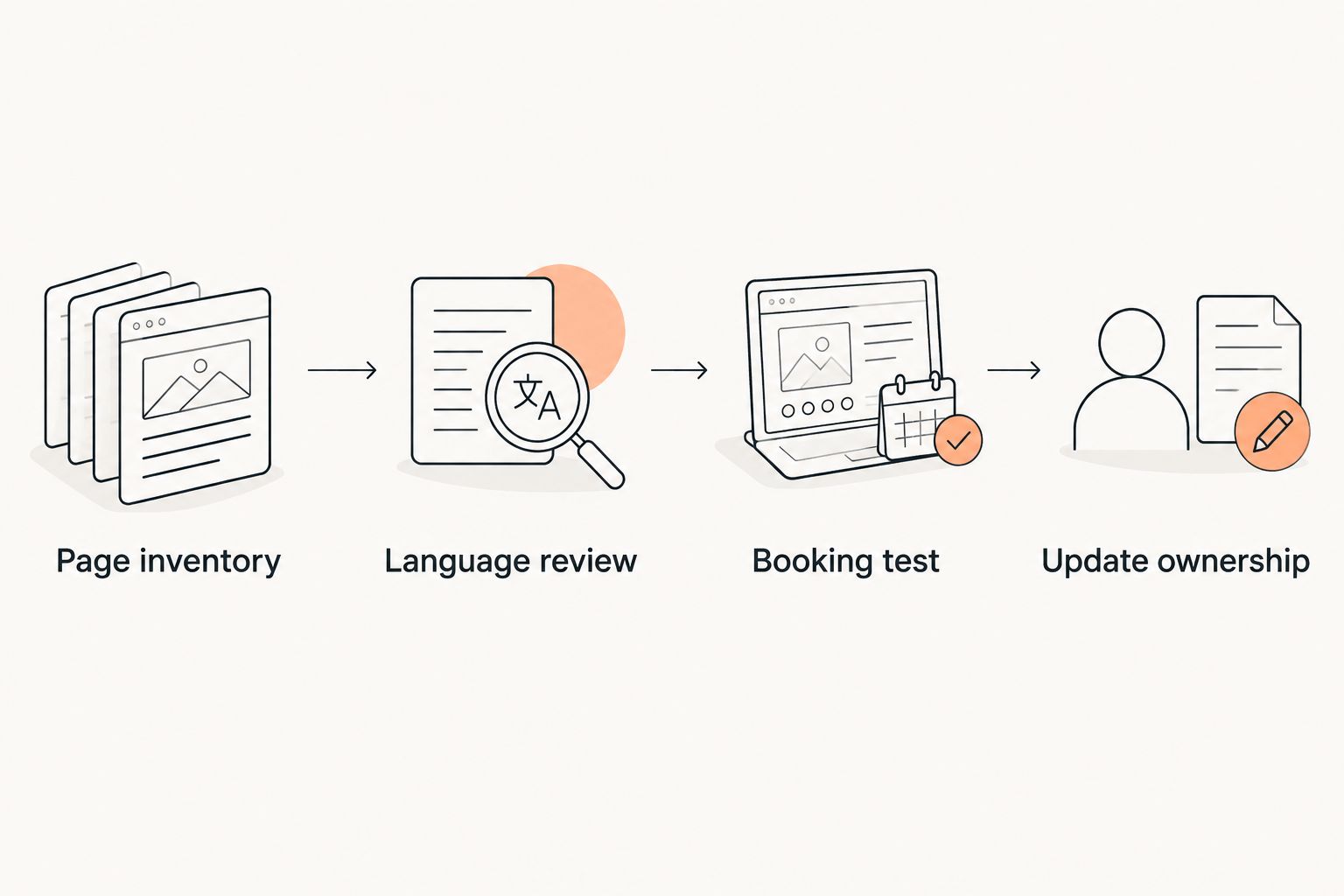
Use the following sequence before asking a supplier to commit to a scope. Each step produces something you can review rather than a vague promise of a bilingual site.
- Page inventory. List the source pages and required language versions. Mark content you intend to remove before translation begins.
- Language review. Assign a fluent reviewer who understands your academy's terminology. Agree on class names, age-group wording, and instructions.
- Booking test. Describe the route from a program page to a submitted inquiry or registration. Include external screens and confirmation messages.
- Update ownership. Name who changes the source content, updates the translation, and approves publication. Record the process in the handover.
For the page inventory, distinguish shared facts from translated explanations. Your street address should remain consistent, while directions and arrival instructions need language review. Class times must agree even when program descriptions use different wording.
For the booking test, write an acceptance checklist. Specify what a parent must understand, which information they submit, and what confirms completion. Make the supplier demonstrate that journey before you approve launch.
Where gym software belongs in the decision
Your website brief should identify where public information ends and member administration begins. Timetables, attendance, billing, and grading have different jobs from translated program descriptions.
MatPilot is for martial arts academy owners who want gym management and website building tools from the same provider. MatPilot's gym management software covers members, classes, billing, and belt grading. Those capabilities do not establish which bilingual publishing requirements a particular website project meets.
Assess MatPilot against your written brief. Confirm language switching, translated forms, search configuration, and update responsibilities before treating any of them as included. The fit is managing the website decision alongside academy operations; the boundary is that each bilingual requirement still needs confirmation.
Does a bilingual website require translating every page?
A bilingual website needs a complete route for the audience you intend to serve, not an automatic translation of everything you have published. Identify the pages necessary to understand your programs and complete the intended action.
For a 2026 launch, separate essential registration content from an older article archive. If you leave some material in one language, make that boundary clear rather than sending visitors into an unexpected language change.
Can you translate the website yourself?
You can supply translated copy if your website agreement allows it. Assign a fluent reviewer and make approval part of the project, especially for class eligibility, billing explanations, and guardian instructions.
Treat legal documents separately from promotional copy. Have the appropriate qualified adviser review translated terms or consent language rather than treating the website supplier's content entry as legal approval.
Will the second language help people find your academy?
A second language lets you publish information for people who read that language, but it does not guarantee search visibility. Each translated page needs useful content, a clear purpose, and correct technical implementation.
Ask the supplier how search engines will distinguish the language versions. Google documents hreflang annotations for localized pages; request an implementation check rather than accepting language selection alone as the search setup.
What to approve before launch
Run the same acceptance test in each language. Use a phone as well as a larger screen, and start from a program page rather than assuming every visitor enters through the homepage.
- Check that language selection opens the corresponding page where one exists.
- Read program descriptions against the current class timetable.
- Submit each inquiry or registration form using test details.
- Check field labels, validation messages, and confirmations.
- Follow every external booking destination and record its language behavior.
- Confirm that the academy controls the accounts needed for future updates.
For your 2026 handover, request a written record of exclusions and unresolved items. Do not approve a launch on the assumption that another supplier will finish the missing steps.
Approve the working journey, then approve the launch. A translated screenshot cannot prove that a registration form, timetable, or confirmation works as agreed.
FAQ
How much does a bilingual martial arts website cost in 2026?
A bilingual martial arts website needs a scoped quote covering the build, translation, language setup, registration journey, and maintenance. Compare those deliverables across suppliers before comparing totals.
Does adding a second language double the website work?
Adding a second language does not require duplicating every design task, but it adds content and review work. For a scope example, 6 source pages in 2 languages create 12 language versions to review.
Can I translate only the pages needed to book a trial?
You can scope the second language around the pages needed to understand your programs and complete a trial inquiry. Identify any untranslated destinations before launch so visitors know what to expect.
Should my booking forms be translated too?
Include booking forms in the bilingual brief if visitors need them to complete registration in their chosen language. Check labels, instructions, validation messages, and confirmations, including those supplied by external systems.
Can MatPilot help with my martial arts website?
MatPilot provides martial arts website building tools alongside gym management software. Confirm your required language navigation, translated forms, search setup, and maintenance process before selecting it for a bilingual project.
Who should update the translated timetable?
Assign a named owner for updating and checking the translated timetable whenever class information changes. Your handover should explain where the source information lives and how each published version is checked.
What should I ask a website supplier before signing?
Ask for an itemized scope, named translation responsibilities, a demonstrated registration journey, and a maintenance handover. Require written exclusions so you can distinguish completed work from dependencies on another provider.
One last thing
Test an error, not just a successful submission. Leave a required field blank and check the resulting message in each language. A form can display translated labels while still giving an instruction the visitor cannot understand.
Add that test to your acceptance checklist. It turns an easily missed detail into a clear approval condition.