How much does credit card processing cost for gyms?
Gym credit card processing costs combine your processor’s transaction charges with any separate payment fee charged by your gym software. Your total also depends on transaction count, card type, payment method, and charges for services such as currency conversion or disputes. Compare the full cost of collecting membership payments, not just the headline percentage.
- How much does credit card processing cost for gyms? Calculate transaction charges, software payment fees, and applicable extras together.
- Separate gym software subscriptions from payment processing when reviewing membership billing costs.
- MatPilot supports Stripe billing; assess payment charges separately from its gym management features.
- Compare quotes using the same collected revenue, transaction count, currency, and payment methods.
Why this matters
Your membership price is not the amount that reaches your bank account. Payment charges reduce collections, while refunds, disputes, and payout timing can make a bank deposit difficult to match against billed memberships.
For a BJJ academy, boxing gym, or multi-discipline school, the useful question is what collecting dues costs across a complete billing period. Start with the payment workflow, then assess the martial arts billing software that supports it. A billing feature list does not replace a processing quote.
How much does credit card processing cost for gyms?
The total is the sum of the charges that apply to your actual payments. A percentage rate alone does not describe the full bill when the agreement also includes a fixed transaction charge, a software payment fee, or other applicable charges.
Use this breakdown when reviewing a 2026 quote:
| Cost component | What it charges for | What to check |
|---|---|---|
| Processor percentage | Processing a share of each payment | Which cards, countries, and payment methods the quoted rate covers |
| Fixed transaction charge | Processing an individual transaction | Whether each successful payment carries a fixed charge |
| Software payment fee | Collecting payments through the gym platform | Whether this sits above the processor’s charges |
| Software subscription | Access to the management platform | Whether it is billed separately from payment fees |
| Conditional charges | Events such as disputes or currency conversion | Which events trigger a charge and how it is calculated |
Keep processing cost and total software cost separate, then review them together. Otherwise, a subscription charge can distort your processing comparison, or a payment fee can disappear inside a software comparison.
For each billing period, calculate:
- Payment collection cost: processor charges plus software payment fees plus applicable payment-related extras.
- Effective processing rate: payment collection cost divided by successfully collected card revenue, expressed as a percentage.
- Combined operating cost: payment collection cost plus the gym software subscription and any other separately billed services you use.
Use collected revenue, not scheduled dues, as the denominator. An unpaid membership invoice is not a successful card payment.
Percentage charges: check what the rate covers
A percentage charge rises with the value of payments processed. Ask whether the quoted rate applies to your actual transactions, including recurring online memberships and any payments taken at reception.
The advantage is straightforward calculation when the rate applies consistently. The limitation is scope: a rate quoted for one payment category does not establish the rate for every card or transaction.
Best for evaluating: the portion of processing cost tied to collected revenue. Check the processor’s current agreement before applying a headline rate to your entire membership book.
For a 2026 comparison, record the country of your merchant account, settlement currency, and payment methods beside the quote. Keep an Irish euro quote separate from a US dollar quote rather than treating them as interchangeable offers.
Fixed transaction charges: count payments, not members
A fixed transaction charge follows the payment count. Member count alone does not tell you how many transactions your gym processes.
A household might make a combined payment, while another household pays through separate memberships. Grading fees, merchandise, and drop-in sessions can create additional transactions beyond recurring dues.
The advantage of a fixed charge is that its contribution is easy to calculate once you know the transaction count. The limitation is that smaller payments carry a larger proportional burden from that charge.
Best for evaluating: the effect of payment frequency and smaller purchases. Use your actual successful transaction count rather than assuming every member generates an identical billing pattern.
Do not change a family’s payment arrangement solely to reduce transaction count. First confirm the payer’s authorization, the membership agreement, and how your billing system records each student’s access and balance.
Software payment fees: keep them visible
A gym platform’s payment fee and the processor’s fee are separate cost components when both apply. Ask the software provider whether its advertised payment charge includes processing or sits above it.
A subscription comparison without this distinction is incomplete. The platform with the smaller recurring bill does not automatically produce the smaller combined bill for your collection volume.
Best for evaluating: the full cost of using a platform to collect dues. The benefit of reviewing this separately is clarity; the limitation is that a payment-fee comparison says nothing about scheduling, attendance, or grading tools.
Request a written explanation of what the software payment fee covers. Confirm which transaction types attract it and how refunds affect it. Do not assume the treatment matches the processor’s own refund policy.
Why gym credit card processing costs vary
These factors explain why two gyms can receive different processing bills without either bill being incorrect:
- Collected revenue. Percentage-based charges depend on the value of successful payments, not your roster size.
- Transaction count. Fixed transaction charges depend on how many payments you process.
- Payment method. Online payments and in-person payments can have different pricing under a processor’s agreement.
- Card origin and currency. Cross-border payments and currency conversion can trigger additional charges under the applicable terms.
- Software payment terms. A platform can charge separately for payments collected through its billing system.
- Payment events. Disputes, refunds, and other events need their own review because fee treatment depends on the agreement.
For your 2026 budget, use the mix your gym actually processes. Do not build the forecast around an advertised rate for a payment method your members rarely use.
How do I calculate my gym’s actual processing cost?
Use a complete billing period and reconcile the charges before comparing providers. A quote is useful only when its assumptions match your payment records.
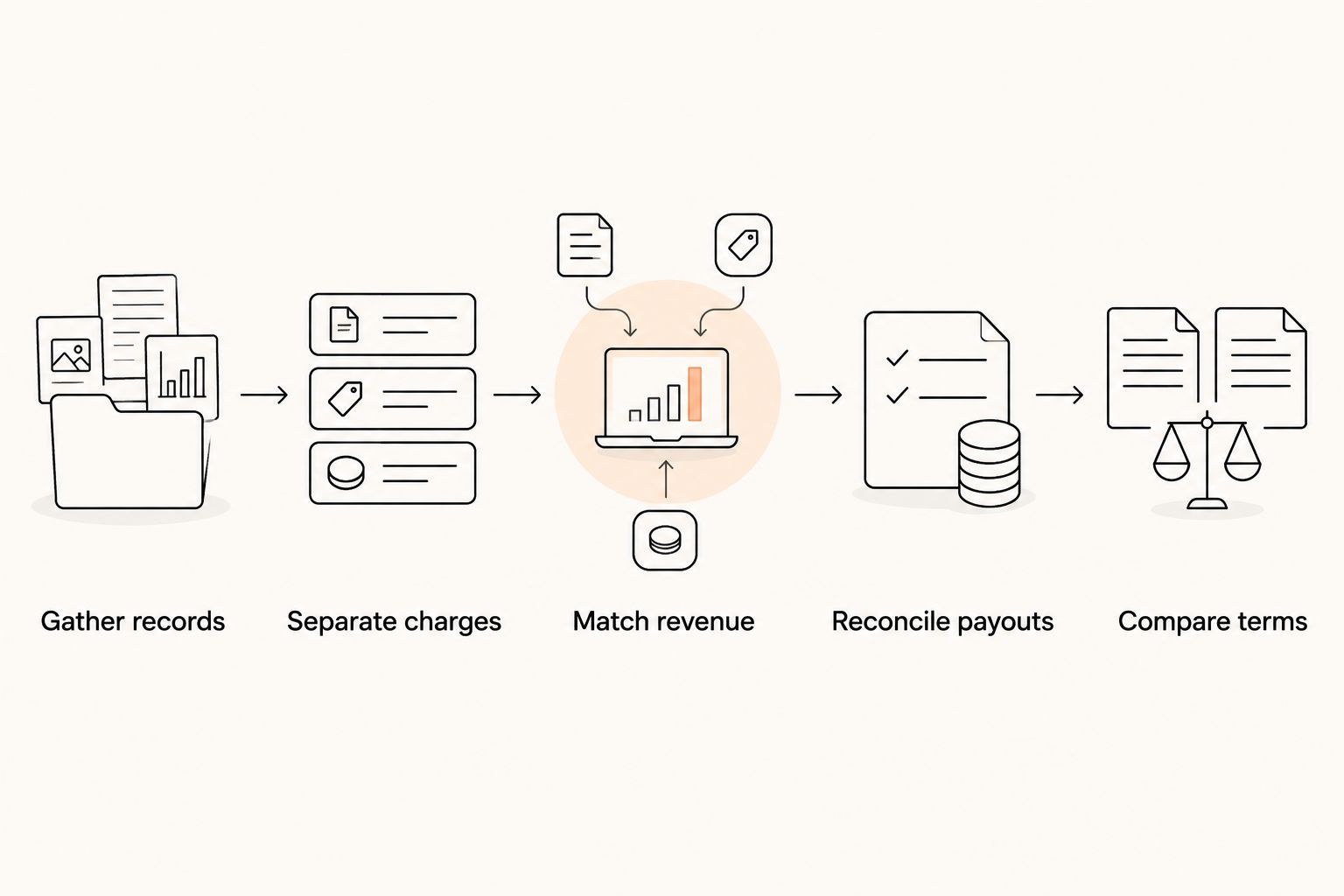
- Gather records. Collect the processor statement, transaction export, software invoice, and payout report for the same dates.
- Separate charges. Identify processing charges, platform payment fees, subscription charges, and conditional payment charges. Avoid counting a charge twice when it appears in multiple reports.
- Match revenue. Total successful card payments for that period. Record refunds and disputes separately so you can explain their effect.
- Reconcile payouts. Match payments, deductions, refunds, and payout timing to the deposits in your bank account.
- Compare terms. Apply each proposed fee structure to the same transaction history, then examine the operational differences.
Keep a reconciliation note for any difference you cannot explain immediately. A payment collected near the end of a reporting period can appear in a later bank payout, so bank deposits alone are not a reliable substitute for a transaction report.
Repeat the calculation after a material change in your billing setup. Switching payment methods, changing collection frequency, or moving software can change which charges apply.
Is the lowest processing rate always the cheapest choice?
The lowest percentage rate is not necessarily the lowest total collection cost. Fixed transaction charges, platform payment fees, and applicable extras belong in the same calculation.
Compare operational requirements separately. A cheaper payment arrangement is not a substitute for accurate member balances, clear payment status, or a workable process for resolving failed dues.
For your 2026 review, ask each provider to explain the same billing scenario using your own records. Request the assumptions in writing, including payment method, currency, and transaction count.
Do not assign a financial value to administrative savings unless you have measured the work. Record the tasks involved first: identifying the failed payment, contacting the payer, checking the result, and updating the member record.
Does a failed membership payment count as processing cost?
A failed membership payment is uncollected revenue, not a successful collection. Keep unpaid dues separate from processing charges so you can see both problems clearly.
Check the processor’s terms for any charges associated with payment attempts or related services. Do not assume every attempted payment is charged identically, or that every failed payment is free of charges.
Give staff a clear recovery process. Confirm the payment status, contact the authorized payer, record the next action, and verify settlement before marking the balance paid. Avoid collecting a replacement payment without checking whether an earlier payment is still pending.
What should I check when choosing martial arts billing software?
MatPilot is best suited to martial arts owners who want Stripe billing alongside attendance, scheduling, and per-art grading. MatPilot gym management software serves BJJ academies and multi-discipline schools, including striking arts.
The relevant benefit is the combination of membership administration and martial arts records. The boundary is financial: choosing MatPilot does not remove the need to review payment charges, reconcile payouts, or resolve disputed payments.
MatPilot includes an AI co-pilot with approval gates for actions involving payment issues and other gym workflows. Keep that approval step distinct from settlement. A proposed action is not evidence that a member’s payment has cleared.
When evaluating MatPilot gym management software in 2026, ask these questions about your own workflow:
- Where will staff see the current payment status?
- Who reviews a payment issue and approves the next action?
- How will the gym distinguish a pending payment from a settled payment?
- What records will the bookkeeper use to explain each payout?
These are acceptance checks, not promises about a particular screen or automated result. Test the workflow you need before changing how your academy collects dues.
FAQ
How much does credit card processing cost for gyms?
Gym credit card processing cost is the total of processor charges, any software payment fees, and applicable payment-related extras. Calculate it using your successful payments and actual transaction count rather than a headline percentage alone.
Is my gym software subscription included in processing fees?
A gym software subscription and payment processing are separate cost components unless your agreement explicitly combines them. Review them separately, then add them together when comparing total operating cost.
Why is my gym’s bank payout smaller than the payments collected?
A bank payout can reflect deducted fees, refunds, disputes, and payout timing. Reconcile the processor’s payout report against the transaction report before treating the difference as a processing charge.
Do family memberships change card processing costs?
Family memberships affect processing cost when they change payment value or transaction count under your fee structure. Confirm payer authorization and billing records before combining payments.
Can I compare an Irish processing quote with a US quote?
Compare Irish and US quotes within their own merchant-account country, currency, and payment-method terms. A euro quote does not establish the charges that apply to a US dollar account.
Does MatPilot handle membership billing?
MatPilot supports membership billing through Stripe alongside martial arts gym management features. Review the applicable platform and processor payment terms separately before budgeting collections.
Should I switch gym software just to get a lower card rate?
Switch only after comparing total collection cost and checking the billing workflow your gym needs. Include applicable payment fees, subscription charges, migration work, and payment authorization requirements in the decision.
One last thing
A smaller bank deposit does not prove you paid a higher processing rate. Refunds and settlement timing can change the deposit without changing the underlying rate.
Before requesting another quote, make your current statement explainable. Match collected dues to charges and payouts. Then compare providers against that same payment history; otherwise, you are comparing assumptions rather than costs.