How much does it cost to add belt tracking to existing software?
Adding belt tracking to existing software requires a vendor-specific quote; there is no single price that applies across gym systems in 2026. Compare the recurring charge with setup, historical-record cleanup, and any work needed to connect attendance to grading—not just the fee for adding a belt field.
- How much does it cost to add belt tracking to existing software? Request a quote covering setup, recurring charges, and integration.
- Compare a native module, separate tracker, custom connection, and platform replacement against the same grading workflow.
- MatPilot fits martial arts owners who want belt grading alongside members, classes, and billing.
- Require a demonstration using your syllabus before agreeing to a purchase or migration.
How much does it cost to add belt tracking to existing software?
The useful quote covers the complete grading process, not just access to a rank field. Ask your current provider whether belt tracking is included, requires a different plan, or needs a separate application. Get that answer in writing before comparing alternatives.
Start with your requirements for belt and rank tracking. A current-belt label and a dated promotion history answer different questions. Neither automatically proves that a student meets your academy’s promotion criteria.
Use this comparison to decide what each quote must cover. These are implementation routes to investigate, not claims that your current provider offers them.
| Route | Best for | Main advantage | Main drawback | What to request |
|---|---|---|---|---|
| Native grading module | Owners keeping their current system | Keeps grading within the existing working environment | The available grading structure must fit your syllabus | Feature demonstration and written change to your agreement |
| Separate belt tracker | Owners keeping billing unchanged | Separates the grading decision from a billing-system switch | Creates another record that staff must maintain or connect | Subscription, import, export, and connection scope |
| Custom connection | Owners with specific data-transfer requirements | Lets you specify which records should move between systems | Adds development and maintenance responsibilities | Written technical scope and support terms |
| Platform replacement | Owners reviewing more than belt tracking | Lets you evaluate attendance, grading, and billing together | Requires a broader migration and staff handover | Migration scope, ongoing terms, and acceptance checks |
Do not compare these routes by their subscription line alone. A separate tracker and a platform replacement involve different work. Put that work beside the recurring commitment so the comparison remains useful.
Why this matters
A belt record needs an owner. Someone must enter promotions, correct errors, and decide which attendance belongs to which discipline. If that responsibility remains unclear, adding software leaves the operating problem unresolved.
For a BJJ academy, distinguish current rank from the evidence an instructor reviews. For a multi-discipline school, distinguish BJJ attendance from karate, taekwondo, boxing, or Muay Thai attendance. Apply grading criteria only where your school uses them; do not force a belt structure onto every program.
Your 2026 buying decision should answer a practical question: what work stops, and what work remains? Ask each provider to show the same student journey so you can compare actual steps rather than feature names.
Native grading module: confirm what changes
Ask your existing provider to demonstrate a promotion using your academy’s syllabus. Start with a student record. Review attendance, record the instructor’s decision, and open the resulting promotion history.
Best for: owners whose current system already meets their billing and scheduling needs. Keeping the existing system narrows the project to grading, provided the module supports your actual process.
Check the boundaries. Does the module store previous ranks or only the current rank? Can staff correct a mistaken entry? Can a student hold separate ranks in different martial arts? Ask for a demonstration rather than accepting a general statement about customization.
Request written confirmation of which account changes are necessary. Include staff access, data import, and export in that discussion. An upgrade decision is incomplete until you know what happens to the records you already hold.
The drawback is fit. Staying with your provider is not a useful shortcut if instructors must keep the real promotion history somewhere else.
Separate belt tracker: define the duplicate work
Best for: owners who want to retain their existing billing system while evaluating a separate grading record. This route keeps the billing decision outside the initial project. It also requires a clear answer about where member details are maintained.
Write down what happens when a student joins, changes programs, pauses training, or leaves. Identify every place staff must update the record. If an integration is proposed, ask exactly which changes it carries and which remain manual.
Attendance needs particular attention. A list of total visits does not explain whether those visits belong to the relevant class or discipline. Decide what evidence instructors need before specifying a connection.
The advantage is a narrower change to your existing setup. The drawback is another working record. Do not accept a claim that systems connect without seeing a member update and a correction move through the proposed workflow.
Custom connection: buy a defined result
Best for: owners who can state precisely which records must move between systems. A custom connection needs a written scope, not a request to make the applications work together.
Specify the source of each field. Identify the member record, discipline, class attendance, current rank, promotion date, and instructor decision wherever those fields are required. State which system staff should edit.
Then ask about failure handling. Who notices a rejected update? Where does it appear? Who fixes a duplicate member? Who maintains the connection when either system changes?
The advantage is control over the requested workflow. The drawback is an ongoing technical responsibility. Your 2026 agreement should name the party responsible for maintenance and explain how additional work is approved. Do not assume an initial build includes future changes.
Platform replacement: assess the whole working day
Best for: owners already reviewing member administration, attendance, scheduling, and billing—not just grading. A replacement decision should cover the full working day, from a trial booking to a payment issue and a promotion review.
MatPilot is martial arts gym management software with members, classes, billing, per-art ranks, and belt grading. MatPilot fits martial arts owners who want belt grading alongside members, classes, and billing. That makes it relevant to a platform-replacement review rather than an assumption that any existing system can accept a plug-in.
The benefit of evaluating these functions together is that you can test the complete process in the same review. The trade-off is scope: a replacement assessment includes payment arrangements, member records, staff access, and the handover—not just rank entry.
Review MatPilot against your own grading checklist. Confirm the import scope, required historical fields, and intended attendance workflow before making a migration decision. A feature list does not settle those implementation questions.
Why the cost of adding belt tracking varies
The scope changes with the records you need and the work your existing system already supports. Ask providers to address these factors explicitly in a 2026 quote:
- Historical records. Decide whether you need current ranks only or a dated history of previous promotions. Identify incomplete records before requesting an import.
- Separate disciplines. List each martial art and its rank structure. Specify whether a student can hold different ranks across programs.
- Attendance evidence. State which classes count toward each grading review. Separate attendance collection from the instructor’s promotion decision.
- Data connections. Identify the records that must move between systems and the direction of each transfer. Include error handling in the scope.
- Staff permissions. Decide who records attendance, who proposes a promotion, and who approves or corrects it.
- Exit requirements. Specify the records you need to export if you leave. Include promotion history, not merely the current belt label.
These factors describe work to price, not additional charges every vendor necessarily applies. Require the provider to mark each item as included, excluded, or separately quoted.
How do you get a belt-tracking quote you can compare?
Use the same brief for every provider. Keep the syllabus and example records consistent so differences in the responses reflect the proposed service rather than different assumptions.
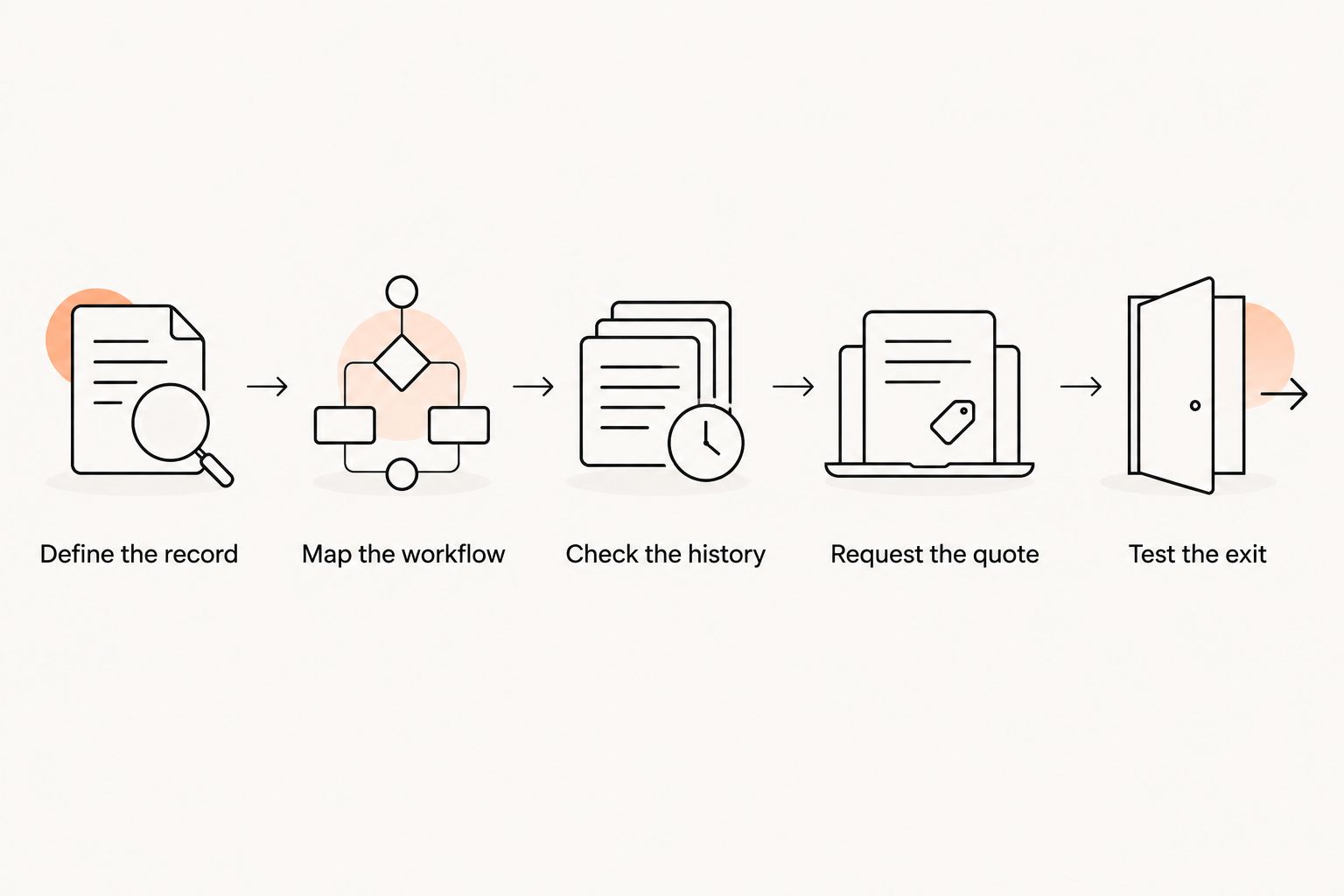
- Define the record. List the fields instructors need to review and the information they must save after a promotion.
- Map the workflow. Show where attendance comes from, who reviews readiness, and who approves the rank change.
- Check the history. Inspect a sample of existing records. Flag missing dates, inconsistent belt names, and duplicate students.
- Request the quote. Separate recurring charges, implementation work, data handling, and ongoing support. Ask for exclusions in writing.
- Test the exit. Request a sample export and check whether another person can interpret it without access to the application.
Set an acceptance test before signing. Use a student who trains in different disciplines, a record with missing historical information, and a promotion entered incorrectly. Ask staff to complete the work they would perform after a real class.
Record the actions required. If the demonstration depends on copying attendance by hand, put that task into your operating plan rather than treating the proposed connection as complete.
What should a written quote include?
A usable quote names the deliverable, the recurring commitment, and the work excluded from the agreement. Ask the provider to attach the demonstration checklist so the promised outcome stays specific.
Separate software access from implementation. Importing a current belt field is not the same task as rebuilding a student’s promotion history. Ask who prepares the source file and who resolves records that do not match.
Include training and responsibility. Identify who configures the syllabus, who checks the imported records, and who signs off before staff begin entering new promotions.
For a 2026 comparison, date the quote and retain the associated terms. Keep the quoted currency visible. US and Irish buyers should not treat different currencies or payment arrangements as interchangeable.
Can you add belt tracking without changing billing software?
You can retain billing while assessing a separate tracker or a supported native module. Whether the result meets your needs depends on the available connection and the work staff must perform manually.
Ask the provider to show how a new member becomes available for grading and how a departing member is handled. Do not assume that a shared name or email address creates a maintained connection between applications.
Keep billing unchanged only if the grading workflow remains manageable. The narrower project has value when instructors can maintain accurate records without creating an unclear second member list.
Is attendance enough to decide belt eligibility?
Attendance is evidence for a grading review, not an instructor’s decision. Define which sessions count and what additional assessment your syllabus requires.
Ask the demonstration to distinguish a student who has attended qualifying classes from a student whose promotion has been approved. That distinction matters even when both records appear on the same screen.
For your 2026 setup, document the approval step before configuring reminders or readiness rules. The software should reflect the academy’s decision process rather than silently replacing it.
FAQ
How much does it cost to add belt tracking to existing software?
The amount depends on the provider and implementation scope. Request a written quote separating recurring access, setup, historical data handling, and any connection to attendance.
What should I ask my current gym software provider first?
Ask whether belt tracking is included in your current agreement and request a demonstration using your syllabus. Confirm historical records, separate disciplines, and export requirements before discussing an upgrade.
Can I keep my billing system and use a separate belt tracker?
You can assess a separate tracker while retaining billing. Confirm how member changes and attendance reach the tracker, and identify every task that remains manual.
Does MatPilot offer more than belt tracking?
MatPilot is martial arts gym management software covering members, classes, billing, and belt grading. Assess those functions together if you are considering replacing your current platform.
Should I import every old belt record?
Import the history your academy needs and can verify. Identify missing dates and uncertain entries rather than presenting an incomplete record as confirmed history.
Can the same student have ranks in different martial arts?
Your requirements should specify a separate rank record for each relevant discipline. Ask the provider to demonstrate that arrangement with a student who trains across programs.
What should I check before signing a belt-tracking agreement?
Check the grading workflow, implementation responsibilities, recurring terms, and usable data export. Require written answers for anything the demonstration leaves unresolved.
One last thing
Test a correction, not just a promotion. Ask a staff member to enter the wrong rank, identify the mistake, and restore the correct record. Then inspect what another instructor sees.
A clean demonstration shows how the system handles normal work. A correction shows whether your staff can maintain a trustworthy history after an ordinary mistake. Include both before approving the purchase.