Is martial arts gym software worth it for a small dojo?

Yes—martial arts gym software is worth it for a small dojo when it replaces repeated work in billing, attendance, scheduling, or grading. It is not worth adopting just because other schools use it: setup, record cleanup, and daily upkeep must solve a problem you already have, not create another job.
- Is martial arts gym software worth it for a small dojo? Yes, when it replaces recurring administrative work.
- MatPilot suits martial arts owners who need member management, billing, attendance, and per-art grading together.
- Keep manual records when you can reliably manage payments, attendance, and follow-ups without duplicate work.
- Measure administrative work before switching; a feature list does not prove value.
Why this matters
A small dojo still has work outside teaching. You need to know who paid, who attended, which trial needs a reply, and which student is ready for a grading review. Student count alone does not tell you how difficult that work is.
For your 2026 software decision, start with the task that interrupts teaching most often. The guide to gym software for small martial arts academies provides a separate starting point for comparing systems. Here, the decision is simpler: does moving your work into software remove more effort than it adds?
Is martial arts gym software worth it for a small dojo?
Martial arts gym software is worth it when your current records no longer give you a reliable answer without checking several places. A payment record, attendance sheet, and grading notebook can each work well. The problem starts when you repeatedly reconcile them by hand.
Use this comparison to choose the approach that matches your actual workload. These are operating approaches, not claims about particular vendors.
| Approach | Best for | Advantage | Limitation |
|---|---|---|---|
| Manual records | Owners whose existing process stays accurate and manageable | You keep familiar tools and control the record format | You must enter updates and reconcile separate records yourself |
| A billing-focused setup | Owners whose main problem is collecting and checking dues | It focuses the change on payment administration | You still need a separate process for attendance and grading |
| Martial arts gym software | Owners handling connected membership, class, payment, and rank records | It can bring those tasks into one working system | Setup and consistent staff use become part of the job |
Choose manual records if they already work. Choose a billing-focused approach if payment administration is the only recurring difficulty. Choose martial arts software when the connection between records is the problem—for example, checking attendance alongside a student's grading history.
The test is not whether software has more features. It is whether you can complete a real task without copying information, searching messages, or rebuilding a list.
When manual records are enough
Best for: an owner with a simple routine and dependable records. Manual records remain a valid choice when you can identify unpaid dues, record attendance, and prepare grading decisions without repeated checking.
Ask yourself whether another instructor can understand the records without asking you to interpret them. A process that only works inside the owner's head is different from a documented process that happens to use a spreadsheet.
Keep the manual approach when:
- Payment status is clear and gets updated consistently.
- Attendance records are complete enough for your teaching decisions.
- Schedule changes reach the people who need them.
- Rank records distinguish each student's art and current grade.
- Trial enquiries have a clear next action.
The advantage is continuity. You avoid a migration and keep a process you know. The limitation is that every connection between separate records remains your responsibility.
For your 2026 review, write down those tasks before shopping. If you cannot identify a recurring difficulty, there is no operational reason to replace the process yet.
When billing is the main reason to switch
Best for: an owner who spends repeated effort checking dues or following up on payment problems. Start with billing when you regularly compare payment records against a membership list to decide who needs attention.
Separate a failed payment from a membership decision. A failed payment needs investigation and follow-up. A cancellation needs a confirmed status and an effective date. Treating both as a vague unpaid label makes the next action unclear.
Use a real billing task to evaluate a system:
- Find the member's current payment status.
- Identify the payment issue without searching unrelated messages.
- Decide who needs to contact the member.
- Record the next action.
- Check that the membership record reflects the resolved issue.
For families, include the parent or guardian in your evaluation. Ask how the system represents the payer and the students they pay for. Do not assume that a vendor's use of the phrase family billing matches your dojo's arrangements.
The benefit of a billing-focused change is a narrower implementation. Its limitation is scope: a payment tool alone does not answer an attendance or grading question. Evaluate those tasks separately before buying a larger system.
When attendance, scheduling, and grading justify software
Best for: an owner whose decisions depend on records from several parts of the dojo. Software becomes more useful when you need to connect membership status, class participation, and rank history rather than manage each independently.
For BJJ, test whether the record supports your actual grading process. For karate, judo, and taekwondo, check that your syllabus and rank structure remain clear. For boxing, Muay Thai, and other striking classes, evaluate scheduling, attendance, and member follow-up without forcing a belt-based workflow onto them.
A multi-discipline school needs a further check: a student's progress in one art must not stand in for progress in another. Ask the vendor to show how the same member's records remain distinct across disciplines.
MatPilot is best for martial arts owners who need member management, billing, attendance, and per-art grading together. MatPilot provides those functions alongside scheduling, Stripe billing, Xero sync, and a co-pilot with owner approval gates. It is available through the web and native iOS and Android apps.
The limitation is practical. Software still needs accurate member records, a usable timetable, and instructors who record attendance consistently. An approval gate also requires your attention; it does not transfer your teaching or membership decisions to the system.
Why the value varies between small dojos
The value of martial arts gym software varies with the work you need it to handle. Use these factors in your 2026 evaluation rather than treating membership size as the only deciding number.
- Payment follow-up: Identify how you find payment issues, assign responsibility, and record resolution.
- Class scheduling: Check who maintains the timetable and how changes reach students or parents.
- Attendance: Decide whether attendance supports follow-up, grading review, or simply a reliable class record.
- Per-art ranks: Confirm whether students train in several disciplines and need separate rank histories.
- Trial follow-up: Establish who replies to enquiries and how the next action stays visible.
- Accounting handoff: Identify what your bookkeeper needs and where payment reconciliation currently requires manual work.
These factors describe operational complexity. They do not promise a financial return. A school with tidy records and straightforward decisions has a different starting point from one where the owner repeatedly reconstructs what happened.
How can you test whether software earns its place?
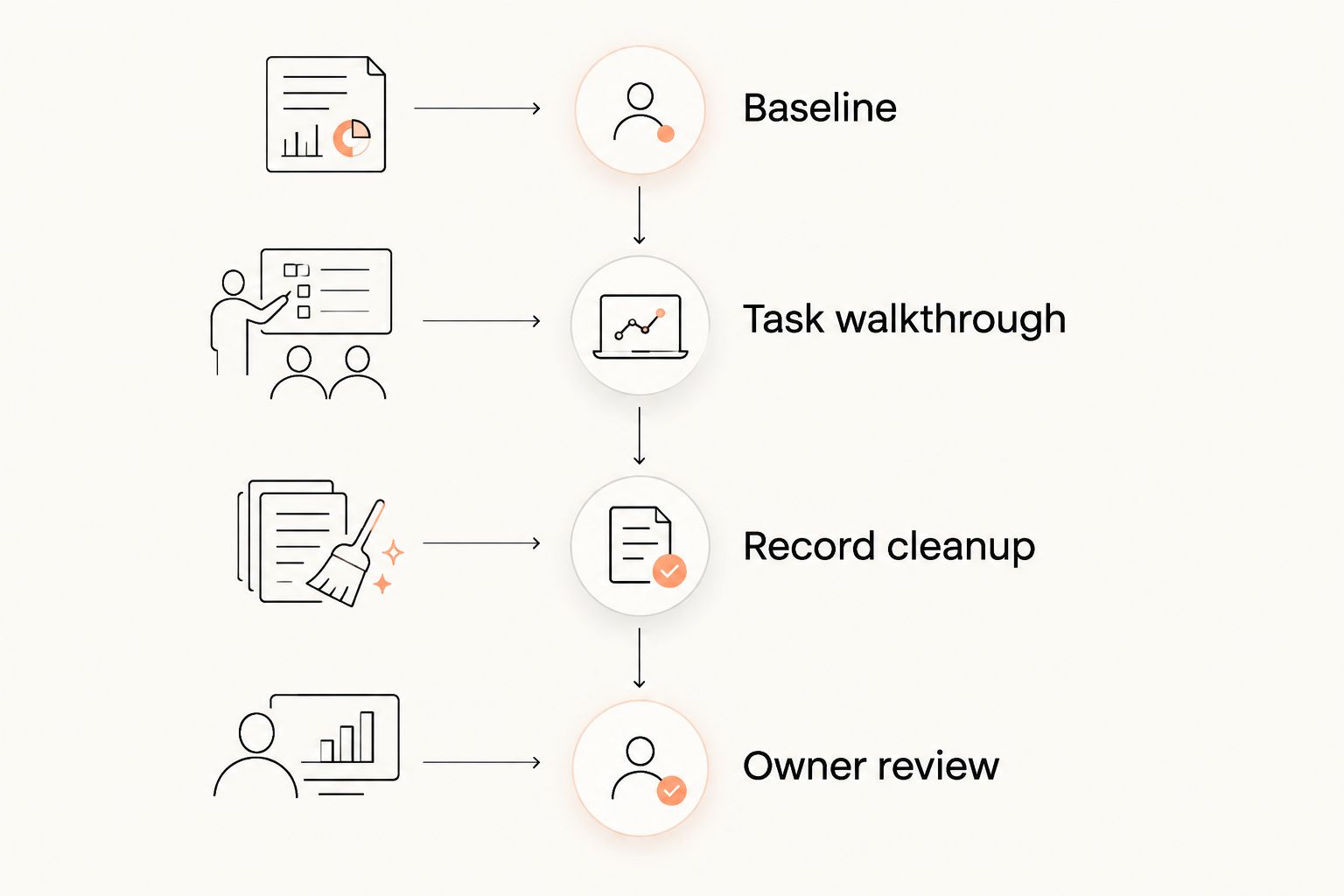
Use a 7-day baseline, a 15-minute task walkthrough, and a 30-day review as a suggested evaluation plan. These are measurement periods, not promised savings or implementation deadlines. Extend them if they do not capture your dojo's normal billing and class routine.
Baseline
For the 7-day baseline, record each time you check payment status, update attendance, change a class, prepare a grading review, or follow up with a trial student. Note the task, the records you opened, and whether you copied information between them.
Measure your own work. Do not borrow another school's claimed time savings or assign a value to features you will not use.
Task walkthrough
Use the 15-minute walkthrough to attempt one task with representative records. Choose a task you already identified, such as finding a payment issue or reviewing attendance before a grading decision.
Ask to see the complete sequence. Finding a dashboard is not the same as finishing the task. Check where you make the decision, where you record it, and what the next instructor sees.
Record cleanup
Before switching, correct member details, active statuses, and rank records. Decide which old information you need to retain and which records require review.
Keep the cleanup separate from the software evaluation. Moving inconsistent records into a new system does not make them accurate.
Owner review
After the suggested 30-day review period, repeat the same tasks. Compare the work against your baseline and ask whether you still maintain duplicate records.
Keep the system only if the live process is clearer and the work is easier to complete. If the new system adds a second attendance list or another payment check, investigate that duplication before expanding its use.
Is gym software worth it if you only teach one class a week?
One class a week does not rule out software, but the class count alone does not justify it. Check the work around that class: collecting dues, recording attendance, contacting parents, and following up with new students.
Keep manual records if those tasks remain dependable and manageable. Evaluate software if you repeatedly reconcile records even though the teaching schedule is simple.
Can software replace your grading judgment?
Software can organize grading evidence; it does not replace your grading judgment. Attendance and rank records help you prepare a review, but the instructor still decides whether the student's performance meets the syllabus.
For your 2026 setup, define what instructors record and what the decision-maker reviews. Keep attendance, technical assessment, and the final promotion decision distinct.
Should you switch before adding more classes?
Switch before expanding only when your current process already needs correction. Adding classes is a reason to examine scheduling and attendance, not proof that a particular system is necessary.
First document who updates the timetable and who records attendance. Then test that workflow in software. A clear process gives you something concrete to evaluate.
FAQ
What's the best way to decide if gym software is worth it for my small dojo?
The best way is to test a recurring task against your current process. Record the work before switching, then check whether software removes duplicate entry, searching, or reconciliation.
Is a spreadsheet better than martial arts gym software?
A spreadsheet is better when it keeps your records accurate and your work manageable. Martial arts gym software is the stronger option when you repeatedly connect separate membership, billing, attendance, and grading records by hand.
Do I need software if I only teach one class a week?
One class a week does not automatically require software. Evaluate the payment, attendance, parent-contact, and trial-follow-up work around the class rather than the timetable alone.
Can a small dojo use MatPilot?
MatPilot supports martial arts member management, scheduling, attendance, billing, and per-art grading. Evaluate those tasks against your dojo's actual process; its Free plan has a limit of up to 20 members.
Will software automatically decide who deserves a belt promotion?
Software should not replace the instructor's promotion decision. Use attendance and rank records as evidence, then assess the student's performance against your syllabus.
Should I move all my records into a new system immediately?
Clean and review the records before moving them. Confirm member details, membership status, and rank history, then test a representative workflow before relying on the new system.
Does a small boxing or Muay Thai gym need belt tracking?
A boxing or Muay Thai gym does not need to adopt a belt-based process to use management software. Evaluate scheduling, attendance, billing, and member follow-up against the way you teach.
One last thing
Test whether you can stop using an old record, not just start using a new screen. That is the most useful final check for your 2026 decision.
Pick the duplicate list you want to retire. Ask what would prevent you from removing it: missing information, an unclear staff responsibility, or a task the new system does not handle. Resolve that specific obstacle before adding more features.