Is month-to-month gym software better than a contract?
Month-to-month gym software is the better choice when you need to prove that billing, attendance, scheduling, and grading work before making a longer commitment. A fixed-term agreement makes sense when the software already fits your academy and the written terms justify the commitment. Monthly billing alone does not establish monthly cancellation rights; check the commitment period, notice requirement, renewal clause, and exit process separately.
- Is month to month gym software better than a contract? Yes, when operational fit remains unproven.
- Monthly billing and monthly cancellation are different terms. Read the agreement before signing.
- MatPilot suits martial arts owners seeking member management, billing, scheduling, and per-art rank tracking together.
- Choose a fixed term only after checking renewal, cancellation, data export, and payment migration requirements.
Is month-to-month gym software better than a contract?
Choose month-to-month terms when you still need evidence that the software fits your academy. Choose a fixed term only after that evidence exists. Both arrangements are contracts; the useful comparison is rolling commitment versus fixed commitment.
| Arrangement | Best for | Main advantage | Main drawback | What to verify |
|---|---|---|---|---|
| Month-to-month agreement | Owners still evaluating daily workflows | A shorter commitment when cancellation terms permit it | Leaving still requires data, payment, and staff preparation | Notice deadline, cancellation method, and export access |
| Fixed-term agreement | Owners with a proven operational fit | A defined commitment with written obligations | Early departure can leave contractual obligations | End date, early termination terms, and renewal rules |
For a concrete martial arts feature checklist, MatPilot covers member management, classes, billing, and belt grading. Use those operational areas to assess fit, then review subscription terms separately.
In your 2026 review, ask the vendor to identify the exact clause governing cancellation. A sales description is not a substitute for the agreement you accept.
Why this matters
Gym software touches the work that must continue when you switch: collecting dues, recording attendance, maintaining ranks, and telling students where to train. A shorter subscription does not move those records for you.
For a BJJ academy, assess whether instructors can find attendance and rank information during normal teaching. For boxing, Muay Thai, or MMA programs, check that the timetable and membership structure match how students actually train. A favorable cancellation clause cannot repair a poor daily workflow.
Keep two decisions separate:
- Operational fit: Can your staff complete the work correctly?
- Commitment risk: What must your academy do if the software stops fitting?
Approve both before you commit. Neither decision replaces the other.
Month-to-month software: best for testing operational fit
A rolling agreement gives you a shorter commitment when its cancellation terms actually allow that. It is useful when you are replacing spreadsheets, changing your class structure, or evaluating software you have not used in daily operations.
The advantage is contractual flexibility. The drawback is that flexibility does not eliminate onboarding, staff training, or migration work. Treat month-to-month terms as permission to evaluate carefully, not permission to skip evaluation.
Build a small acceptance checklist before activating your academy. Use examples from your actual membership structure, without exposing unnecessary personal information during demonstrations.
Ask staff to demonstrate these tasks:
- Find a member and check the correct membership status.
- Record attendance against the intended class.
- Review a failed payment and identify the next action.
- Find a student's rank under the correct martial art.
- Update a timetable without creating conflicting instructions for students.
Keep the software only if the recurring work passes your checks. Do not confuse a polished demonstration with proof that your own setup works.
For your 2026 evaluation, record the outcome of each task: passed, failed, or unresolved. Unresolved billing and member-record questions belong on the decision list, not in a forgotten support conversation.
Fixed-term software: best for a proven academy workflow
A fixed term deserves consideration after you have verified the product and documented the vendor's obligations. Ask what the longer commitment provides, and make sure the answer appears in the agreement rather than only in a conversation.
The advantage is a defined arrangement that both parties can reference. The drawback is the commitment itself: leaving before the end date does not automatically end your obligations.
Before accepting a fixed term, request written answers about:
- The commitment start and end dates.
- Any implementation work included in the agreement.
- Responsibilities when setup is incomplete or incorrect.
- Cancellation and early termination provisions.
- Renewal and notice requirements.
- Access to records when the relationship ends.
Do not assume that a fixed term guarantees better support or that a rolling agreement provides less support. Compare the actual service commitments.
A longer term needs a documented reason. If the only reason is that the vendor prefers it, you have not established a benefit for your academy.
Why the better choice varies
The right commitment depends on your operating requirements, not the label on the subscription page. These factors determine how much flexibility you need:
- Unproven workflows. If billing, attendance, or grading remains untested, resolve that uncertainty before accepting a longer commitment.
- Cancellation requirements. Compare the permitted method, notice deadline, and effective cancellation date.
- Renewal language. Establish whether renewal happens automatically and what commitment follows it.
- Data access. Confirm what you can export, in which format, and when access ends.
- Payment migration. Ask how existing recurring payments will continue or be reauthorized during a move.
- Documented vendor obligations. Match any longer commitment to specific implementation or service responsibilities.
A 2026 procurement decision should use the agreement offered to your academy. Another owner's terms do not establish yours, even when you are considering the same software.
How do I check the agreement before signing?
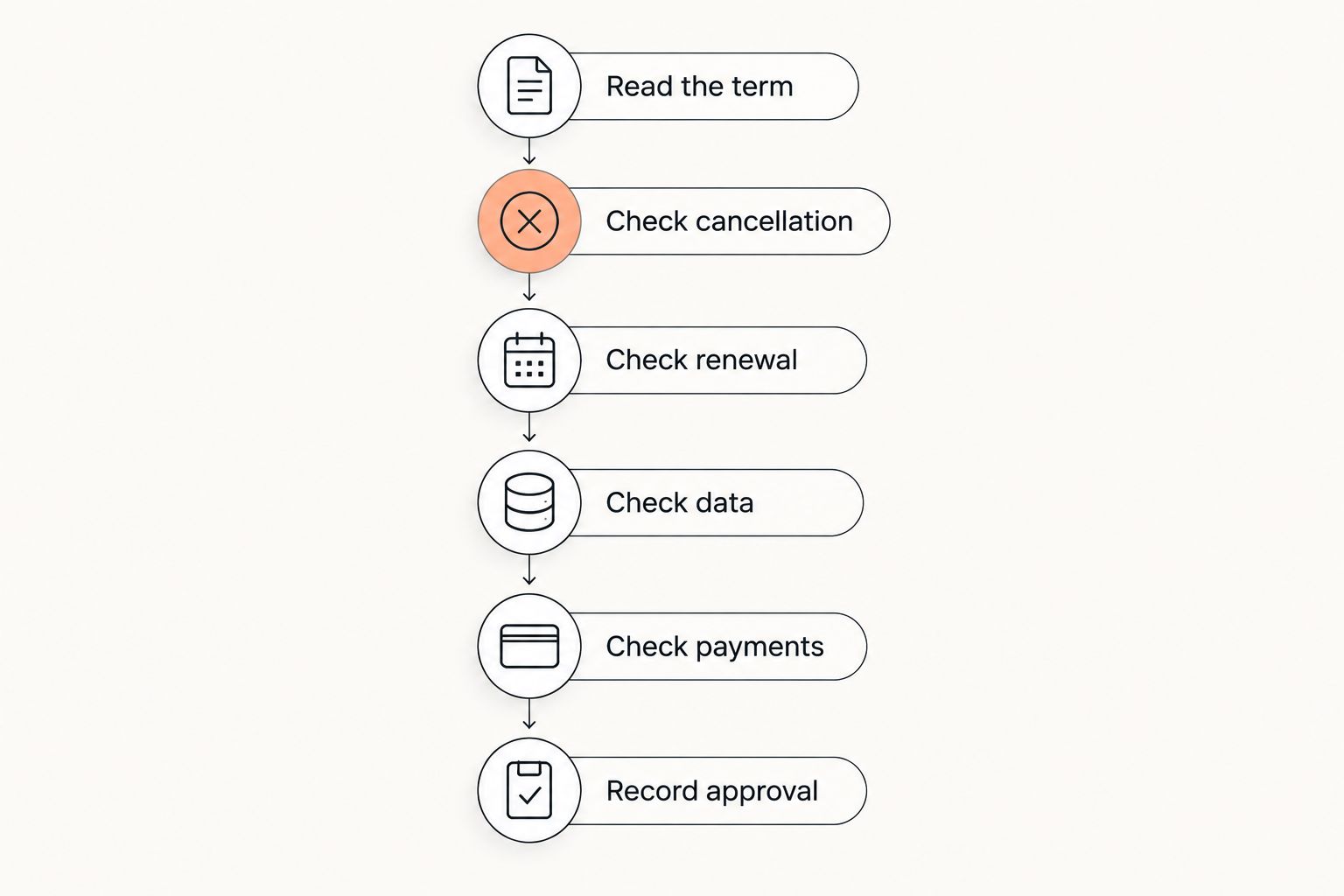
Use this sequence to turn a sales discussion into a decision you can document. Keep the agreement and the vendor's written answers together.
- Read the term. Identify when the commitment begins, when it ends, and whether billing frequency differs from commitment length.
- Check cancellation. Find the permitted cancellation method, notice requirement, and person or address that must receive it.
- Check renewal. Establish what happens at the end of the initial term and what action prevents an unwanted renewal.
- Check data. Request the export fields and file formats you need to preserve member, attendance, and rank records.
- Check payments. Ask how recurring collections are stopped or transferred, and who confirms the final collection date.
- Record approval. Resolve conflicts between the proposal, order form, and terms before accepting them.
For your 2026 records, save the accepted version and its acceptance date. If a vendor later sends revised terms, keep the earlier version rather than overwriting it.
This is a purchasing checklist, not a statement of legal rights. Get qualified advice on disputed or unclear clauses, especially when the agreement's governing law differs from your academy's location.
What should I test before making a longer commitment?
Test the work your academy repeats, including the exceptions that create extra administration. Ask the person who normally handles each task to perform it.
Billing and payment issues
Trace 1 billing cycle from the membership record to the payment result. Confirm who reviews an unsuccessful collection, what information that person receives, and how staff record the resolution.
If your academy bills families together, demonstrate that exact arrangement. Do not accept an unrelated individual-membership example as proof that your family setup works.
Attendance and teaching records
Review 1 full week of your actual timetable. Check overlapping disciplines, instructor access, and the class names students recognize.
For rank-based programs, find the student's current rank under the correct art. Do not treat a BJJ rank as a substitute for a judo or karate record. For striking programs without belts, focus on the attendance and membership information instructors need.
Owner review and approval
Give every unresolved issue a named owner. Record the expected behavior, the observed result, and the next action.
Use 1 named decision-maker to approve the final acceptance checklist. Other staff should contribute evidence, but responsibility for accepting the subscription must be clear.
Do not extend the commitment while a critical billing or record-access issue remains unresolved. A longer agreement does not make an incomplete workflow complete.
Does monthly billing mean I can cancel every month?
Monthly billing does not establish monthly cancellation rights. Billing frequency describes when you pay; the agreement defines how long you commit and how you leave.
Read the term and cancellation clauses together. Ask for written clarification if a proposal says monthly while another document describes a fixed commitment.
Can I switch software without disrupting recurring payments?
Switching software requires a separate payment transition plan. Ask both providers which payment arrangements can continue, which require member action, and who confirms that the old collection process has stopped.
Set the cutover around your academy's actual collection schedule. Follow the preparation questions in the guide to how long it takes to switch gym software, then confirm the details for your own systems.
Where MatPilot fits in this decision
MatPilot is best for martial arts academy owners who need member management, billing, scheduling, and per-art ranks together. It serves BJJ academies and multi-discipline schools, including striking arts, in the United States and Ireland.
The product includes attendance, Stripe billing, Xero sync, and an AI co-pilot with owner approval gates. Owners can access it through the web and native iOS and Android apps.
The fit question is whether those functions match your academy's work. The limitation is equally clear: a feature list does not establish that your particular billing setup, records, or migration requirements are covered. Demonstrate those requirements and review the current agreement before committing.
Apply the same 2026 acceptance checklist to this product as to any alternative. Evaluate the work first; decide the commitment second.
FAQ
Is month to month gym software better than a contract for a small academy?
Month-to-month terms are better when a small academy still needs to verify its billing, attendance, scheduling, and member workflows. Confirm that the agreement permits monthly cancellation rather than merely monthly payments.
Does no contract mean I have no obligations?
No contract is not a substitute for reading the subscription terms. Check the commitment period, cancellation method, notice requirement, renewal language, and data-access provisions before accepting the service.
Should I sign a fixed-term gym software agreement?
Sign a fixed-term agreement only after proving operational fit and identifying a documented reason for the longer commitment. Review the vendor's obligations and your early termination responsibilities before signing.
What should I ask before canceling my current gym software?
Ask how to give valid notice, when cancellation takes effect, and when access to records ends. Separately confirm the final payment collection and the process for exporting member, attendance, and rank data.
Can I keep taking membership payments while changing software?
Plan payment continuity with both providers before changing software. Confirm which arrangements can continue, whether members must authorize anything again, and who stops the old collections.
Is MatPilot only for tracking BJJ belts?
MatPilot provides martial arts gym management beyond belt tracking, including member management, classes, attendance, and billing. It also includes per-art ranks, an AI co-pilot with approval gates, and website building tools.
Are gym software cancellation rules the same in Ireland and the United States?
Do not assume an Irish academy and a US academy have identical cancellation rights or terms. Review the agreement offered to your business, its governing law, and any unclear provisions with a qualified adviser.
One last thing
The strongest exit plan starts with a usable export, not a cancellation button. Ask for the export field list before signing, then check that it covers the records your academy needs to retain.
A short commitment is useful. Records you can understand and a payment transition you can execute make that flexibility practical.