Is one platform cheaper than separate billing and website tools?

One platform is cheaper than separate billing and website tools only when its total operating cost is lower for the same work. In 2026, compare subscriptions, payment fees, setup, and ongoing administration—not just the headline plan—and include the cost of moving before you cancel anything.
- Is one platform cheaper than separate billing and website tools? Only when the full operating comparison favors consolidation.
- MatPilot combines martial arts gym management and website building tools; check your required workflows before replacing existing tools.
- Compare payment fees, website requirements, migration work, and recurring administration—not subscriptions alone.
- Keep separate tools when replacing a working website adds cost without removing enough operational work.
Why this matters
Your academy needs a working route from website inquiry to class attendance and membership payment. Buying those functions together does not, by itself, prove that the route works better or costs less.
MatPilot provides member management, classes, billing, belt grading, and website building tools. The useful question is which existing expenses and tasks a replacement actually removes. A feature you never use does not justify a switch.
Is one platform cheaper than separate billing and website tools?
One platform is cheaper when the expenses and recurring work it removes exceed the expenses and work it adds. Separate tools are cheaper when their combined operating cost stays lower and they already handle your academy's requirements.
Use this comparison sheet for your 2026 review. Enter figures from current invoices and written proposals; do not compare an existing renewal bill with an introductory offer that excludes required services.
| Cost or requirement | One platform | Separate billing and website tools |
|---|---|---|
| Subscriptions | Include every required plan and add-on | Include billing, website, and any connecting services |
| Payment charges | Check platform and processor charges separately | Check platform and processor charges separately |
| Website work | Confirm what you can build and maintain | Include the work needed to maintain the existing site |
| Administration | Test whether shared tools remove repeated work | Count handoffs and repeated updates that actually occur |
| Moving costs | Include data preparation, setup, and training | Include these only for tools you replace |
| Exit requirements | Check access to member records and website content | Check access and cancellation requirements for each provider |
Compare equivalent coverage. A website subscription does not replace membership billing merely because it accepts a payment. Likewise, billing software does not replace the pages, inquiry process, or timetable your academy needs.
Separate cash expenses from owner time. Both matter, but an hour you stop spending on administration is not automatically money removed from your bank statement.
One platform: best for replacing repeated administration
Best for: academies replacing both their website tools and member-management system, especially when staff repeat the same updates across systems.
The potential advantage is fewer handoffs. You can evaluate member records, billing, scheduling, and website work together rather than making a separate purchase decision for each task.
That advantage needs proof. A provider offering several functions does not establish that every function shares data, supports your exact workflow, or removes manual work. Ask for a demonstration using your own academy's process.
The trade-off is a wider replacement project. Moving the website and billing together means checking public pages, member records, payment setup, staff access, and training before the change is complete.
For BJJ and multi-discipline schools, include the operational details that generic billing tools do not address. Test per-art ranks, attendance, and class scheduling alongside payments. Give boxing, Muay Thai, and other striking classes the same attention as grappling classes.
Separate tools: best for keeping a working website
Best for: academies whose existing website meets their needs and whose billing process does not create repeated administrative work.
Keeping separate tools avoids replacing a website solely to reduce the number of subscriptions. It also lets you assess a billing change without making a website rebuild part of the same project.
The trade-off is responsibility for the connection between systems. Establish who updates the timetable, checks incoming inquiries, and keeps membership information accurate. If those tasks require duplicate entry, count that work rather than ignoring it.
Do not assume separation is expensive. A straightforward website and a billing process that staff understand deserve a fair comparison against any replacement.
For your 2026 decision, retain a tool because it performs a necessary job well—not because it is familiar, and not because another provider promises to replace it.
How do you compare the total cost?
Build a worksheet around the work your school actually performs. Use the same comparison period and expected payment activity for both options.
1. List current tools
Record every service involved in the journey from inquiry to paid membership. Include the website, billing system, member database, and any connecting services you pay for.
Assign each service a purpose. If you cannot name the work a subscription performs, investigate it before treating it as essential. Do not cancel it until you establish whether another process depends on it.
2. Match required work
Write down the tasks a replacement must support. Start with an inquiry, a trial booking, a membership payment, a timetable change, and an attendance record.
Add family billing and grading requirements where your academy uses them. Ask the provider to show the process, including what happens when information is incomplete or a payment fails. A feature name is not a completed demonstration.
3. Check recurring charges
Request a written breakdown of the required subscription, payment charges, add-ons, and renewal terms. Identify which charges belong to the software provider and which belong to the payment processor.
Use the same expected transaction activity for both proposals. Different assumptions about payment volume or payment methods make the resulting totals unsuitable for comparison.
4. Test daily work
Follow an inquiry through to a member record and a payment. Then change a class and check the places where that change must appear.
Record each manual handoff. Include correction work, such as resolving a mismatch between a member's status and the information used for billing. Test whether the proposed setup removes that task rather than moving it elsewhere.
5. Plan the switch
List what must move, what must stay accessible, and who signs off before launch. Keep website content, member records, rank history, payment arrangements, and staff training as separate checklist items.
Check payment continuity before cancelling the old billing service. For that part of the project, use the guide to switching payment processors without disrupting billing.
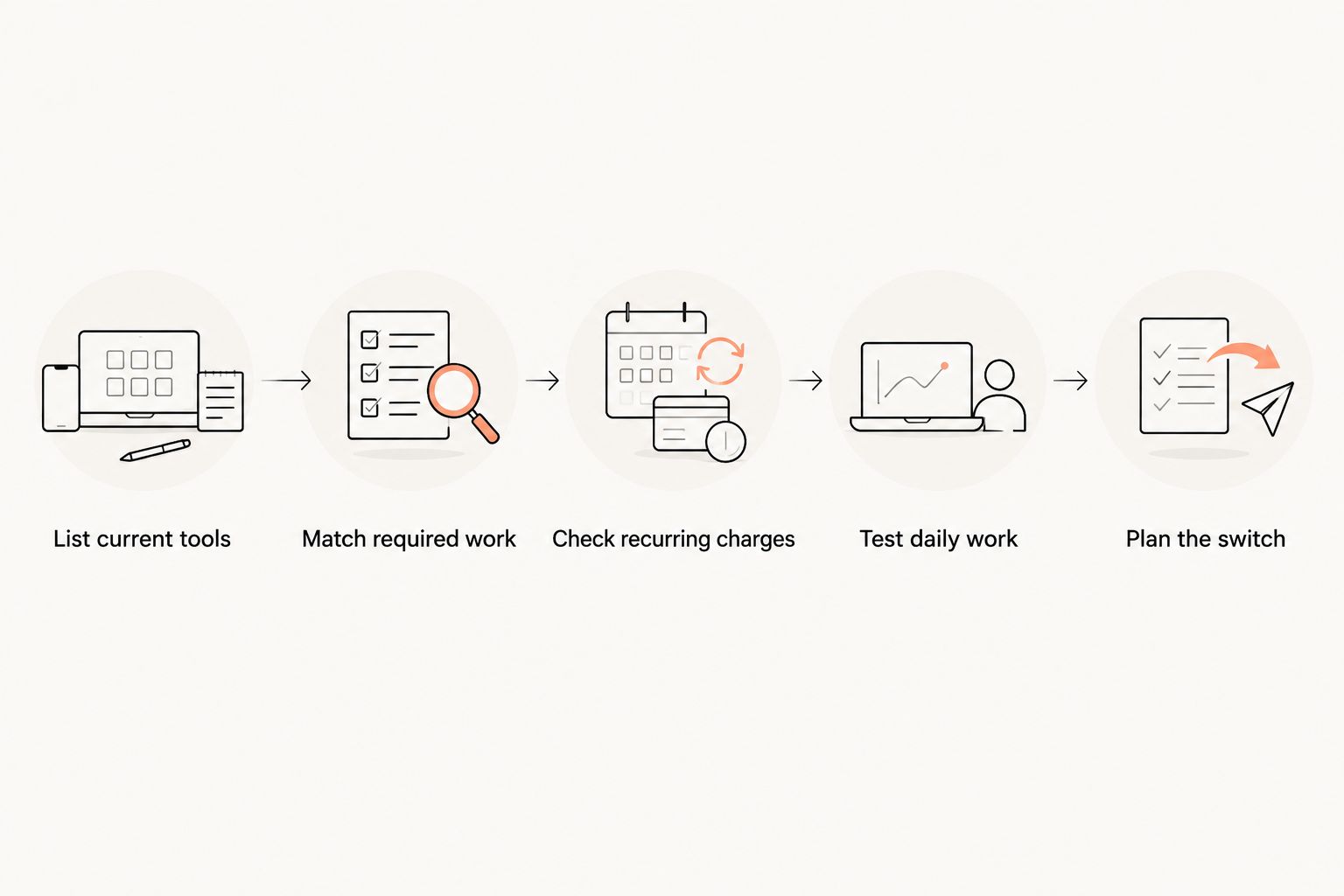
Keep the worksheet after the purchase. Your 2026 comparison becomes a record of what the provider demonstrated, which services you expected to replace, and which tasks still belong to your staff.
Why the total cost varies
The answer changes with the work your academy needs, not simply the number of tools on its invoice list.
- Required functions. Member management, scheduling, attendance, billing, and rank tracking are different jobs. Compare the functions you need, not the longest feature list.
- Payment arrangements. Compare charges using the same payment activity. Confirm whether a quoted charge includes or excludes payment processing.
- Website requirements. List the pages, inquiry forms, timetable information, and editing tasks your academy needs. Check each requirement before replacing the current site.
- Manual handoffs. Count repeated updates and checks in your actual process. Do not assign savings to automation you have not seen demonstrated.
- Migration work. Include preparing records, checking imported information, training staff, and coordinating the change. Keep these separate from ongoing expenses.
- Cancellation and export terms. Read each agreement and establish how you retain access to records and content. Do not assume the same terms apply across providers.
A smaller subscription bill can still leave you with more work. Conversely, a broader system does not earn its place unless your academy uses enough of its functions to justify the change.
Where MatPilot fits in the comparison
MatPilot fits martial arts owners who want member management, billing, and website tools from one provider. Its scope includes classes, attendance, per-art ranks, belt grading, billing through Stripe, and Xero sync.
That makes MatPilot relevant to this comparison, but it does not establish that every academy should replace its existing website. Demonstrate your required website and billing workflows before making that decision.
For a BJJ academy, test how staff review attendance and rank information alongside member administration. For a multi-discipline school, test the separate ranks and timetable requirements of each art. A boxing class needs its own scheduling check, not a passing mention during a BJJ demonstration.
The trade-off is implementation work. You still need to review records, configure the processes you intend to use, and approve the change. Treat those tasks as part of the purchase decision rather than assuming a broader product removes them.
Will combining tools reduce payment fees?
Combining tools does not establish a lower payment fee. Compare the software provider's charges and the processor's charges using the same payment activity and payment methods.
Keep payment-fee savings separate from subscription savings in your 2026 worksheet. A reduction in one category does not prove that the total is lower.
Should you replace a website that already works?
Keep a working website unless the replacement solves a defined problem or lowers the full operating cost. Fewer logins alone are not a sufficient reason to rebuild it.
Write down what is currently difficult: editing pages, handling inquiries, updating class information, or connecting the website to member administration. Then test that exact task in the proposed replacement.
Does less administration count as a saving?
Less administration counts as an operational benefit when a demonstrated process removes recurring work. Record the task and the time it takes before assigning a value to the change.
Report that benefit separately from cash savings. You can then decide whether the time returned to teaching, follow-up, or running the school justifies any difference in direct expenses.
FAQ
Is one platform always cheaper than separate billing and website tools?
No. One platform is cheaper only when its total operating cost is lower for the same required work. Compare subscriptions, payment charges, administration, and the work needed to switch.
What should I check before cancelling my current billing software?
Check payment continuity, member records, cancellation terms, and access to historical information before cancelling. Confirm who approves the new billing setup and when the old service stops being used.
Can I keep my current martial arts website and change billing software?
You can assess billing separately from a website replacement. Confirm how the proposed billing setup will work with your existing inquiry and membership processes before committing.
Does a combined platform remove payment-processing charges?
A combined platform does not, by itself, remove payment-processing charges. Request a written breakdown that distinguishes software charges from processor charges.
What should a BJJ academy test during a software demonstration?
A BJJ academy should test an inquiry, membership payment, attendance record, timetable change, and rank review. Add family billing and failed-payment scenarios where those processes are required.
Does MatPilot include more than belt tracking?
MatPilot includes member management, classes, attendance, billing, belt grading, and website building tools. Test the workflows your academy needs rather than evaluating it as a belt-tracking tool alone.
How do I prove that a combined platform saves staff time?
Record the current task and compare it with the demonstrated replacement process. Count the manual handoffs that disappear, and keep time savings separate from reductions in cash expenses.
One last thing
The clearest consolidation test is the cancellation list. Before signing, name every service you expect to stop paying for and every recurring task you expect to stop doing.
If the list stays empty, you have not yet established a consolidation benefit. You are evaluating a different product—not a proven saving. Keep that distinction visible when you approve the purchase.