SEPA direct debit to automatic dues collection: complete 2026 workflow

Instead of checking bank transfers and chasing membership dues every month, set up SEPA direct debit gym billing with a valid mandate, recurring collection instructions, and payment-status checks. For an Irish academy collecting euro dues, this 2026 workflow separates permission to debit from confirmed payment, so a submitted collection never gets mistaken for money received.
- SEPA direct debit gym billing needs a mandate, advance notice, and confirmed payment status before dues are marked paid.
- MatPilot combines martial arts billing, attendance, and per-art rank tracking; confirm SEPA support in your actual billing setup.
- Stripe SEPA Direct Debit is a delayed-notification payment method, not an instant confirmation of collected dues.
- Irish euro collections and US domestic bank collections require different payment methods.
Why this matters
A direct debit mandate authorizes collection. It does not prove that the bank accepted a payment, that the member had sufficient funds, or that the gym received the dues. Your billing process must keep those states separate.
MatPilot provides Stripe billing, attendance, member management, and per-art rank tracking. MatPilot is best for martial arts owners who need billing, attendance, and per-art rank tracking together. Its payment-issue co-pilot uses approval gates, so the owner stays responsible for approving actions.
Those capabilities do not establish which payment methods a particular gym account exposes. Verify the SEPA enrollment and recurring collection path before asking members to switch. This guide explains the payment controls; it does not assume a native SEPA setup screen inside the gym app.
For your 2026 billing rollout, use SEPA for eligible euro-denominated collections. US domestic bank collections use a different rail, such as ACH. Do not give a US member SEPA instructions merely because your gym software serves both markets.
Before you start
- Account access: Have administrator access to your gym billing records and the Stripe account responsible for collections. Check who owns the account and who can change payment settings.
- Enrollment materials: Prepare the payer's name, contact details, eligible bank-account details, membership agreement, collection schedule, and a secure mandate-acceptance process. For children, identify the adult account holder rather than treating the student's name as the payer.
- The gotcha: Confirm that your actual subscription or dues workflow supports SEPA recurring collections. Enabling a payment method in Stripe does not automatically make every gym checkout or integration accept it.
Do not collect bank details in an ordinary shared spreadsheet. Use the payment provider's supported collection flow and restrict access to billing records. Staff need to identify the payer and payment status, not copy account details between systems.
Mandate and payer configuration
Confirm the collection route
- Open the Stripe Dashboard for the account that will receive gym payments. Go to Settings, then Payment methods, and review SEPA Direct Debit. Confirm eligibility against Stripe's current SEPA Direct Debit documentation before making changes.
- Check the actual member enrollment flow. Establish whether it can collect a SEPA mandate and attach the payment method to the correct recurring billing record. A Dashboard setting alone is not a completed integration.
- Assign ownership. Name the person who handles enrollment exceptions, failed collections, refunds, and disputes. Give other staff only the access their work requires.
- Run a test using Stripe's documented SEPA testing process in a test environment. Do not use a member's live bank account as a substitute for testing.
Expected result: You have a supported route from enrollment to recurring collection, with someone responsible for each exception. If the route stops at a one-off payment, resolve that gap before migrating recurring dues.
Match the mandate to the payer
- Identify the bank-account holder. For a children's BJJ, boxing, or taekwondo membership, record which guardian pays and which student receives the membership.
- Present the provider's mandate-acceptance flow. Let the account holder review and authorize the debit; a staff member should not accept it on the payer's behalf.
- Retain the mandate reference and acceptance evidence through the payment provider's supported process. Link the payer record to the appropriate membership record.
- Record how the payer receives collection notices. Check the contact address with the payer before the first scheduled debit.
Expected result: Each recurring collection traces back to an authorized payer, an identifiable mandate, and the membership it funds. A surname match is not enough to establish that relationship.
For family billing, separate the payer from the students. One guardian can fund memberships across different disciplines, but each student's attendance and rank record still belongs to that student. This avoids attaching a sibling's payment problem to the wrong training record.
Collection schedule configuration
Define dues and advance notice
- Record the agreed billing frequency, collection date, and membership covered. Keep the membership agreement and recurring billing instructions consistent.
- Set the pre-notification process. The European Payments Council's SEPA Direct Debit Core scheme specifies notice at least 14 calendar days before the due date unless the creditor and payer agree another timeline.
- State the collection date and amount in the notice. A recurring schedule can cover repeated collections when it supplies the necessary information; check the provider's implementation and the agreement before relying on it.
- Assign responsibility for notices when the schedule changes. Decide who verifies the message, who sends it, and where the delivery record is retained.
Expected result: The payer knows what will be collected and when. Staff can locate both the agreement and the notice without searching through personal inboxes.
These notice and refund rules are scheme rules, not gym-software features. The source is the European Payments Council's SEPA Direct Debit Core rulebook applicable in 2026. Check that rulebook and Stripe's current implementation documentation when configuring your process.
Separate enrollment from the first collection
- Record mandate acceptance as its own event. Do not mark membership dues paid because the payer completed enrollment.
- Schedule the first collection using the agreed notice timeline. Check the membership start date against the collection date before releasing the schedule.
- Explain the interim membership status to the payer. State your gym's actual access policy while payment is pending; do not improvise a different rule at reception.
- Inspect the first collection through its final payment status. Confirm that the correct membership record receives the result.
Expected result: The gym can distinguish an enrolled payer, a pending collection, and confirmed dues. The first debit tests the entire operational path, not just whether a form submits.
For a 2026 launch, move a controlled group through this path before switching the rest of the academy. Include the payer relationships your gym actually uses, such as an adult member and a guardian-funded membership. Expand only after notices, statuses, and exception handling work.
Payment-status and recovery configuration
Define the payment states
- Mandate accepted: Record authorization without treating it as payment. Confirm that the intended membership is attached.
- Collection submitted: Show the collection as pending. Stripe describes SEPA Direct Debit as a delayed-notification payment method; submission is not immediate payment confirmation.
- Payment confirmed: Update the dues record only after the provider reports a successful payment. Retain the payment reference for reconciliation.
- Exception review: Send failed, refunded, or disputed payments to a separate review process. Keep the original transaction history rather than replacing it with a manually edited paid status.
Expected result: Staff can answer whether dues are authorized, pending, confirmed, or under review. Each state has an owner and a next action.
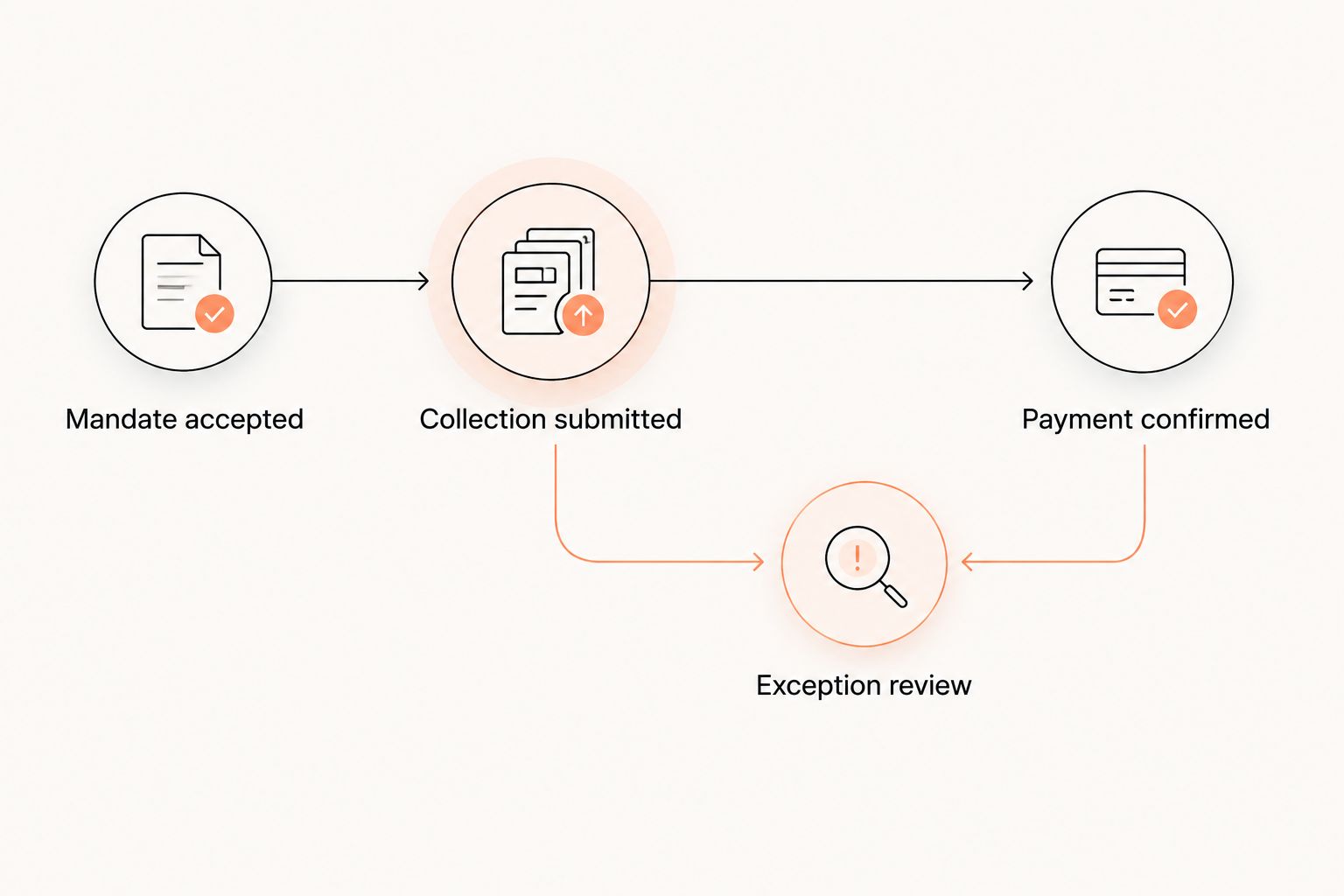
Do not turn a pending payment into an automatic suspension. Apply the gym's documented access policy, and give staff a way to see that collection is still processing. A payment-state label should explain the record, not silently decide a student's access.
Assign recovery actions
- Read the provider's failure reason before contacting the payer. Distinguish a funding problem from an invalid account, rejected debit, or mandate issue.
- Send a specific message. Identify the affected membership and collection, explain the problem, and give the payer a supported way to resolve it without emailing bank details.
- Check authorization before resubmitting. A canceled mandate is not permission to keep trying the same account.
- Review overlapping collections. If the payer settles through another method, stop an unnecessary retry before collecting the same dues twice.
Expected result: Recovery follows the actual failure rather than a generic reminder sequence. The gym retains a record of what staff reviewed, communicated, and approved.
MatPilot's payment-issue co-pilot is useful for owner review, but approval does not replace mandate requirements or provider status checks. Review the transaction first; approve the action second. Keep the owner in control of member-facing decisions.
When membership dues change
A recurring collection workflow also needs a change workflow. A member can move from a single discipline to a broader membership, add a child, pause training, or leave. None of those changes should create a second collection by accident.
| Workflow | Best for | Advantage | Limitation |
|---|---|---|---|
| Standard recurring dues | Memberships with an unchanged collection schedule | Reuses an agreed schedule and authorized payment route | Still requires monitoring failures, refunds, and cancellations |
| Changed recurring dues | Membership changes affecting future collections | Keeps billing aligned with the current agreement | Requires review of notice, authorization, and overlapping schedules |
- Review the membership change and identify its effective date. Keep the original request attached to the membership record.
- Check whether the existing mandate and provider workflow cover the changed collection. Do not assume every amendment requires a new mandate, or that every amendment is covered.
- Update the schedule and provide the required notice. Confirm which upcoming collection changes and which remains unchanged.
- Inspect the old schedule for pending or duplicate collections. Cancel or amend through the supported provider process, then verify the result.
- Check the next completed collection against the revised membership agreement.
Expected result: One intended collection schedule remains, with a clear effective date and an informed payer. Your 2026 change process should be as explicit as your initial enrollment process.
For a cancellation, treat future collections and any outstanding dues separately. Ending a membership does not justify silently changing an already submitted payment, and canceling a collection schedule does not resolve every existing balance.
Troubleshooting
SEPA appears in Stripe but not in enrollment
The gym's enrollment flow must support the payment method; account-level activation alone is insufficient. Check the integration's supported payment methods and recurring-payment route. Do not instruct members to enter bank details into a card-only form.
Enrollment completes but dues remain pending
SEPA uses delayed payment notification. Inspect the payment status and wait for the provider's result rather than manually forcing the membership to paid. Escalate a genuinely stalled record through the provider's support process.
A payer receives duplicate collection notices
Check for overlapping subscription records, duplicate payer records, or an old schedule left active during migration. Compare transaction references before canceling anything. Preserve the correct schedule and document what happened to the duplicate.
A canceled mandate is still attached to a membership
Stop treating that mandate as usable authorization. Ask the payer to complete a supported authorization process if collections should continue. Updating a contact address or membership label does not restore a canceled mandate.
A refund arrives after dues were marked paid
Record the refund against the original payment and review the membership balance. Under SEPA Core, payers have an 8-week refund right for authorized debits; unauthorized debits can be challenged for up to 13 months, subject to the scheme's conditions. Confirm the case with the provider before taking further collection action.
Customize your workflow
Start with payment accuracy, then connect the operational records. Keep the payer, membership, attendance, and accounting references aligned. A student missing classes and a payer missing dues are different situations; staff should investigate them separately.
MatPilot includes Xero sync alongside Stripe billing. Use the MatPilot-to-Xero payment reconciliation guide to examine the accounting handoff. Check how confirmed payments, refunds, fees, and payouts are represented before accepting the records as reconciled.
For your 2026 operating checklist, assign an owner to each handoff: enrollment, notice, collection status, recovery, and reconciliation. Review those assignments when staff responsibilities change. Automatic collection reduces repeated collection work, but it does not remove the need to handle exceptions.
FAQ
How do I set up SEPA direct debit gym billing?
Set up a supported SEPA collection route, obtain the payer's mandate, provide advance notice, and monitor recurring payment results. Confirm that your gym's actual billing integration supports SEPA before enrolling members.
Does MatPilot's Stripe billing mean SEPA is automatically enabled?
No. Stripe billing does not establish that every payment method is exposed in a gym's enrollment or recurring billing workflow. Verify the supported collection route before asking members to switch.
Can a US gym use this workflow for domestic bank payments?
Use a US domestic payment workflow, such as ACH, rather than treating SEPA as a US bank-debit method. SEPA Direct Debit is for eligible euro-denominated collections, and account eligibility must be checked with the provider.
Does a signed SEPA mandate mean membership dues are paid?
No. A mandate authorizes collection; it does not confirm that a debit succeeded. Keep authorization, pending collection, and confirmed payment as separate states.
How much notice must I give before collecting SEPA dues?
SEPA Core specifies pre-notification at least 14 calendar days before the due date unless the creditor and payer agree another timeline. Include the collection amount and due date, and check the provider's implementation.
Can I collect a child's membership dues from a guardian's account?
The authorized bank-account holder can pay for a child's membership. Keep the payer and student records distinct, and obtain authorization through the provider's supported mandate process.
What should I do when a SEPA membership payment fails?
Inspect the provider's failure reason before contacting the payer or retrying. Confirm that authorization remains valid and that another payment has not already settled the dues.
Can members request a refund after a SEPA debit succeeds?
Yes. SEPA Core provides an 8-week refund right for authorized debits, while unauthorized debits can be challenged for up to 13 months under the scheme's conditions. Record the refund against the original transaction and review the resulting membership balance.
One last thing
The most useful billing check is not whether a debit was submitted. It is whether every unpaid membership has an explained status and an assigned next action. Review pending collections separately from failed collections. Otherwise, staff can chase a payer whose debit is still processing while overlooking a failure that needs attention.