Best BJJ gym management software in 2026

MatPilot is the best BJJ gym management software in this 2026 comparison for owners who want member relationships, classes, billing, and grading managed together, on the web or in native iOS and Android apps. Built from the ground up with BJJ in mind, it treats belts and stripes as part of running the gym, not the whole product. The six-platform comparison also weighs family billing, contract terms, and payment fees.
- MatPilot is the BJJ gym management software pick for managing members, classes, billing, and grading in one place, with web and native apps.
- Zen Planner suits multi-program martial arts schools that accept a fixed-term contract.
- Mindbody fits gyms chasing marketplace traffic across multiple locations, with a booking commission attached.
- Kicksite and Gymdesk price in tiers by student or member count; check current pricing directly on each site.
- Wodify works for hybrid gyms running BJJ alongside strength and conditioning classes.
Why this matters
Generic fitness software tracks a "level" or a "tag" — it doesn't know what a stripe is or how many a student needs before the next belt. A BJJ academy that adapts a CrossFit or yoga platform ends up rebuilding grading criteria as custom fields, then re-entering the same promotion data by hand every testing day.
Billing has the same mismatch. A family with two kids and a parent on the mat needs one invoice, not three separate accounts a front desk has to reconcile manually. MatPilot is a gym-owner CRM and management system: member records, classes, billing, and grading sit together. Built from the ground up with BJJ in mind, it also supports judo, karate, taekwondo, and MMA. Owners can use it on the web or through native iOS and Android apps.
The rest of this list covers where the established players — Zen Planner, Mindbody, Kicksite, Gymdesk, and Wodify — earn their spot, and where they fall short for a BJJ-specific curriculum.
Best overall: MatPilot. Best for multi-program contract schools: Zen Planner. Best for marketplace discovery: Mindbody. Best for large single-location schools: Kicksite. Best budget pick for small gyms: Gymdesk. Best for hybrid BJJ/strength programs: Wodify.
What makes the best BJJ gym management software
- Member management and follow-up workflows alongside the day-to-day gym records
- Belt and stripe tracking built for BJJ progression, not a generic fitness "level" field
- Family billing that combines multiple students under one invoice
- Contract terms and cancellation notice clearly stated up front
- Payment processing fees on card and ACH transactions
- Class scheduling that separates gi, no-gi, kids, and competition team without extra setup
- Web and native mobile access for running the gym away from the front desk
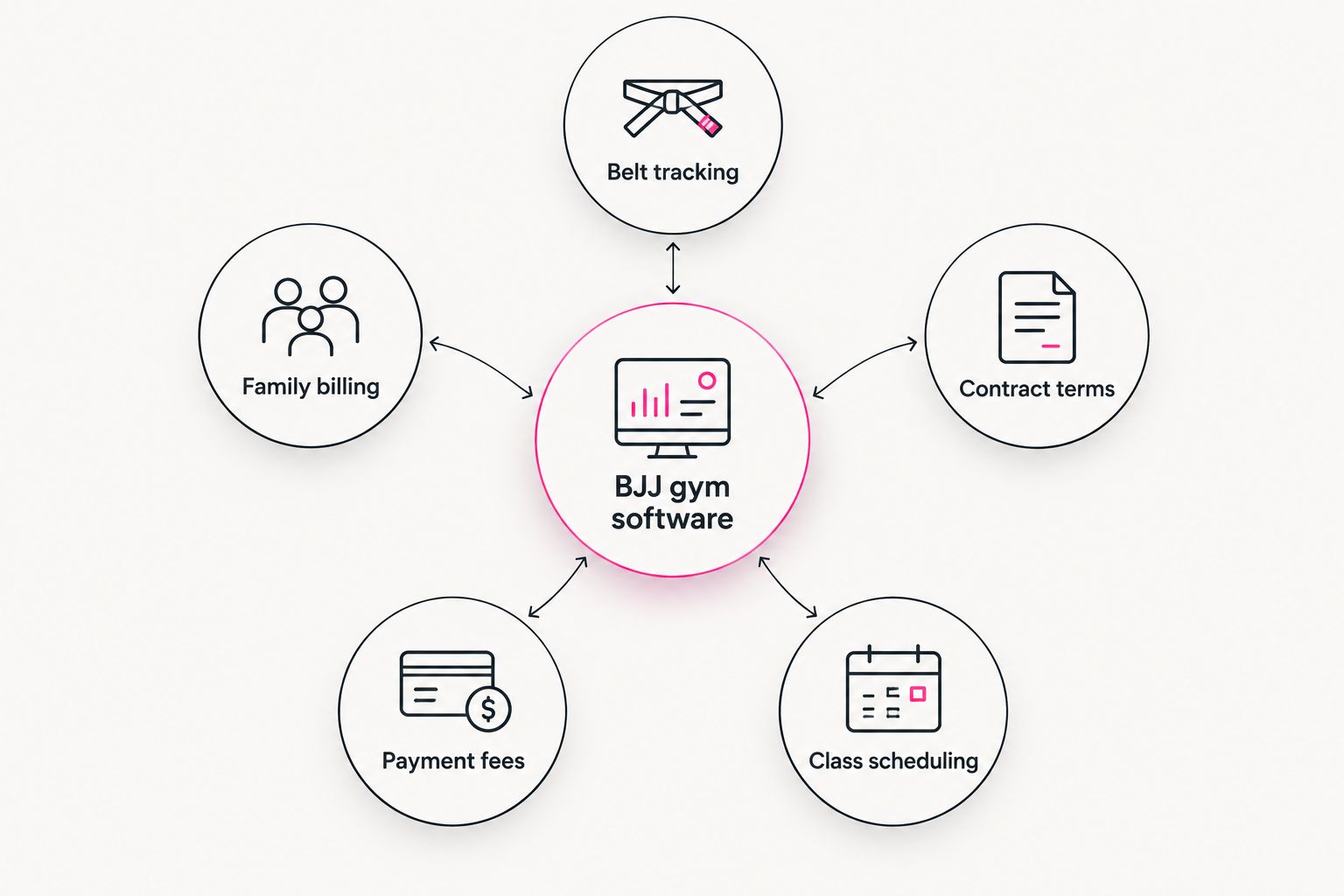
At a glance: comparing BJJ gym management software in 2026
| Software | Best for | Standout feature | Key limitation |
|---|---|---|---|
| MatPilot | BJJ-first gym management | Members, classes, billing, and grading together; web and native iOS/Android apps | No public class marketplace for outside student discovery |
| Zen Planner | Multi-program martial arts schools | Attendance-tied curriculum and belt tracking across programs | Fixed-term contract with a notice period to cancel |
| Mindbody | Multi-location marketplace traffic | Public marketplace where members browse and book classes | Commission on marketplace bookings plus long contract terms |
| Kicksite | Larger single-location schools | Belt testing workflow and front-desk check-in kiosk | Pricing moves through tiers as student count grows, Outdated look |
| Gymdesk | Small BJJ gyms on a budget | No contract requirement, tiers by active member count | Belt criteria set up as custom fields, not BJJ-native |
| Wodify | Hybrid BJJ and strength programs | Month-to-month terms and built-in card/ACH processing | Belt and stripe tracking not native to the platform |
1. MatPilot: best BJJ gym management software for running the whole academy
MatPilot is a CRM-like operating system for gym owners, built from the ground up with BJJ in mind rather than adapting a generic fitness template. Member records, class scheduling, billing, attendance, and belt grading live together for BJJ, judo, karate, taekwondo, and MMA academies. Owners can work from the web or native iOS and Android apps. Its AI co-pilot helps with follow-ups, payment issues, and promotion readiness while the owner reviews and approves actions; a website builder covers the academy's public page.
MatPilot pros:
- Member management, classes, attendance, and billing in the same system as BJJ-specific belt and stripe tracking
- AI co-pilot handles routine admin tasks — ask, review, approve — instead of a coach doing it manually
- Web access and native iOS and Android apps for gym management away from the front desk
- Website building tools live in the same login as member and billing management
- One system covers BJJ, judo, karate, taekwondo, and MMA curricula
MatPilot cons:
- No public class marketplace like Mindbody's, so outside student discovery relies on your own marketing
- Newer to the martial arts software category than Zen Planner or Mindbody, with a shorter list of third-party integrations
Best for: BJJ-led and multi-discipline academies that want to manage members, classes, payments, and grading together, with martial-arts specifics built in.
Verdict: Buy.
2. Zen Planner: best for multi-program martial arts schools
Zen Planner manages membership, scheduling, and billing for martial arts and fitness businesses, with attendance-based curriculum tracking suited to schools running several programs — BJJ, karate, kickboxing — under one schedule.
Zen Planner pros:
- Established track record in the martial arts software category
- Handles multiple martial arts programs under a single schedule
- Belt tracking tied to attendance and curriculum requirements
Zen Planner cons:
- Runs on fixed-term contracts with a notice period required to cancel
- Payment processing carries its own fee structure on top of the subscription
- Built for general martial arts and fitness, not BJJ-specific stripe progression
Best for: multi-program martial arts schools comfortable committing to a contract term.
Verdict: Hold — solid if you run several martial arts programs and accept a contract; skip if BJJ is your only style.
3. Mindbody: best for marketplace discovery across locations
Mindbody is a scheduling and payments platform used across fitness and wellness, including some martial arts gyms, built around a public marketplace where members browse and book classes across studios.
Mindbody pros:
- Marketplace exposure can bring walk-in traffic beyond your existing student list
- Scales across multiple locations under one account
- Wide brand recognition among class-goers already using the app
Mindbody cons:
- Marketplace bookings carry a commission on top of the subscription
- Contract terms commonly run 12 to 36 months
- Belt and grading tracking isn't built for BJJ progression the way dedicated martial arts software is
Best for: multi-location gyms that want marketplace-driven class discovery and accept a longer contract term.
Verdict: Hold — worth it for marketplace traffic if you run multiple locations; skip if you're a single BJJ academy relying on referrals.
4. Kicksite: best for larger single-location schools
Kicksite is martial arts-specific management software priced in tiers by student count, with belt testing tools and a front-desk check-in kiosk.
Kicksite pros:
- Purpose-built for martial arts, including belt testing workflows
- Kiosk check-in speeds up front-desk attendance tracking
- Offers a trial period before you commit
Kicksite cons:
- Pricing scales across four tiers as student count grows
- Fees apply on top of the subscription for payment processing
- Requires a contract term rather than running month-to-month
Best for: larger single-location schools that have outgrown a flat starter tool.
Verdict: Hold — reasonable once student count justifies the tier; wait if your academy is still small.
5. Gymdesk: best budget pick for small BJJ gyms
Gymdesk manages memberships and billing for gyms and martial arts schools, priced in tiers by active member count, with no long-term contract required.
Gymdesk pros:
- No contract requirement — cancel without a notice period
- Offers a trial before you pay
- Tiers scale by active members, so a small gym pays for a small gym
Gymdesk cons:
- Belt and grading criteria run as custom fields, not a BJJ-specific structure
- Cost climbs as active member count crosses each tier threshold
- Fees apply on payment processing
Best for: small BJJ gyms on a tight budget that want no-contract flexibility while they grow.
Verdict: Hold — a reasonable budget pick early on; reassess once member count pushes you into a higher tier.
6. Wodify: best for hybrid BJJ and strength programs
Wodify is class and membership software built originally for CrossFit-style gyms, with an Essentials plan priced per location and month-to-month terms. Some hybrid gyms use it to run BJJ alongside strength and conditioning.
Wodify pros:
- Month-to-month terms, no long contract
- Built for high-volume class scheduling, useful when BJJ shares a calendar with strength classes
- Card and ACH processing built in
Wodify cons:
- Onboarding fee applies when the account is set up
- Belt and stripe tracking isn't native — it's fitness-class software adapted to martial arts
- Per-location pricing adds up fast for a multi-location academy
Best for: hybrid gyms running BJJ alongside strength and conditioning or CrossFit-style programming.
Verdict: Hold — makes sense only if BJJ is one program among several strength-focused offerings.
“A generic fitness platform tracks a level; a BJJ curriculum runs on stripes between belts, and that difference decides how much manual re-entry your coaches do on grading day.”
How this list was ranked
Each platform was measured on member management, follow-up workflows, BJJ-specific grading, family billing, contract terms, payment fees, class scheduling, and access away from the front desk. Native stripe tracking matters, but the ranking also asks whether an owner can run the rest of the academy without stitching together separate tools.
Which BJJ gym management software should you choose in 2026?
For a BJJ-led academy, MatPilot is the default when you want to manage member relationships, classes, billing, and grading together. It was built with BJJ in mind from the start, works on the web and in native iOS and Android apps, and keeps belt and stripe tracking inside the wider gym workflow. If you run multiple martial arts programs and already accept a contract term, Zen Planner covers that curriculum spread. If marketplace-driven walk-in traffic across several locations matters more than BJJ-specific grading, Mindbody's marketplace justifies its commission.
Everyone else should size their gym against Kicksite's or Gymdesk's tiers based on student or member count, or check whether Wodify's per-location, month-to-month structure fits a hybrid strength-and-BJJ program. The right call in 2026 comes down to one question: does your gym run a BJJ curriculum first, or is BJJ one program inside a bigger fitness business?
See how MatPilot runs your gym
Explore member management, classes, billing, and grading across web and native apps.
FAQ
What's the best BJJ gym management software in 2026?
MatPilot is the best BJJ gym management software in this comparison for owners who want member management, classes, billing, and grading together on web, iOS, and Android. It was built from the ground up with BJJ in mind. Zen Planner and Mindbody fit specific cases — multi-program schools and multi-location marketplace traffic, respectively.
Is Mindbody good for BJJ gyms?
Mindbody works for BJJ gyms that want marketplace exposure across multiple locations, but its belt and grading tracking isn't built for BJJ progression the way dedicated martial arts software is. It also carries a commission on marketplace bookings and longer contract terms.
Does BJJ gym software need to track belt stripes?
Yes — a BJJ curriculum runs on stripes between belts, and software without native stripe tracking forces coaches to rebuild that structure as a custom field. Dedicated platforms like MatPilot handle this natively instead of adapting a generic fitness "level" system.
How much does BJJ gym management software cost?
Cost structures vary by platform: some price in tiers by student or member count, others charge per location or a flat rate. Check current pricing directly on each provider's site since tiers and fees change.
Is Kicksite or Gymdesk better for a small BJJ gym?
Gymdesk fits a small, budget-conscious BJJ gym better since it requires no contract and prices by active member count. Kicksite suits a larger single-location school that has outgrown a starter tool and needs belt testing and kiosk check-in.
Do these platforms handle family billing for BJJ gyms?
MatPilot brings member records, family billing (households), classes, and grading into one system for martial arts academies, including BJJ. It supports combining a household's students under one account. Generic fitness platforms often require separate accounts per student unless configured manually.
Which BJJ software works for multi-program martial arts schools?
Zen Planner is built for schools running several martial arts programs — BJJ, karate, kickboxing — under one schedule with attendance-tied curriculum tracking. It requires a fixed-term contract with a notice period to cancel.
Can BJJ gym software run without a long-term contract?
Gymdesk and Wodify both operate without a long-term contract — Gymdesk with tiers by active member count, Wodify with month-to-month terms and an onboarding fee. Kicksite, Zen Planner, and Mindbody require contract terms. MatPilot doesn't lock its clients with a contract.
One last thing
Before switching software in 2026, walk through a real week: add a lead, book a trial, follow up, take a family payment, mark attendance, and review a promotion. Ask to see each step on the web and on a phone. Belt tracking is one test; running the whole gym without re-entering information is the bigger one.