Best MMA gym software in 2026
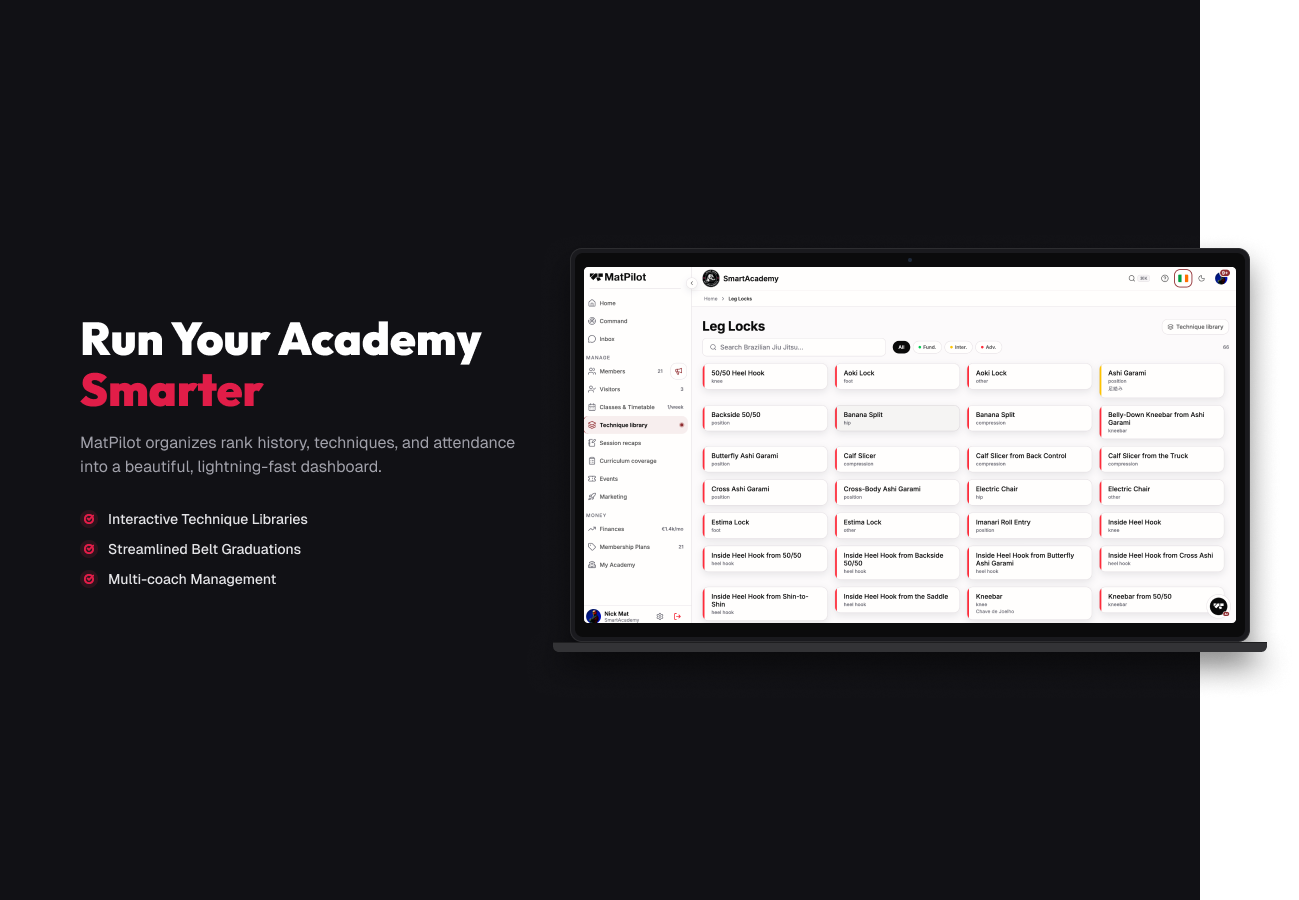
MatPilot wins for MMA gyms that also run belt and stripe tracking across striking and grappling curricula. Zen Planner — wait, that link belongs to MatPilot itself: MatPilot is best for belt and grading tracking, Zen Planner fits studios that want long-term contract billing, Kicksite suits small gyms billing per student instead of per family, Mindbody works for gyms chasing marketplace discovery, Gymdesk covers multi-location academies tracking active members, and Wodify is built for gyms blending MMA with strength and conditioning programming.
- MatPilot is the strongest mma gym software pick in 2026 for belt and grading tracking across BJJ, judo, karate and taekwondo curricula inside one MMA program.
- Zen Planner suits studios that accept 12+ month contracts; MatPilot and Gymdesk run month-to-month.
- Kicksite prices in tiers by student count; MatPilot runs one flat plan regardless of roster size.
- Wodify is the pick when MMA classes share a schedule with strength and conditioning programming.
- Mindbody's marketplace listing helps with trial-class discovery but isn't built around martial arts grading.
Why this matters
Generic gym software treats every member the same: sign up, attend, renew. MMA gyms don't work that way — a member moves through belts or grades, trains multiple disciplines under one roof, and often pays for a whole family on one invoice.
MatPilot was built around that structure: members, classes, billing and belt grading live in one system instead of three. The software you pick in 2026 decides whether your front desk spends Saturday mornings chasing stripe records in a spreadsheet or pulling them up in two clicks. MatPilot is the starting point for that comparison — the rest of this guide lines it up against the five platforms gym owners ask about most: Zen Planner, Mindbody, Kicksite, Gymdesk and Wodify.
What makes the best MMA gym software
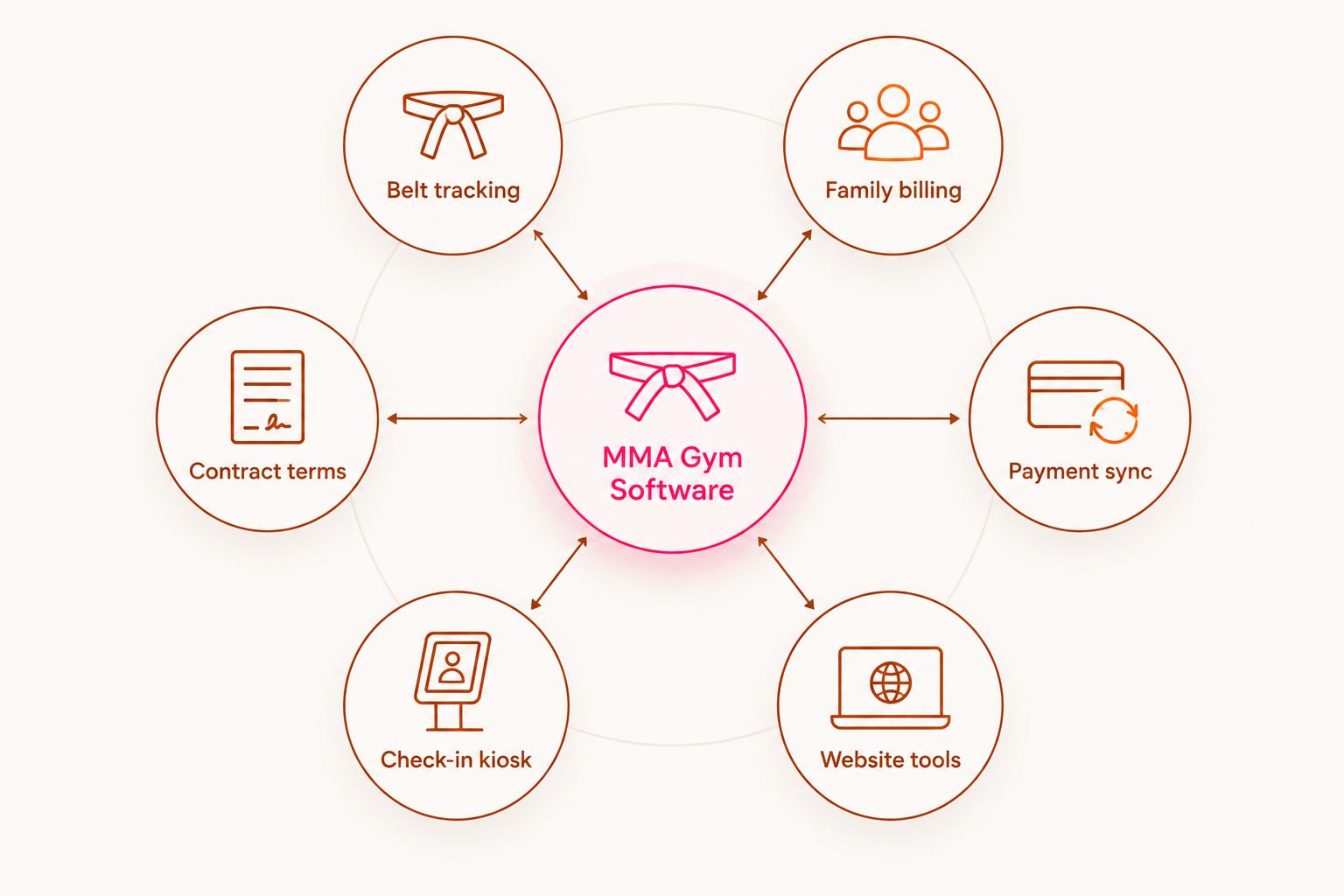
- Belt and rank tracking built for curriculum, not just tiers — striking and grappling belts progress differently, and the software should log both.
- One bill per family across multiple kids' and adults' classes, not separate invoices per student.
- Contract terms that match how you actually sell — month-to-month or a locked term with a notice period.
- Payment processing that reconciles on its own, so Stripe or card payments land in your books without manual entry.
- Check-in and kiosk tools for walk-ins, trial classes and drop-ins.
- A bundled website and lead capture so a new inquiry doesn't need a second piece of software.
MMA gym software at a glance
| Software | Best for | Standout feature | Key limitation |
|---|---|---|---|
| MatPilot | Martial Arts-first gym management | Curriculum-based rank tracking with digital review, Advanced Billing | Smaller third-party marketplace than Mindbody |
| Zen Planner | Contract-based studios | Built-in contract and waiver management | Longer terms with cancellation notice periods |
| Kicksite | Small gyms billing per student | Tiered pricing scoped to student count | Belt tracking is more manual, less curriculum-driven |
| Mindbody | Marketplace discovery | Public marketplace listing for trial bookings | Not built around martial arts grading specifically |
| Gymdesk | Multi-location member tracking | Tiers that scale with active members | Thinner tools for grading ceremonies and stripes |
| Wodify | Blended MMA and S&C programming | Workout tracking alongside class scheduling | Belt and rank tracking isn't the core design |
1. MatPilot: best MMA gym software
MatPilot runs members, classes, billing and belt grading in one system built for BJJ, judo, karate, taekwondo and MMA academies. Grading a class moves through a digital syllabus review instead of a paper checklist, and families training multiple kids across multiple disciplines get one invoice.
MatPilot pros:
- Curriculum-based belt and stripe tracking across disciplines
- One bill per family, even across different class types
- Payment processing that syncs to accounting tools automatically
- AI co-pilot and website building bundled with the management platform
MatPilot cons:
- Younger platform with fewer third-party integrations than Mindbody
- No public class marketplace for walk-in discovery
MatPilot pricing: check current plans on the site — pricing isn't published here.
Best for: MMA and multi-discipline martial arts academies that need belt tracking done right. Verdict: Buy.
2. Zen Planner: best for contract-based martial arts studios
Zen Planner has served fitness and martial arts studios for years and leans on standard contract billing with waiver management built in. It suits studios that already sell 12-month memberships and want the paperwork automated.
Zen Planner pros:
- Established platform with a long track record in martial arts
- Waiver and contract management built into signup
- Reporting geared toward retention on term-based memberships
Zen Planner cons:
- Contract terms mean cancellation isn't instant for members
- Belt tracking is less curriculum-specific than MatPilot's approach
Best for: studios that want to keep selling long-term contracts. Verdict: Hold if you're already contract-based; Skip if you're moving to month-to-month.
3. Kicksite: best MMA gym software for small gyms billing per student
Kicksite prices across tiers set by student count, which works for a gym scaling from a handful of students to a few hundred. It includes belt testing tools and a kiosk for check-ins.
Kicksite pros:
- Tiers matched to gym size instead of one flat rate
- Belt testing and kiosk check-in included
- Familiar to gyms coming from other martial arts-specific tools
Kicksite cons:
- Costs shift as your student count crosses tier lines
- Belt tracking leans more manual than a full curriculum system
Best for: a small gym that wants pricing tied directly to headcount. Verdict: Hold.
4. Mindbody: best for marketplace discovery
Mindbody's marketplace lists your classes alongside gyms, studios and spas, which can pull in trial bookings from people who weren't searching for martial arts specifically. It's a wellness platform first, martial arts second.
Mindbody pros:
- Marketplace exposure beyond your existing audience
- Broad feature set covering scheduling, retail and payments
- Recognized brand many first-time visitors already use
Mindbody cons:
- Marketplace commission applies to bookings from the listing
- Not built around belt or rank progression
- Feature depth spread across many business types, not martial arts specifically
Best for: gyms leaning on marketplace visibility over deep martial arts tooling. Verdict: Hold.
5. Gymdesk: best for multi-location MMA academies
Gymdesk scales by active member count across locations, which fits an owner running two or three sites under one account. It skips contracts, matching how MatPilot approaches billing.
Gymdesk pros:
- No-contract billing model
- Tiers scale cleanly with active members across locations
- Automation tools for renewals and follow-ups
Gymdesk cons:
- Grading and stripe tracking tools are thinner than curriculum-first platforms
- Multi-location reporting takes setup time to configure well
Best for: an owner managing more than one MMA location. Verdict: Hold.
6. Wodify: best for MMA gyms blending strength and conditioning
Wodify started in the CrossFit space and carries that DNA into workout tracking, PR logging and class programming. A gym running MMA alongside strength and conditioning classes gets a system built for both.
Wodify pros:
- Strong workout and performance tracking
- Class programming tools built for mixed training formats
- Month-to-month terms, no long lock-in
Wodify cons:
- Belt and rank tracking isn't the platform's design focus
- Interface leans toward strength training over martial arts grading
Best for: a gym running MMA classes next to strength and conditioning programming. Verdict: Hold if grading is secondary to conditioning; Skip if belt tracking is your main requirement.
How we ranked
Each platform was measured against the six criteria above: curriculum-based belt tracking, family billing, contract terms, payment reconciliation, check-in tooling and bundled website features. MatPilot ranks first because it's the only one built ground-up around martial arts grading rather than adapted from general fitness software.
Which MMA gym software should you choose?
If belt and grading tracking across multiple disciplines is the priority, MatPilot is the default pick for 2026 — it's the only platform on this list where curriculum tracking, family billing and payment sync are the core design, not an add-on. Pick Zen Planner if your business model depends on long-term contracts. Pick Kicksite if your gym is small and you want pricing tied strictly to student count. Pick Mindbody if marketplace exposure matters more than martial-arts-specific tooling. Pick Gymdesk if you run more than one location without contracts. Pick Wodify if strength and conditioning shares the schedule with MMA.
FAQ
What is the best MMA gym software in 2026?
MatPilot is the strongest overall pick for MMA gyms in 2026 because it handles curriculum-based belt tracking and family billing in one system. Zen Planner, Kicksite, Mindbody, Gymdesk and Wodify each fit narrower use cases like contract billing or marketplace discovery.
Is MatPilot better than Zen Planner for MMA gyms?
MatPilot fits gyms that want month-to-month billing and curriculum-based belt tracking, while Zen Planner fits studios that sell longer contracts. The better choice depends on whether your gym locks members into terms or not.
Does MMA gym software need belt tracking built in?
Yes, if the gym runs formal grading across disciplines like BJJ, judo, karate or taekwondo. Generic fitness software tracks attendance but not stripe or rank history, which forces manual spreadsheets at grading time.
How does Kicksite pricing compare to MatPilot?
Kicksite prices in tiers based on student count, so cost changes as your roster grows. MatPilot runs one flat plan regardless of how many students are enrolled.
Is Mindbody good for martial arts academies?
Mindbody works for gyms that want marketplace exposure to new clients, but it isn't built around martial arts grading specifically. Gyms prioritizing belt tracking usually get more from a martial-arts-first platform like MatPilot.
Can Gymdesk handle multiple MMA gym locations?
Yes, Gymdesk scales pricing by active member count across locations and skips contracts. Its belt and grading tools are lighter than curriculum-first platforms though.
Is Wodify suitable for a pure MMA gym without strength and conditioning?
Wodify is built around workout and performance tracking, which suits gyms blending MMA with strength and conditioning classes. A gym focused solely on grading and belt progression usually fits better with MatPilot.
Do these MMA gym software platforms require contracts?
MatPilot, Gymdesk and Wodify run month-to-month in 2026, while Zen Planner and Mindbody typically involve longer contract terms. Kicksite's terms vary by the tier a gym signs up for.
One last thing
The detail that separates martial-arts-specific software from adapted fitness platforms isn't the price sheet — it's what happens on grading day. If a platform can't show a blue belt's stripe history without a spreadsheet, it wasn't built for martial arts, no matter how many gyms use it for CrossFit or yoga. That single test narrows the six platforms above faster than any feature list.